How to Compare Stretch Film Quotes: 9 Traps That Make Cheap Film Expensive
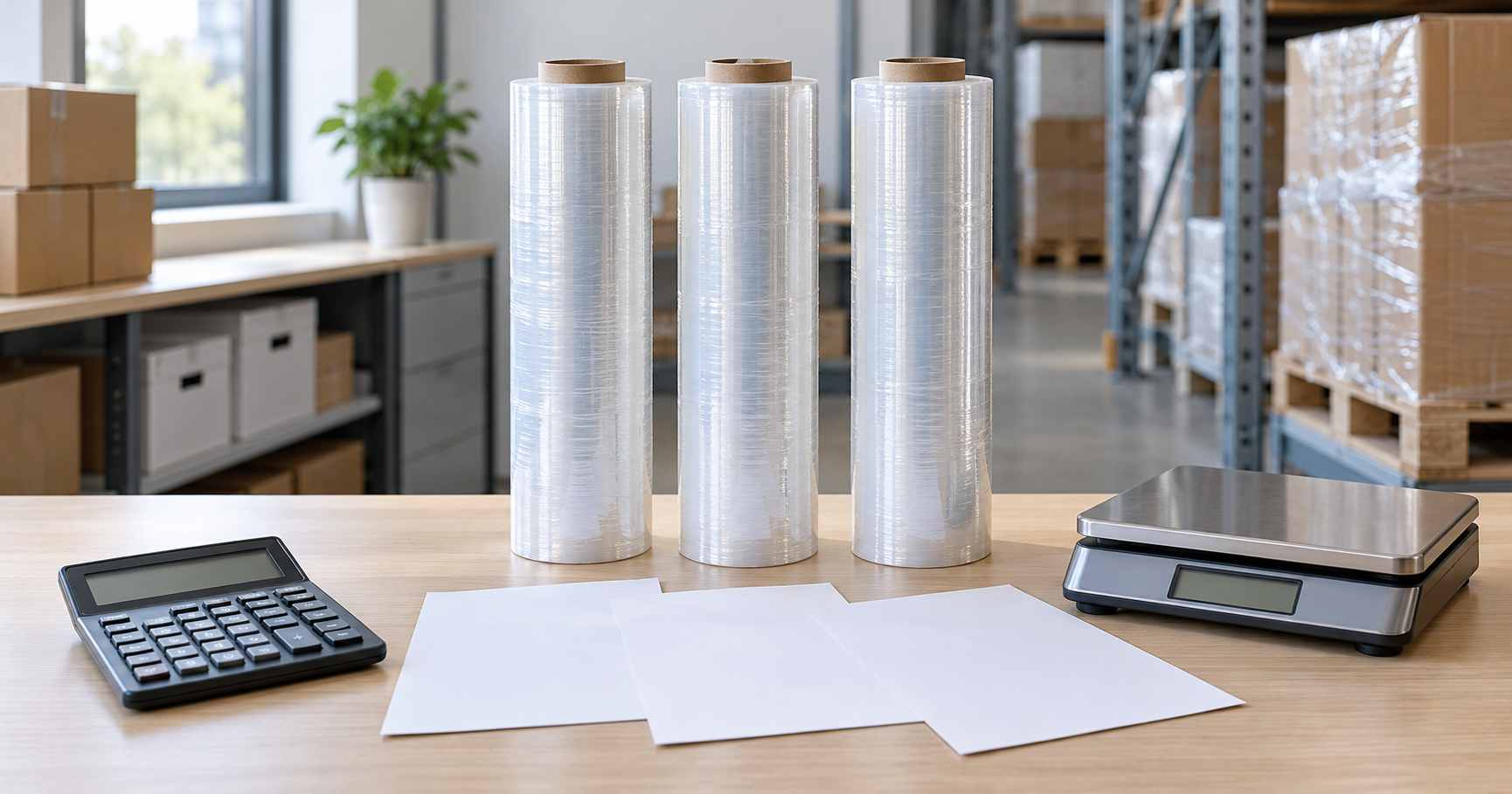
Put three stretch film quotes side by side and the cheapest roll is often not the cheapest film. One supplier prices per roll, one per carton, one per kilogram, each on its own shipping terms. And the rolls themselves rarely hold the same amount of film.
Below: how to put stretch film quotes on one basis, then nine traps to check before you order. We’re Tuosheng Packaging, a stretch film manufacturer in Suzhou, China, since 2012. Every roll weight we quote is net film weight, with the core listed separately.
Quick answer: how to compare stretch film quotes
- Convert every quote to price per kg of net film (no core) and price per 1,000 m, on the same Incoterm.
- Check the nine traps below, from heavy cores to missing cartons.
- The lowest price per kg is not always the lowest cost per pallet, so trial the film on your own loads.
How Do You Put Stretch Film Quotes on the Same Basis?
To put stretch film quotes on the same basis, convert each one to price per kilogram of net film and price per 1,000 metres, on the same Incoterm, using each roll’s width, net film weight and thickness:
- Net film weight (kg) ≈ width (m) × length (m) × thickness (µm) × 0.92 ÷ 1,000
- Roll length (m) ≈ net film weight (kg) × 1,000 ÷ (width (m) × thickness (µm) × 0.92)
The 0.92 is the density of LLDPE film. Here are three quotes for the same 500 mm × 300 m × 23 µm hand roll, which should carry about 3.17 kg of film.
| Example figures, not market prices | Quote A | Quote B | Quote C |
|---|---|---|---|
| Quoted as | $4.20 per roll | $27.00 per carton of 6 | $1.40 per kg, gross |
| Weighed sample | 3.5 kg gross, 0.7 kg core, 2.8 kg film | 0.3 kg core, 3.17 kg film | 0.5 kg core, 3.17 kg film |
| Price per roll | $4.20 | $4.50 | $5.14 |
| Roll length from net weight | about 265 m | 300 m | 300 m |
| Price per kg of net film | $1.50 | $1.42 | $1.62 |
| Price per 1,000 m | $15.87 | $15.00 | $17.15 |
Example figures for illustration only, not market prices.
Quote A wins on roll price. Quote B wins on film. A’s roll carries about 12% less film than its label suggests, and C charges its 0.5 kg core at film price. Each trap below is one way a quote ends up like A or C.
Trap 1: Is the “Price per kg” Based on Net or Gross Weight?

A stretch film price per kg means little until the quote says whether the kilogram is net film or gross roll weight. Gross weight includes the paper core: about 0.3–0.7 kg on a hand roll, 1–1.5 kg on a machine roll. On a 3.2 kg hand roll, a 0.7 kg core is about 18% of the gross weight, billed at film price. Compare what you pay divided by the net film you receive.

What we see most often: The most common trap we see in quotes customers send us is a heavier core inside the same gross weight. A machine roll is offered as 15 kg gross with a 1 kg core, so it should hold 14 kg of film. It actually sits on a 2 kg core and still weighs 15 kg, leaving 13 kg of film: about 7% less, so each kilogram of film costs about 8% more while the quote looks cheaper. On a 500 mm × 17 µm roll, that’s roughly 130 m of film missing.
- What to ask: Is the quoted weight net film or gross? What does the core weigh?
- How to check: When a roll runs out, weigh the empty core and compare it with the core weight on the quote. No unwinding needed.
Standard roll and core weights are in our stretch wrap sizes chart.
Trap 2: Why Is Comparing Only the Price per Roll Misleading?
Comparing stretch film quotes by price per roll is misleading because a lower roll price often buys less film. The roll may be narrower (450 mm against 500 mm), shorter, thinner or on a heavier core. Compare net film weight, width and length first. Price comes last.
What we see: We see low roll prices that come from less film on the roll, with a narrower or shorter roll quoted next to a full-size one as if it were the same product.
- What to ask: What are the net film weight, width, length and measured thickness of each roll?
Trap 3: What Does the Quoted Roll Length Actually Mean?
The roll length on a stretch film quote should be the length on the roll as supplied, because that’s the only length you can compare. A quoted length can mean three things:
- Roll length as supplied: the film actually on a standard hand or machine roll.
- Factory pre-stretched film: a real roll length, but on film much thinner than its “equivalent” rating and often narrower. Ask for measured thickness and width.
- Theoretical applied length: how far the film could reach at an assumed pre-stretch ratio. Not a roll length.
Width, thickness, net weight and length have to agree with the formula. Quote A says 300 m, but 2.8 kg of 500 mm × 23 µm film makes only about 265 m.
What we see: We have seen rolls where the labelled length and the length the net weight supports don’t match.
- What to ask: Is the stated length the roll as supplied? If you quote a stretched length, at what pre-stretch ratio?
- How to check: Strip a few outer wraps and cut a 50 cm × 50 cm sheet without stretching it. Weigh it on a 0.01 g scale, multiply by 4 for g/m², and divide by 0.92 for the real thickness in microns (a 23 µm sheet weighs about 5.3 g). Innoform, a German packaging test lab, calculates roll length the same way, from net weight, mass per area and width.
More on factory pre-stretched film: pre-stretch film vs standard stretch film.
Trap 4: Why Is the Price per Carton Not a Fixed Quantity?
A price per carton is not a fixed quantity of stretch film. One carton holds 4 rolls, another 6: a 50% gap before you look at the rolls inside. Convert every carton price to a roll price, then to price per kg of net film. We pack hand film 4 or 6 rolls per carton and machine film 1 per carton.
- What to ask: How many rolls are in each carton, and what is each roll’s size and net film weight?
Trap 5: Is “80 Gauge Equivalent” the Same as True 80 Gauge?

No. “80 gauge equivalent” stretch film is thinner than true 80 gauge, made stiffer so it holds a load like 80 gauge film. One US distributor’s 2026 listings describe “80–90 gauge equivalent” film that measures 63 gauge. An 18 in × 1,500 ft roll of true 80 gauge holds about 3.9 kg of film. At 63 gauge: about 3.1 kg, roughly 21% less.
Honestly labelled equivalent film can wrap well, but it’s a different product: compare it with other equivalent films and test it on your pallets. If you resell, put the measured thickness or a clearly stated equivalent rating on your label, nothing else. Our stretch film thickness guide explains both. If you are choosing between true gauges, see 60 vs 80 gauge stretch wrap.
- What to ask: Is the thickness measured, or an equivalent? A clear quote reads “63 gauge actual (80 gauge equivalent performance)”.
- How to check: Use the cut-and-weigh test from Trap 3. A 50 cm × 50 cm sheet of true 80 gauge weighs about 4.7 g; of 63 gauge, about 3.7 g.
Trap 6: Are Both Quotes for the Same Film Grade?
Two stretch film quotes at the same thickness can be for very different film: cast or blown, butene (C4) LLDPE or hexene (C6), octene (C8) and metallocene grades, virgin resin or recycled content. Sometimes a cheaper quote is just a cheaper film.
What we see: We have seen lower-priced offers where the film used a different resin, or contained recycled material the quote didn’t mention.
Resin labels don’t rank film on their own, though. In Braskem’s published data for 23 µm three-layer cast stretch film (Highlight tester, ASTM D4649), puncture across four grades ran from 2.3 to 3.2 kg, a butene and a hexene grade tied at 2.6 kg, and the best puncture came with the lowest ultimate stretch. Judge the finished film at your thickness. Our guide to LLDPE vs LDPE explains what the resin names mean.
- What to ask: Which film grade, and how much recycled material? What are the finished film’s tensile, elongation and dart impact results at this thickness (for example ASTM D882 and D1709)?
See also cast vs blown stretch film and GRS-certified recycled stretch film.
Trap 7: Does the Low Price Only Apply Under Certain Conditions?
A low stretch film quote may only hold for one order size, one specification, standard packaging or a short validity window. Switch to the order you actually place, with several widths, a colour or your own label, and the price may change. A price for 1 ton is not a price for a full container.
What we see: We see low quotes that only hold for one size or one order quantity.
How we quote: stretch film prices follow LLDPE resin, so our quotes are usually valid for about 7 days and the final price follows the resin price on the order date. Confirm it again before you pay the deposit. Our MOQ for clear film in standard sizes is 3 tons, and hand and machine film can share a container.
- What to ask: Which quantity, size and packaging does this price cover? When does it expire? Please quote my real order mix.
Trap 8: What Charges Does Each Stretch Film Quote Include?
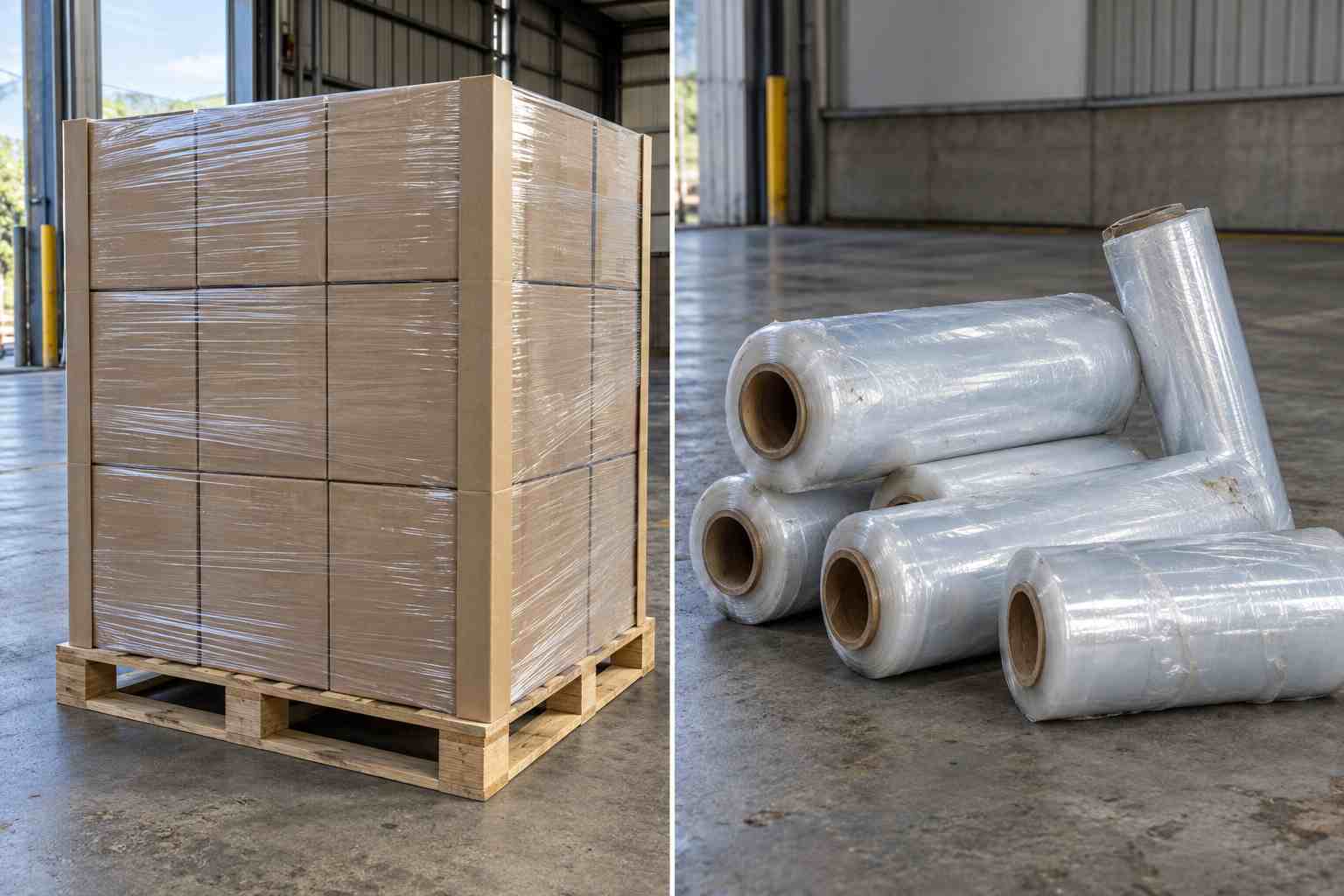
Two stretch film quotes with the same unit price can cover different things: cartons, pallets, labels, delivery point, freight. Quotes on different Incoterms (EXW, FOB, CIF or DDP under ICC’s Incoterms 2020 rules) can’t be compared on the headline number, so ask everyone for the same term and place, such as FOB Shanghai.
What we see: Many buyers compare only the unit price, and some quotes are low because they leave out cartons or pallets. Without cartons, roll edges get knocked in transit and the film breaks more easily on the wrapper. Without pallets, rolls travel loose and get handled, and damaged, more.
How we quote: standard export packing includes cartons and pallets at no extra charge. Printed labels, heavier cartons and upgraded pallets cost extra. We quote FOB Shanghai, EXW, CIF or DDP.
Read DDP quotes line by line. Official trade-remedy listings we checked in October 2026 showed no anti-dumping duties on standard PE stretch film from China in the US, EU, UK or Australia, but normal duties and taxes apply. US tariffs on Chinese goods have changed often, and UK Plastic Packaging Tax (£228.82 per tonne from April 2026) applies below 30% recycled content. A DDP quote should name the duties and taxes it includes and the importer of record. Check with your customs broker.
- What to ask: What is in the unit price and what is extra? Which Incoterm and place? For DDP, which duties and taxes?
More in importing stretch film from China and stretch film HS code.
Trap 9: Will the Bulk Order Match the Approved Sample?

An approved stretch film sample doesn’t guarantee the bulk order. Put the sample’s net film weight, width, length, thickness, film grade and core weight into the purchase order. Keep one sample roll, then weigh a few random rolls from the shipment against it.
How we handle it: samples are free; you pay the courier cost up front and we deduct it from your first bulk order. We check net film weight by weighing cores before production and finished rolls after. Bulk orders are made to the approved sample, and if a shipment has a quality problem we agree a remedy with you: replacement rolls, a price reduction or a credit on the next order.
- What to ask: Is the bulk film the same grade as the sample? Can you send weighing photos of random rolls before shipment?
Is the Lowest Price per Kilogram Always the Cheapest Stretch Film?
No. You end up paying for the film on each pallet. A thinner high-performance film can cost more per kilogram and less per pallet, while a cheap film that needs extra wraps or keeps breaking burns through its discount fast. Trial the shortlist on your own loads and compare grams per pallet, using our guide to stretch film cost per pallet. To lower film cost on the line as well as at purchase, see pallet wrap cost reduction.
What Should a Complete Stretch Film Quote Include?
A complete stretch film quote gives enough detail to convert it to price per kg of net film. Copy this table into your RFQ:
| Quote field | What to ask for | Trap |
|---|---|---|
| Net film weight and core weight | Listed separately | 1, 2 |
| Width, length, thickness | Length as supplied; measured thickness | 2, 3 |
| Thickness basis | Actual, or a stated equivalent | 5 |
| Film grade | Resin type and recycled content | 6 |
| Packing | Rolls per carton, cartons per pallet | 4 |
| Price, validity, quantity | Expiry date, resin basis, quantity per size | 7 |
| Packaging and Incoterm | What’s included; named place; DDP duties | 8 |
| Sample reference | Bulk made to the approved sample | 9 |
A one-line roll spec ties the weights together: 500 mm × 23 µm × 300 m, N.W. 3.17 kg + core 0.30 kg = G.W. 3.47 kg.
See also pallet wrap suppliers for distributors and our machine stretch film RFQ checklist.
Stretch Film Quotes FAQ
How do I compare stretch film prices from different suppliers?
Convert each quote to price per kg of net film and price per 1,000 m on the same Incoterm, then check thickness basis, film grade, packaging and what each price includes.
How do I calculate stretch film price per kg?
Divide the price per roll by the net film weight, excluding the core. Net film weight in kg is about width (m) × length (m) × thickness (µm) × 0.92 ÷ 1,000.
How can I check a stretch film roll’s length without unwinding it?
Weigh the roll, subtract the core, and divide the net film weight by width × thickness × 0.92. For accuracy, get the real thickness by weighing a 50 cm × 50 cm sheet.
Why is one stretch film quote much cheaper than the others?
Check whether it has less film per roll, a heavier core, thinner or different film, no cartons or pallets, a different Incoterm, or a price that only fits one order size.
Does Tuosheng Packaging quote net film weight?
Yes. Tuosheng Packaging, a stretch film manufacturer in Suzhou, China, quotes net film weight with the core weight listed separately, and makes bulk orders to the approved sample.
Compare Your Stretch Film Quotes With Us
Send us the quotes you’re comparing, supplier names removed if you like, and we’ll put them on one basis: price per kg of net film and per 1,000 m. Add a photo of your current roll label and we’ll make a free sample to match.
See our hand stretch film and machine stretch film, or contact us for a quote.
Recommended Tuosheng Packaging Solution
Tuosheng Packaging manufactures hand stretch film and machine stretch film in Suzhou, China, with customizable thickness, width, roll length and export packing.