LLDPE vs LDPE: What’s the Difference for Stretch Film Buyers?
LLDPE vs LDPE: both are low-density polyethylene, but they behave very differently as film. LLDPE film stretches further and resists punctures better, while LDPE film is clearer and easier to process, which is why stretch film is made mainly from LLDPE.
At Tuosheng Packaging, hand stretch film is made from film-grade LLDPE, and machine stretch film from LLDPE blended with metallocene LLDPE (mLLDPE). This guide explains how the two resins differ, what published resin data shows, and what to check when a quote names the resin.
Quick answer
- LLDPE is the main resin in stretch film because it stretches further and resists punctures and tears better than LDPE.
- LDPE makes clearer film and runs more easily on extrusion lines, so it is used in shrink film and as a blend partner.
- Density can’t tell LLDPE and LDPE apart: both sit around 0.92 g/cm³.
- Judge a stretch film by its tested performance at your thickness, not by the resin name on the quote.
What Is the Difference Between LLDPE and LDPE?
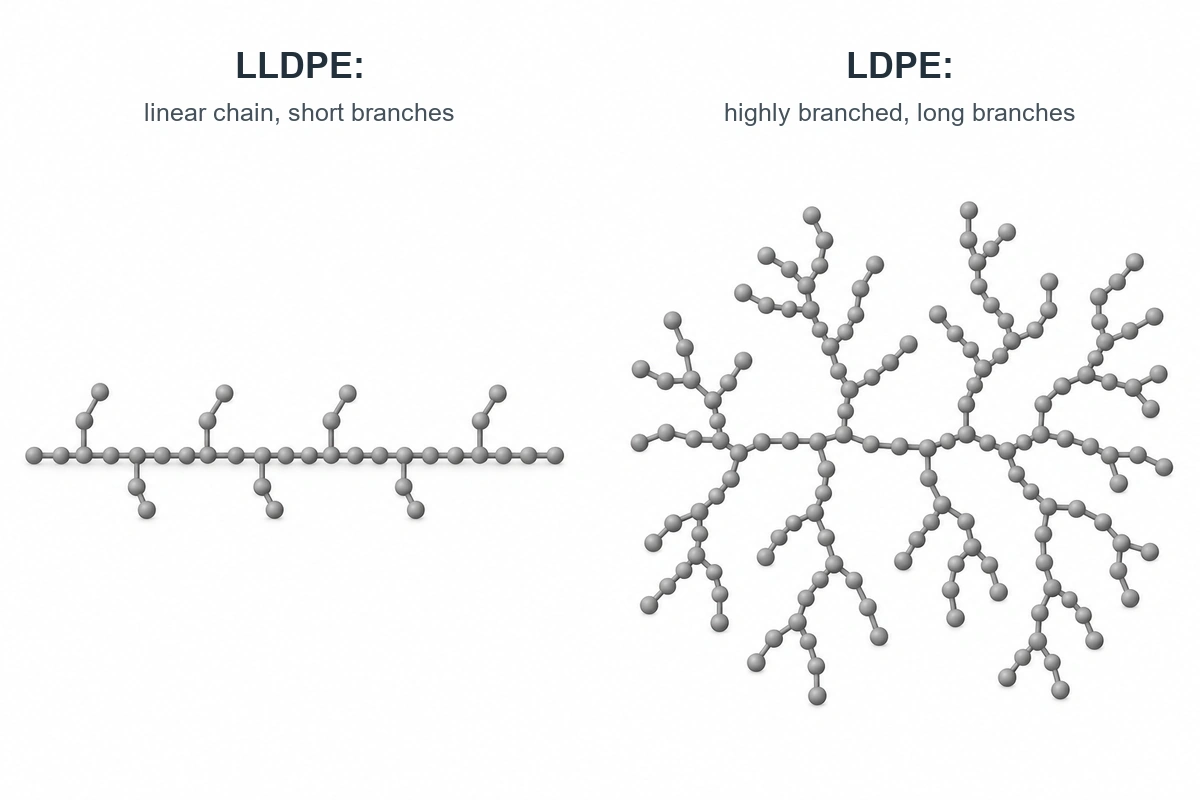
The difference between LLDPE and LDPE starts with the shape of the polymer chain. LLDPE has a linear backbone with short branches. LDPE is highly branched, with long branches. That one difference drives how each film stretches, how strong it is, how clear it looks and how easily it runs on an extrusion line.
What is LLDPE?
LLDPE (linear low-density polyethylene) is polyethylene made by copolymerizing ethylene with butene, hexene or octene using Ziegler-Natta or metallocene catalysts, which gives a linear chain with short branches.
What is LDPE?
LDPE (low-density polyethylene) is polyethylene made by high-pressure free-radical polymerization, which gives a highly branched chain with long branches.
| # | Difference | LLDPE | LDPE |
|---|---|---|---|
| 1 | Molecular structure | Linear backbone, short branches | Highly branched, long branches |
| 2 | How it’s made | Catalyst copolymerization with butene (C4), hexene (C6) or octene (C8) | High-pressure free-radical polymerization |
| 3 | Stretch and strength | Higher elongation, tensile strength, impact and puncture resistance | Lower |
| 4 | Clarity and processing | Lower gloss, harder to process | Clearer, glossier, easier to extrude |
| 5 | Main film uses | Stretch film, heavy-duty bags, liners | Shrink film, high-clarity film, blend partner |
Density won’t settle the question. LLDPE runs from about 0.916 to 0.940 g/cm³ and LDPE sits around 0.92, so the two overlap, and a density figure on a datasheet can’t tell you which resin is in a film.
How Do LLDPE and LDPE Compare on Film Properties?
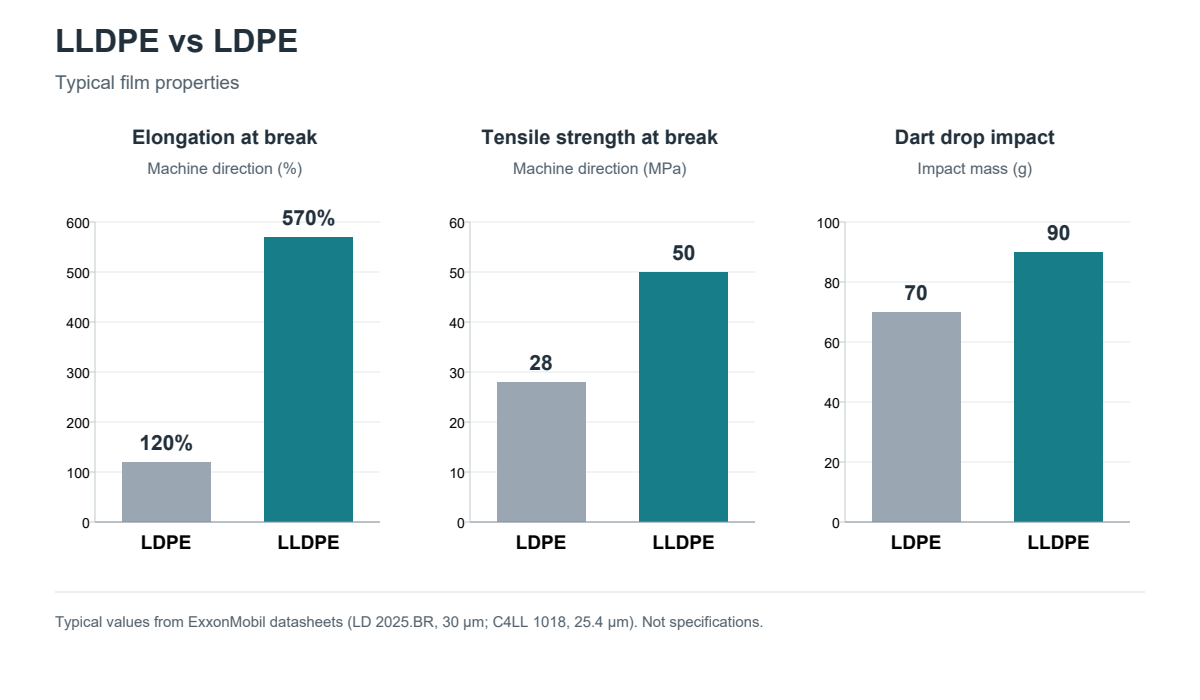
In ExxonMobil’s published datasheets for two blown-film resins, the LLDPE film was thinner (25.4 µm against 30 µm) yet stretched 570% before breaking in the machine direction, against 120% for the LDPE film. The LLDPE film was also stronger and took more impact, while the LDPE film was clearer and glossier. These are typical values from resin datasheets, not stretch film specifications.
Typical blown-film properties: ExxonMobil LDPE vs LLDPE datasheets
| Property (ASTM method) | LDPE film: LD 2025.BR, 30 µm | LLDPE film: C4LL 1018 (butene), 25.4 µm | What it means for stretch film |
|---|---|---|---|
| Density (D1505 / D792) | 0.925 g/cm³ | 0.918 g/cm³ | Nearly the same; density can’t identify the resin |
| Tensile strength at break, MD / TD (D882) | 28 / 18 MPa | 50 / 36 MPa | LLDPE film holds more load before it breaks |
| Elongation at break, MD / TD (D882) | 120% / 470% | 570% / 870% | LLDPE can be stretched much further |
| Dart drop impact (D1709A) | 70 g | 90 g | LLDPE takes impacts better |
| Elmendorf tear, MD / TD (D1922) | 370 / 80 g | 90 / 450 g | Mixed: tear depends on direction, so test on real loads |
| Haze (D1003) | 7.4% | 14% | LDPE film is clearer |
| Gloss 45° (D2457) | 62 | 45 | LDPE film is glossier |
| Listed applications | Blend partner, high-clarity film, light-duty shrink film | Blown film, industrial packaging, heavy-duty bags, liners | LDPE suits shrink and display film; LLDPE suits strength-driven film |
Read the table for direction, not for exact comparisons. The two films were tested at different thicknesses, the values are typical rather than guaranteed, and both are general blown films, not finished stretch film. A five-layer cast stretch film made from a different LLDPE grade will give different numbers.
Why Is Stretch Film Made from LLDPE?
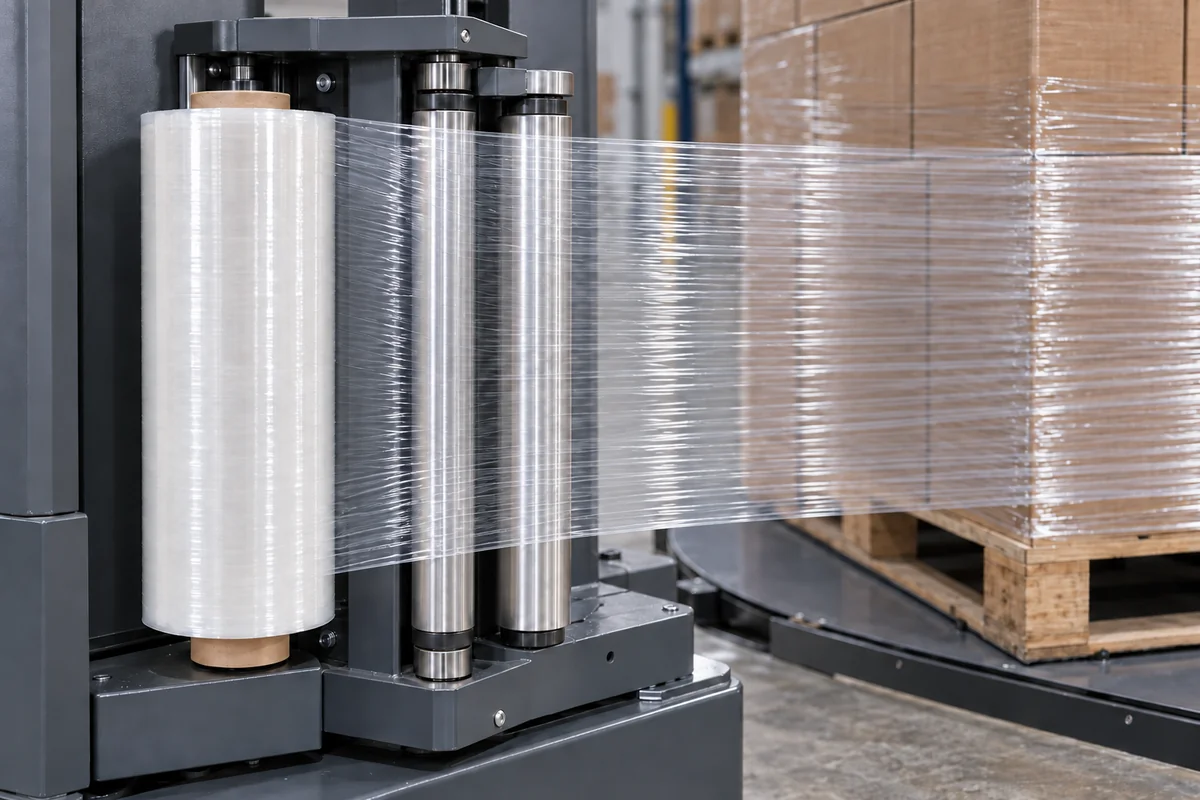
Stretch film is made from LLDPE because the job asks for exactly what LLDPE does better than LDPE. Machine film is pre-stretched, often by 200% or more, before it touches the load; hand film is pulled tight by the operator. Then it has to survive carton corners, forklift tines and the trip itself. Clarity barely matters. Elongation, puncture resistance and toughness do.
LLDPE’s strength also lets film run thinner. A stronger film can be downgauged and still hold the load, which cuts the amount of film on every pallet; our stretch film thickness guide explains how gauge, microns and pre-stretch relate.
What Tuosheng uses: Tuosheng Packaging makes hand stretch film from film-grade LLDPE. Machine stretch film blends LLDPE with metallocene LLDPE for higher pre-stretch on powered wrappers. Neither contains LDPE. Our guide on how stretch film is made walks through the line, and the machine stretch film page lists the specs.
What Is LDPE Used for in Packaging Film?
LDPE is used in packaging film where clarity and easy processing matter more than stretch: shrink film, high-clarity display film, food packaging, and as a blend partner mixed into LLDPE. ExxonMobil’s LD 2025.BR datasheet lists blend partner, high-clarity film and light-duty shrink film among its applications.
Shrink film works differently from stretch film. It is heated so it contracts around the load rather than being stretched onto it, which our stretch wrap vs. shrink wrap guide explains.
Some stretch films do contain LDPE in a blend. That alone doesn’t make a film bad; what counts is how the finished film performs at your thickness, on your loads.

What Are mLLDPE and C4, C6 and C8 LLDPE?
C4, C6 and C8 describe the comonomer used to make an LLDPE: butene (four carbons), hexene (six) or octene (eight). mLLDPE is LLDPE made with a metallocene catalyst, which gives a more uniform molecular structure; machine film uses it to reach higher pre-stretch and better toughness at lower thickness. Our machine stretch film guide covers how converters combine these resins in multilayer film.
These labels don’t rank finished film on their own. Published cast-film data shows a butene and a hexene grade with the same puncture result, as trap 6 in our guide to comparing stretch film quotes explains. Compare tested film, not resin names.
How Do You Check What Resin Is in a Stretch Film Quote?
A resin name on a stretch film quote tells you what went into the film, not how well the film will perform. To compare quotes, ask for test data on the finished film at your thickness and trial samples on your own pallets.
- Ask what’s in it: the main resin (LLDPE, mLLDPE or a blend), any LDPE or other blend partner, and whether there is recycled content and how much. Our recycled stretch film and GRS certification guide covers how to verify recycled claims.
- Ask for finished-film data: tensile strength, elongation and dart impact at the thickness you’re buying, with the test method named (for example ASTM D882 and D1709). Our checklist for evaluating a stretch film manufacturer lists what a credible data sheet should show.
- Trial the samples: run them on your wrapper or by hand and check the real pre-stretch, breaks and how well the load holds.
- Order to the approved sample: at Tuosheng, bulk orders are made to the sample you approve.
LLDPE vs LDPE FAQ
Is stretch film made of LDPE or LLDPE?
Stretch film is made mainly from LLDPE, often with metallocene LLDPE in machine film. LDPE appears in some stretch film blends, but it isn’t the main resin because it doesn’t stretch as far or resist punctures as well.
Is LLDPE stronger than LDPE?
LLDPE film is generally stronger than LDPE film. In ExxonMobil’s datasheets, a 25.4 µm LLDPE blown film reached 50 MPa tensile strength and 570% elongation in the machine direction, against 28 MPa and 120% for a 30 µm LDPE film. These are typical resin values, not stretch film specs.
Is LDPE or LLDPE better for shrink wrap?
LDPE is the more common base for shrink wrap, and LDPE and LLDPE are often blended in packaging film to balance clarity and toughness. ExxonMobil, for example, lists light-duty shrink film and blend partner among the applications for its LD 2025.BR LDPE.
What is mLLDPE in stretch film?
mLLDPE is linear low-density polyethylene made with a metallocene catalyst. Its more uniform structure helps machine stretch film reach high pre-stretch and stay tough at lower thickness, which is why Tuosheng blends it into machine film.
Are LLDPE and LDPE film recyclable together?
LLDPE and LDPE are both polyethylene, so they belong to the same plastic family. Whether used film is accepted depends on your local film recycler, so follow their rules rather than relying on a resin code; our guide to whether pallet wrap is recyclable explains how.
Get LLDPE Stretch Film Matched to Your Line
Tell us whether you wrap by hand or by machine, your wrapper’s pre-stretch setting and what your loads look like, and we’ll recommend a hand stretch film or machine stretch film spec and send samples to test.
Recommended Tuosheng Packaging Solution
Tuosheng Packaging manufactures hand stretch film and machine stretch film in Suzhou, China, with customizable thickness, width, roll length and export packing.