
Table of Contents
- Start by defining what you need from a stretch film manufacturer
- Check the stretch film factory’s product and quality capability
- Ask the stretch film supplier for evidence, not promises
- Compare cost per pallet, service, and supply reliability
- Stretch film manufacturer evaluation checklist
- Why include Tuosheng Pack in your supplier shortlist?
Choosing a stretch film manufacturer is not just a price negotiation. The film has to run on your equipment, hold the load through storage and transport, and show up the same way from one order to the next.
Two rolls can share the same width and nominal gauge and still perform very differently. One stretches smoothly and cuts film use. The other breaks at the edges, blocks during unwind, or loses holding force after a few days. That’s why factory and warehouse buyers should compare suppliers on applied performance, not just price per roll.
This guide helps procurement managers answer one concrete question: how to choose a stretch film manufacturer, regional distributor, or OEM supplier. It skips unnecessary polymer theory and focuses on the questions, documents, samples, and line trials that lead to a better buying decision.
Start by defining what you need from a stretch film manufacturer
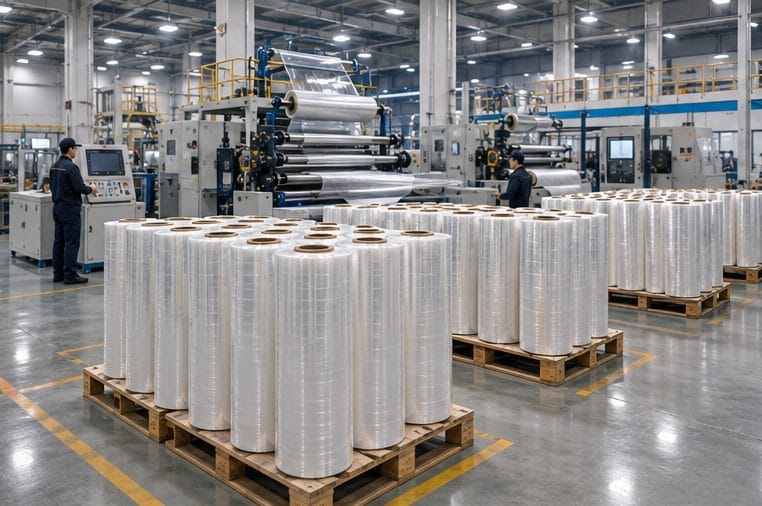
Before you call any supplier, write down the application. A good manufacturer can’t recommend the right film without knowing what it must wrap and how it will be applied.
If you are still comparing film types, specifications, and applications, start with our complete guide to machine stretch film
Describe the load and wrapping process
Give every candidate the same baseline information:
- pallet dimensions, height, and total weight
- product type and carton strength
- uniform, irregular, or sharp-edged load profile
- hand, semi-automatic, or automatic wrapping method
- wrapper type, film carriage, and available pre-stretch ratio
- current film width, thickness, roll length, and net film weight
- current problems: web breaks, loose loads, excessive film use, poor cling
- storage temperature, transport route, and expected outdoor exposure
- monthly consumption and delivery location
This lets a machine stretch film manufacturer decide whether to start with cast film, blown film, a conventional gauge, or a high-performance downgauged film. It also keeps suppliers from quoting products that won’t fit your roll holder, carriage, or production speed.
Ask for a recommendation by load family, not one film for the whole facility. Uniform cartons benefit from clarity, quiet unwind, and high pre-stretch. Irregular or sharp loads need more puncture and tear resistance. The best stretch film supplier should explain this tradeoff in plain language.
Decide whether you need a factory or distributor
Buying directly from a stretch film factory works well for high, predictable volumes and standard specifications. A direct manufacturer may offer better customization, container pricing, private labeling, and control over production scheduling. The catch: factory-direct orders usually come with higher minimums, longer lead times, and more inventory to manage.
A regional pallet wrap supplier makes more sense when consumption is moderate, specs change often, or local safety stock matters. Distributors can offer mixed products, smaller orders, and faster emergency deliveries. The real issue here is traceability: ask who actually makes the film and whether the distributor can provide original technical data and lot information.
For most buyers, the most resilient setup is a primary stretch wrap manufacturer for planned volume plus a qualified local distributor for short-notice demand.
Check the stretch film factory’s product and quality capability
You don’t need to become an extrusion engineer. You do need to know whether the supplier can produce the film your operation requires and keep it consistent.
Confirm the product range and manufacturing fit
Most industrial stretch wrap is LLDPE-based. Many performance films use metallocene LLDPE and multilayer structures to improve stretch, toughness, or consistency. Buyers should judge the result, not the resin recipe.
Ask the manufacturer:
- Do you produce cast stretch film, blown stretch film, or both?
- Which products are designed for hand, machine, and high-speed automatic wrapping?
- What physical thicknesses, widths, roll lengths, colors, and cling configurations are available?
- Can you supply one-sided cling, UV-resistant film, anti-static film, VCI film, or certified recycled-content grades?
- What continuous pre-stretch range do you recommend for the intended equipment?
- Can you support custom stretch film specifications without changing the product after approval?
Cast film normally delivers high clarity, consistent thickness, quiet unwind, and smooth performance on automated lines. Blown film tends to be preferred for loads that need stronger puncture resistance or better tear-propagation resistance. Neither is inherently better. A capable LLDPE stretch film manufacturer should base the recommendation on the load, wrapper, and distribution route.
Multilayer construction can support downgauging, but layer count alone doesn’t tell you much. A claim like “55-layer nano film” means nothing without physical thickness, test data, applied film weight, and line-trial results. Don’t accept a promise that a thinner film will replace your current grade on every pallet.
Look for repeatable quality control
For factory and logistics operations, consistency usually matters more than one impressive sample. A solid stretch film quality control program should cover:
- thickness and width variation
- roll length and net plastic weight
- edge quality and slitting condition
- roll concentricity, telescoping, and winding tension
- gels, holes, and visible contamination
- cling and unwind force
- production-lot identification and retention samples
Small edge defects turn into full web breaks at high pre-stretch. Poor winding creates uneven tension. Excessive cling causes blocking and difficult unwind. Weak cling lets the film tail release. These problems often look like wrapper faults but can originate in film conversion or storage.
Request the supplier’s quality management certificate, its scope, a sample certificate of analysis, and an explanation of change control. If resin family, recycled content, thickness, additive package, core, or production site changes, the buyer should get advance notice and be able to requalify the product.
For recycled stretch film, ask for the exact recycled-content claim, supporting certification where applicable, and the same runnability data required for virgin film. For guidance on Scope Certificates, Transaction Certificates, and supplier verification, see our GRS-certified recycled stretch film buyer’s guide. PCR content alone doesn’t prove the film will perform well on an automatic wrapper.
Ask the stretch film supplier for evidence, not promises
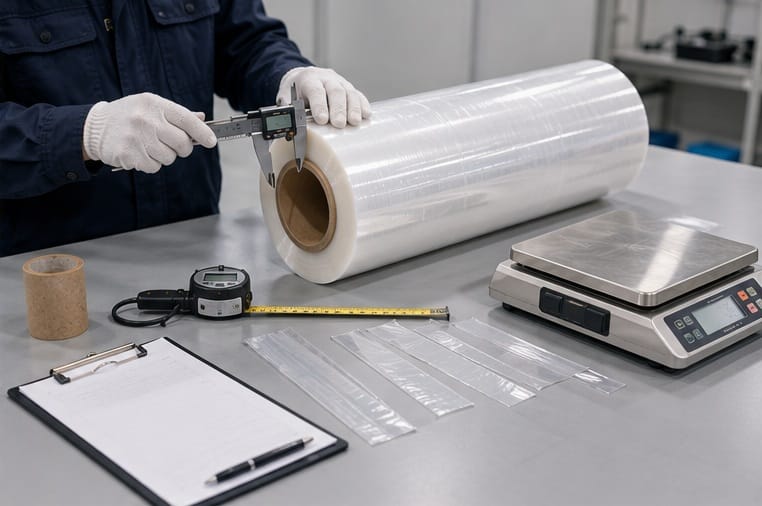
A professional stretch film supplier should back its datasheet with test methods, production records, and a controlled sample trial. Marketing terms like “heavy duty,” “super strong,” and “300% stretch” don’t cut it.
Request useful documents and test data
For a copy-ready supplier questionnaire covering film dimensions, machine compatibility, testing requirements, commercial terms, and change control, use our machine stretch film specification and RFQ checklist.
Ask shortlisted suppliers for:
- technical data sheet with physical gauge in microns or mils
- roll width, guaranteed length, net film weight, gross weight, and core dimensions
- tensile and elongation data with test direction and method
- puncture or dart impact results with the stated test method
- elastic recovery and stress-retention data
- peel-cling information for the proposed cling configuration
- certificate of analysis or lot inspection record
- shelf-life, storage, and temperature recommendations
- recycled-content or specialty-additive documentation when required
ASTM methods give buyers and sellers a common language. ASTM D4649-20(2025) is a guide for selecting, specifying, and applying stretch film. ASTM D5459-95(2025) covers elastic recovery, permanent deformation, and stress retention. ASTM D5458-95(2025) measures peel cling, while ASTM D5415-95(2025) compares load-containment performance under vibration.
These are test methods and guides, not automatic product certifications. Ask which edition and conditions were used, then set your own acceptance criteria. ASTM also notes that vibration-test results don’t predict every field condition, so a real pallet trial still matters.
Run a controlled film audit on your line
Never approve a new machine stretch film supplier based on a small hand-pulled sample. Test normal production rolls on the intended wrapper with both your easiest and most difficult loads.
Keep the comparison fair:
- Record the current film, wrapper settings, wrap pattern, and applied film weight.
- Run the candidate film on the same pallet family.
- Adjust settings only through an agreed trial plan.
- Measure containment at the top, middle, and bottom.
- Count web breaks, tail failures, damaged loads, and stopped-line minutes.
- Recheck the pallet after storage and, where possible, after transport simulation or a real route.
- Repeat with enough loads to separate a real pattern from one good or bad roll.
For a detailed explanation of measurement locations, holding force, and load movement, see our guide to stretch film containment force and pallet stability
A useful film audit shows whether the film stretches, whether it holds the load, and whether it runs without abnormal interruption. The best stretch film manufacturer will help document the settings and results rather than pushing the machine to an unrealistic maximum just for the trial.
Compare cost per pallet, service, and supply reliability
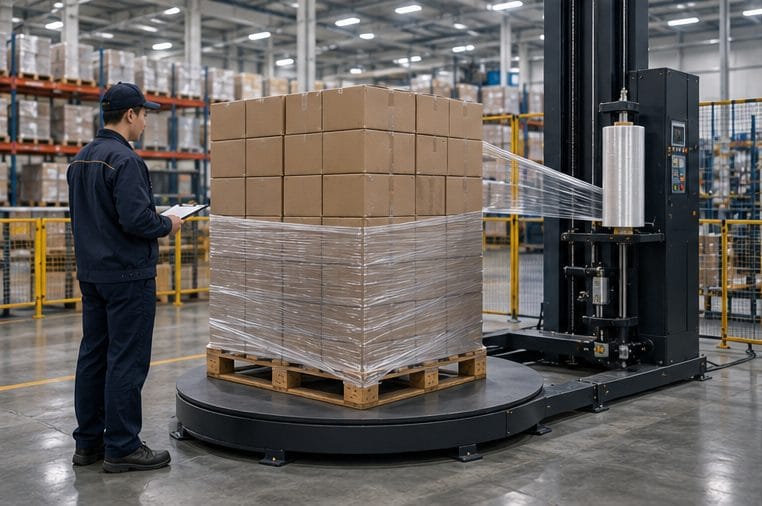
Price per roll is easy to compare and almost always misleading. The real purchasing question is how much the film costs to protect one pallet at an acceptable failure rate.
Calculate applied cost instead of roll price
Use net plastic weight, not gross roll weight, because the cardboard core doesn’t wrap a pallet.
Film cost per unit weight = delivered roll price / net film weight
Material cost per pallet = film cost per unit weight x applied film weight per pallet
For a complete cut-and-weigh method, roll-yield calculation, and worked cost example, see how to calculate stretch film usage, yield and cost per pallet
Then factor in web-break waste, downtime, rewrapping, product damage, freight claims, and disposal. A higher-priced high-performance film may lower cost per pallet if it uses less plastic and runs consistently. A cheap film may cost more when operators add wraps or the line stops repeatedly.
Treat advertised 30% or 50% savings as a proposal, not a fact. Confirm the result with your own film audit. Procurement should compare the current product and candidate products on the same loads, equipment, and acceptance standard.
Ask each wholesale stretch film supplier to quote price per roll and price per net kilogram or pound. The quote should clearly separate core tare, packaging, freight, duties, and minimum order quantity. This makes offers easier to compare across different roll weights and lengths.
Review service, capacity, and commercial terms
A low price doesn’t help if the film arrives late or changes without notice. Check:
- normal production lead time and peak-season capacity
- minimum order quantity and pallet or container quantity
- forecast requirements and order flexibility
- local or regional safety stock
- on-time delivery performance
- complaint response and replacement process
- technical support for trials and wrapper settings
- backup production line or contingency plan
- export packaging, labels, and shipping documents
- price-review method and any resin-index adjustment formula
If pricing is tied to an LLDPE market index, the contract should name the index, starting value, review frequency, trigger, time lag, and calculation method. Increases and decreases should follow the same rule.
Supply resilience also includes inventory age and storage conditions. Ask the supplier for its recommended shelf life rather than relying on a universal limit. Your warehouse should use first-in, first-out rotation and protect rolls from heat, direct sunlight, moisture, and impact damage.
Stretch film manufacturer evaluation checklist

Use this checklist during a stretch film supplier evaluation, manufacturer audit, or sourcing meeting.
B2B buyer checklist
| Evaluation area | What to verify | Warning sign |
|---|---|---|
| Application fit | Supplier asks about load, wrapper, route, and current problems | Recommends one grade before reviewing the application |
| Manufacturing source | Factory location, cast/blown capability, product scope | Trader or distributor won’t identify the actual producer |
| Specifications | Physical thickness, width, length, net weight, core, cling | Only provides “equivalent gauge” or gross roll weight |
| Quality control | Thickness control, edge inspection, winding, lot traceability | No batch records or acceptance tolerances |
| Test evidence | Identified methods for tensile, puncture, recovery, stress retention, and cling | Datasheet lists large numbers without methods or units |
| Machine trial | Normal production rolls tested on actual equipment | Approval requested from a small sample or hand test |
| Applied performance | Containment, film weight, break rate, and load stability recorded | Focuses only on maximum stretch percentage |
| Total cost | Cost per pallet and operational losses compared | Promotes roll price as the only saving |
| Change control | Written notice before material or process changes | Supplier may substitute resin or production site without approval |
| Supply reliability | Capacity, lead time, safety stock, delivery record, backup plan | No clear response for peak demand or disruption |
| Commercial terms | Net-weight pricing, freight, MOQ, index formula, claim process | Hidden core weight or one-way price adjustment |
| Support | Named contact for trials, complaints, and corrective action | Sales support ends after the purchase order |
A simple approval process
Use four stages to keep the decision clear:
- Document review: remove suppliers that can’t disclose the manufacturing source, complete specification, quality system, and test methods.
- Sample review: inspect roll dimensions, labels, edges, winding, and basic datasheet consistency.
- Production trial: measure applied film weight, containment, breaks, load condition, and cost per pallet on real equipment.
- Commercial approval: agree on the approved product, tolerances, price basis, delivery plan, complaint handling, and change-control terms.
The right industrial stretch film manufacturer is not necessarily the largest factory or the lowest bidder. It’s the supplier that can match the film to your load, prove repeatable performance, keep quality stable, and support the delivery schedule you need at the lowest verified total cost.
When requesting a quotation, send the same application data and checklist to every candidate. That gives procurement a like-for-like comparison and makes it much easier to figure out which manufacturer can support your factory or warehouse long term.
Why include Tuosheng Pack in your supplier shortlist?
Requesting a quotation from Tuosheng Pack is straightforward. Send us the stretch film specifications you need:
- hand or machine stretch film
- film width and thickness
- roll length or net roll weight
- core size, color, and cling requirements
- required quantity and delivery destination
- any private-label or OEM packaging requirements
If available, you can also provide basic information about the goods being wrapped, including pallet dimensions, load weight, load shape, sharp corners, and the wrapping method or machine type. These details aren’t required for an initial quotation, but they help us recommend a film that better matches the application.
Based on the information you provide, Tuosheng Pack will recommend a suitable stretch film specification and prepare a quotation for your purchasing team. Samples and production-line testing can be arranged when further performance verification is needed.