
When buyers first look at a stretch film quotation, thickness is usually right there at the top. A US supplier quotes 80 gauge, an international buyer asks for 20 microns, and someone else calls the same film 0.8 mil. These are all different ways of saying roughly the same thing.
Thickness matters because it affects puncture resistance, tear tolerance, roll yield, and how many loads a film can handle. But thickness alone doesn’t tell you how a film will perform on your pallet. Resin formulation, stretch capability, film uniformity, wrapping tension, layer count, load shape, and transport conditions all play a role in pallet stability.
This guide covers gauge, mil, micron, millimeter, and inch measurements. It includes a conversion chart, explains the difference between true gauge and equivalent stretch wrap, and walks through how to pick a starting specification for hand or machine wrapping.
Table of Contents
- What Do Gauge, Mil, and Micron Mean?
- Stretch Film Gauge to Micron Conversion Chart
- True Gauge vs Equivalent Stretch Wrap
- How to Select Stretch Film Thickness for a Pallet Load
- Hand Wrap vs Machine Wrap Thickness Selection
- A Practical Specification and Trial Checklist
What do gauge, mil, and micron mean?
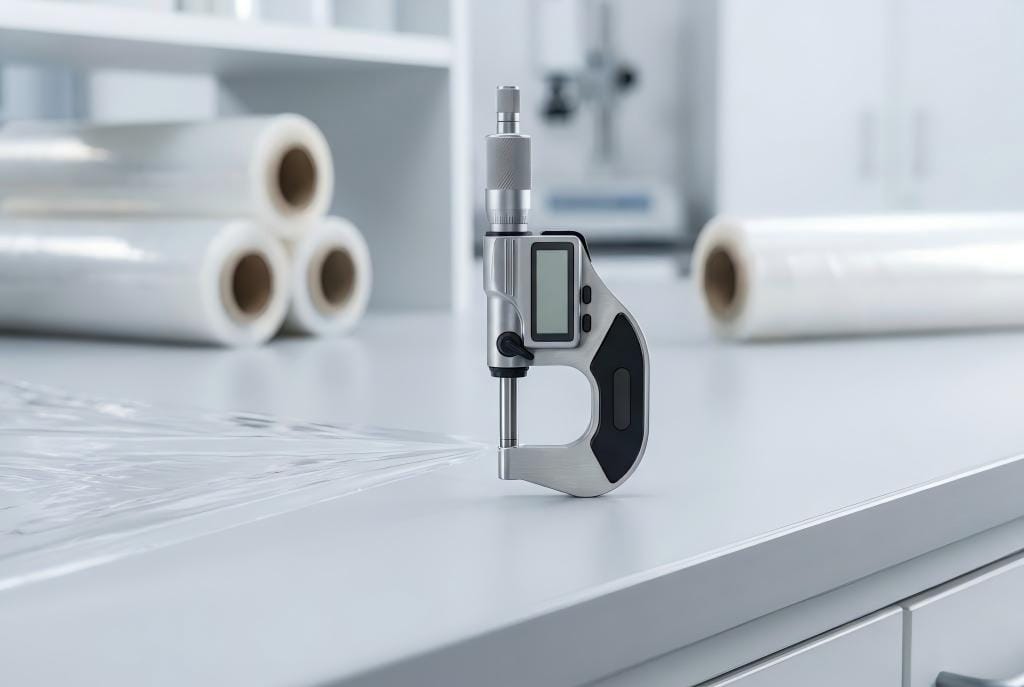
Gauge, mil, and micron are all units for describing how thick plastic film is. Buyers sometimes treat them as separate specs, but they’re just different ways of measuring the same dimension.
If you’re comparing mil vs micron stretch film quotations, the first step is to convert everything to one unit before you start evaluating thickness, yield, or performance.
- Gauge is the standard unit in the North American market. One gauge equals 0.01 mil, or 0.00001 inch.
- Mil means one-thousandth of an inch. Not millimeter. One mil equals 0.001 inch.
- Micron (written as µm) means one-millionth of a meter. This is the most common unit in metric film specs.
- Millimeter (written as mm) shows up on some technical data sheets. One millimeter equals 1,000 microns.
The baseline relationship:
1 mil = 100 gauge = 25.4 microns = 0.0254 mm = 0.001 inch
Which means:
1 gauge = 0.01 mil = 0.254 micron
The conversions you’ll use most often:
- Gauge to mil:
gauge ÷ 100 = mil - Gauge to micron:
gauge × 0.254 = micron - Micron to gauge:
micron ÷ 0.254 = gauge - Mil to micron:
mil × 25.4 = micron - Micron to mil:
micron ÷ 25.4 = mil - Micron to millimeter:
micron ÷ 1,000 = mm
For example, an 80-gauge film is 0.80 mil. Multiply 0.80 by 25.4 and you get 20.32 microns. In commercial discussions, people usually round to 20 microns, but a purchase spec should state whether the value is nominal and what production tolerance is acceptable.
The same caution applies to gauge to mil conversion. A quoted gauge represents nominal thickness, not proof that every point across the web and roll is exactly that thick. For critical applications, talk to your supplier about measurement method, sampling plan, and allowable variation.
Stretch film gauge to micron conversion chart
This chart connects the units you’ll see in industrial stretch-wrap specs. All values are mathematical conversions; displayed figures are rounded where appropriate.
| Gauge | Mil | Micron (µm) | Millimeter (mm) | Inch |
|---|---|---|---|---|
| 37 | 0.37 | 9.4 | 0.0094 | 0.00037 |
| 47 | 0.47 | 11.9 | 0.0119 | 0.00047 |
| 60 | 0.60 | 15.2 | 0.0152 | 0.00060 |
| 80 | 0.80 | 20.3 | 0.0203 | 0.00080 |
| 100 | 1.00 | 25.4 | 0.0254 | 0.00100 |
| 120 | 1.20 | 30.5 | 0.0305 | 0.00120 |
| 150 | 1.50 | 38.1 | 0.0381 | 0.00150 |
This stretch film gauge conversion chart comes in handy when you’re comparing quotes from different regions. The stretch wrap gauge to micron conversion shows that a buyer requesting 23-micron film is actually asking for about 90.6 gauge, which the industry usually discusses as 90-gauge or a 23-micron product. The spec should follow the supplier’s actual manufactured caliper, not a rounded label that doesn’t match reality.
Why nominal thickness must be verified
Film is thin and easy to deform, so getting an accurate measurement requires controlled equipment and procedures. ASTM D6988 thickness testing uses a mechanical micrometer approach for plastic film up to 0.25 mm thick. For international specs, ISO 4593 mechanical scanning covers unembossed plastic film and requires 1-micron accuracy for material at or below 100 microns.
One reading won’t tell you the story of an entire roll. You need multiple readings across different locations to catch thin spots and caliper variation. A roll can have a perfectly acceptable average while still containing areas that tear under wrapping tension. When evaluating consistency, ask how thickness is sampled, what tolerance applies, and whether the results include individual measurements alongside the average.
True gauge vs equivalent stretch wrap
The phrase true gauge means the film’s physical thickness matches its stated gauge. A true 80-gauge film should measure about 0.80 mil or 20.3 microns.
An equivalent, hybrid, or high-performance film may be physically thinner than the conventional product it replaces. The formulation and film structure are designed to deliver comparable performance at a lower caliper. That might mean selected LLDPE grades, metallocene-enhanced resins, multilayer construction, or other processing choices.
“Equivalent” describes a performance position, not a unit conversion. If a film is sold as 80-gauge equivalent, don’t record it as physically 80 gauge. Ask for the actual micron or mil value and the performance data that matters for your application.
Why thickness alone doesn’t predict performance
Two films with different calipers can behave the same way in one wrapping operation and completely differently in another. Thickness is part of the picture, but these properties matter too:
- tensile strength and elongation behavior;
- puncture and tear resistance;
- elastic recovery and retained holding force;
- cling performance;
- thickness uniformity;
- compatibility with your pre-stretch level;
- response to sharp corners, temperature, and repeated handling.
ASTM D882 tensile testing measures properties like tensile strength, yield behavior, modulus, break point, and tensile energy for thin plastic films. Puncture performance is a separate question: ASTM D5748 testing applies biaxial stress and records values such as maximum force, penetration distance, and energy at failure.
This is why a thinner engineered film can sometimes replace a thicker conventional film without losing the containment you need. It’s also why a swap based only on a marketing label can fail. You need to prove comparable performance on your actual load, with your wrap pattern, on your equipment.
Downgauging can reduce plastic weight per pallet and support sustainability goals, but only when the thinner film still hits the required containment and puncture targets without extra revolutions, frequent breaks, or rewrapping. Otherwise, the material savings on paper vanish in practice.
How to select stretch film thickness for a pallet load
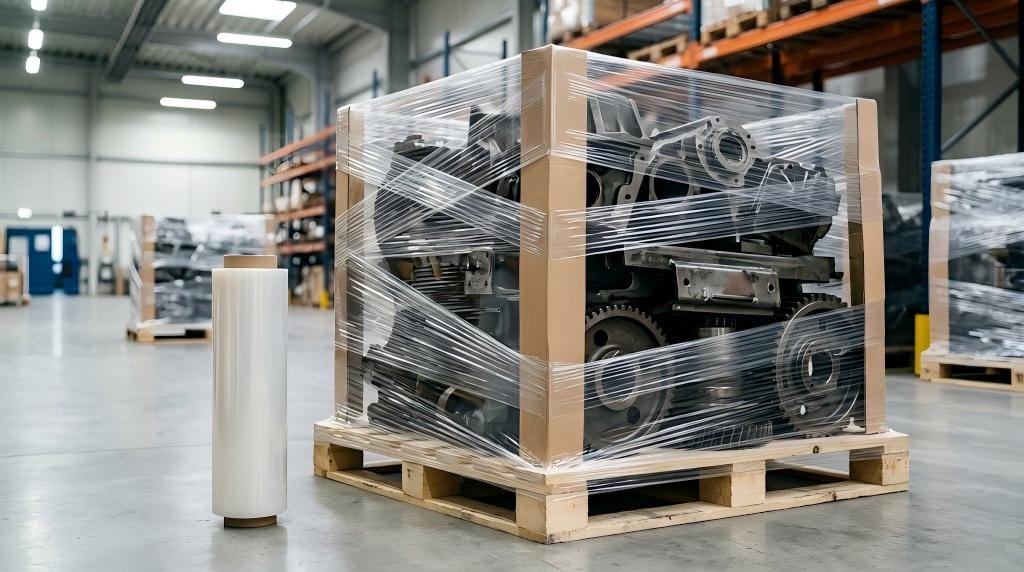
There’s no universal pallet wrap load capacity for a given gauge. A stable, cube-shaped pallet of cartons and a pallet of irregular metal parts can weigh the same but need very different films. Load weight is a starting variable, not a complete specification.
The table below offers preliminary screening ranges for conventional industrial film. It’s not a guarantee of load stability. Equivalent films may use a lower physical caliper, and sharp, unstable, or high-risk loads may need a heavier grade, a different formulation, edge protection, or a revised wrap pattern.
| Nominal gauge | Approx. micron | Preliminary load-weight range | Typical containment need and load profile |
|---|---|---|---|
| 37 | 9.4 | Up to 250 lb / 113 kg | Very light bundling or small, uniform items; not normally the first choice for a full shipping pallet |
| 47 | 11.9 | 250–500 lb / 113–227 kg | Light, stable cartons with smooth edges and limited handling risk |
| 60 | 15.2 | 500–900 lb / 227–408 kg | Light-to-medium regular loads; commonly evaluated where material yield is important |
| 80 | 20.3 | 800–2,000 lb / 363–907 kg | General warehouse pallets and medium loads; both film performance and wrap pattern remain important |
| 100 | 25.4 | 2,000–3,000 lb / 907–1,361 kg | Heavy or dense loads and profiles needing greater puncture tolerance |
| 120 | 30.5 | 3,000–4,500 lb / 1,361–2,041 kg | Extra-heavy industrial loads, irregular profiles, or severe handling conditions |
| 150 | 38.1 | Application-specific | Very demanding or abrasive loads requiring engineered testing rather than selection by weight alone |
These ranges overlap on purpose. When you’re sitting at the boundary between tiers, think about these factors before moving up or down in thickness:
- Load profile: Uniform, box-shaped loads are easier to contain than irregular or sharp-edged profiles. Protrusions and voids concentrate stress and raise puncture risk.
- Load behavior: Bags, liquids, unstable cartons, and compressible products can shift or deform even when total pallet weight is low.
- Transport exposure: Multiple transfers, rough roads, long-distance export, vibration, and temperature swings all add risk.
- Wrap pattern: More layers don’t automatically fix a weak specification. Film tension, overlap, reinforcement zones, and attachment to the pallet all affect the result.
- Acceptable failure risk: A low-value local shipment and a high-value export load shouldn’t necessarily share the same safety margin.
Cast film is usually chosen for clarity and quiet unwind, while blown film gets considered for demanding puncture and tear conditions. Those are general tendencies, not substitutes for product data. Extrusion process, resin formulation, and actual test results all need to be weighed together.
Hand wrap vs machine wrap thickness selection
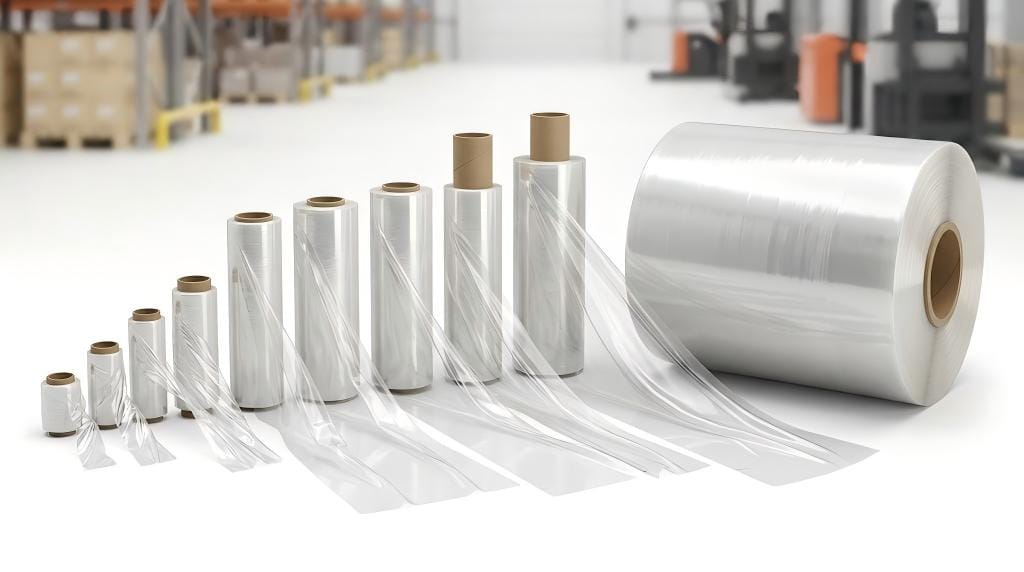
The application method changes how the film is tensioned and how consistently it goes on. The same nominal thickness can produce very different results in hand wrapping versus a powered pre-stretch carriage.
Hand stretch film needs to be manageable for the operator and forgiving of variation in walking speed, pulling force, and overlap. Conventional hand films usually fall in the 47-to-100-gauge range, depending on load risk. Pre-stretched hand film is physically stretched during manufacture, so it takes less operator force to apply. The lower applied caliper shouldn’t be confused with a true-gauge equivalent; the product still has to provide enough holding force for the load.
Machine stretch film is built for controlled application on semi-automatic or automatic wrappers. A machine applies repeatable tension and can pre-stretch the film before it hits the pallet. That can improve yield and consistency, but machine compatibility is non-negotiable. Film stretch capability has to match the carriage setting, and the roll dimensions, core, unwind behavior, and break resistance need to suit the equipment.
| Selection factor | Hand wrapping | Machine wrapping |
|---|---|---|
| Application consistency | Operator-dependent | More repeatable when settings are controlled |
| Typical priority | Ease of use and reliable manual containment | Yield, throughput, stable tension, and line compatibility |
| Thickness decision | Balance puncture resistance with operator effort | Evaluate caliper together with available pre-stretch and wrap program |
| Trial requirement | Test with representative operators and loads | Conduct a production-line trial at intended settings |
| Main substitution risk | A thin film may require excessive layers or break on corners | An incompatible film may break, neck down, or fail to reach intended pre-stretch |
Don’t put a hand-grade roll into a high-speed machine just because the width and thickness look compatible. In the same way, throwing thicker machine film at a problem doesn’t automatically help if the wrapper can’t apply it right. The smarter move is to compare cost and performance per successfully wrapped pallet, not price per roll or gauge alone.
A practical specification and trial checklist
The best thickness is the thinnest tested film that repeatedly hits your containment and protection targets with an acceptable operating margin. Use the conversion chart to normalize supplier quotes, then test under real conditions.
Before approving a specification, record:
- actual thickness in micron and mil, not only an equivalent-gauge label;
- whether the value is nominal and the permitted caliper tolerance;
- true gauge, equivalent, hybrid, or pre-stretched construction;
- hand or machine application and the intended pre-stretch setting;
- pallet weight, height, footprint, and load profile;
- sharp edges, protrusions, voids, or compressible products;
- wrap pattern, overlap, reinforcement layers, and film tension;
- puncture, tensile, cling, and retained-force data where relevant;
- transport route, storage temperature, handling frequency, and failure criteria.
Run trials on representative pallets, not an ideal demonstration load. Keep the pallet, product arrangement, wrap program, and transport exposure consistent when comparing films. Record film weight used per pallet, breaks, wrapping time, load movement, damage, and rework. A successful downgauge trial should cut material use without shifting costs into extra layers, labor, stoppages, or freight claims.
For incoming quality control, use a defined sampling method instead of checking one point on one roll. If a specification is especially sensitive, align the measurement method with ASTM D6988 or ISO 4593 and agree on how results will be reported.
Gauge, mil, and micron are straightforward units. But picking stretch film is a performance decision. Use 1 mil = 100 gauge = 25.4 microns to compare calipers, separate physical thickness from equivalent-performance labels, and treat load-weight charts only as starting points. Final approval should come from a controlled trial on the real pallet, with the real wrapping method, in the real distribution environment.
When you ask a supplier for a recommendation, give them the load dimensions, pallet weight, product profile, wrapping method, current film spec, film used per pallet, and the operational problem you’re trying to solve. That’s a lot more useful than just asking for a gauge.
Need Help Choosing the Right Stretch Film?
Every packaging application has different requirements. Share your wrapping method, load type and specifications, and Tuosheng Pack can help recommend a suitable stretch film solution for your business.
Suggestions based on product type, wrapping method and performance needs.
Support for thickness, width, roll size, color and packaging requirements.
Working with distributors, wholesalers and industrial packaging buyers.
Recommended Tuosheng Pack Solution
For buyers looking for reliable stretch film solutions, Tuosheng Pack supplies hand stretch film, machine stretch film, pre-stretched film and specialty packaging films with customizable thickness, width, roll length and packaging options.
Jumbo Stretch Film
Large-format stretch film rolls designed for high-volume packaging requirements.
Learn More →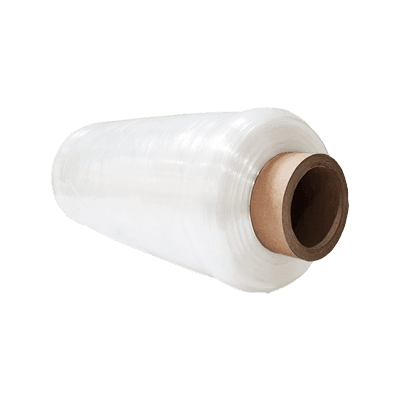
Pre-Stretch Film
Lightweight pallet wrapping solution helping reduce material consumption while maintaining load security.
Learn More →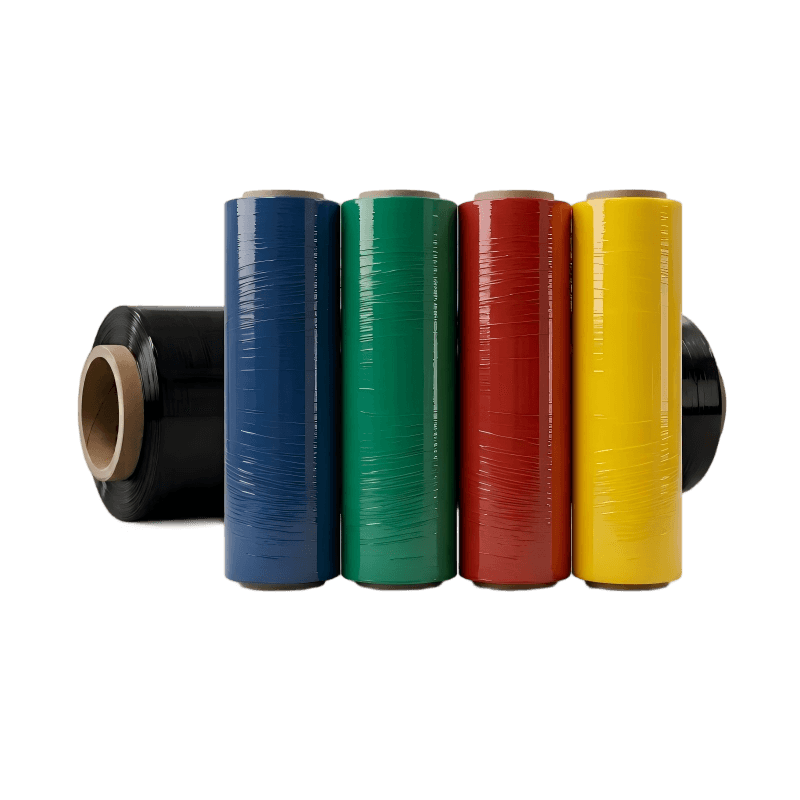
Colored Stretch Film
Custom color options for product identification, privacy protection and branded packaging needs.
Learn More →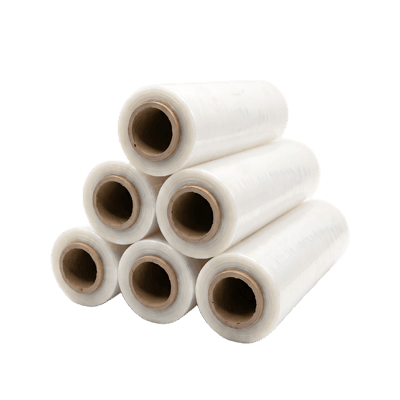
Machine Stretch Film
High-performance film designed for automated pallet wrapping operations with consistent load stability.
Learn More →