
A pallet that reaches the receiving dock leaning, loose or split open costs money twice: once in the damaged goods, and again in the claims, rework and re-wrapping that follow. That failure usually traces back to a specification decision made months earlier, when two quotations were compared and the cheaper roll won. Cast and blown stretch film are not the same material at two price points. They come off different extrusion lines, they cool along different histories, and the molecular orientation each route produces shapes how the film clings, how far it stretches, how it behaves at a sharp corner and whether a scanner can still read a label through it.
For most pallet-wrapping operations, cast stretch film is the sensible starting candidate. The slot-die and chill-roll route is associated with optical clarity, consistent gauge, quiet unwind and lower force-to-stretch, and those properties feed straight into machine behaviour and throughput. Blown film keeps a genuine place where puncture initiation and tear propagation dominate the risk profile, and this comparison states that fairly. What it will not do is treat “blown for heavy loads, cast for everything else” as an engineering answer, because multi-layer cast construction has moved that boundary.
The sections below follow the sequence a specification review should. They trace both extrusion mechanisms and the orientation effects each produces, compare the metrics that decide pallet stabilisation alongside the test conditions needed to compare them fairly, build a cost model running from delivered roll price to cost per stable pallet, examine what nano-layer cast construction can and cannot be assumed to deliver, and close with an application matrix and a line-trial protocol. Film construction is one input among resin system, gauge, additives, machine settings and wrap pattern, so readers who need that wider framework can work through the comprehensive industrial stretch film materials and specifications guide alongside this comparison.
The Core Difference: How Manufacturing Processes Shape Performance
Cast and blown stretch film both begin as molten polyethylene resin. What separates them is how that melt is shaped, how quickly it cools, and in which directions it is drawn while solidifying.
Cast Stretch Film Manufacturing Process
Molten resin is forced through a flat or slot die, emerges as a wide thin sheet, and is brought immediately into contact with a chilled roll. The roll removes heat by direct contact and fixes the sheet into film.
Metal-to-melt contact quenches the sheet rapidly. Rapid cooling leaves less time for ordered crystallisation before the polymer locks in place, which is why the cast route is typically associated with high clarity, gloss and smooth surfaces. No published cooling rate is available, so the comparison stays qualitative.
The sheet is drawn forward through extrusion and around the chill roll, producing predominantly machine-direction orientation. This is consistent with cast film’s lower force-to-stretch behaviour, though resin, additives, gauge and draw conditions all influence the outcome.
Slot-die geometry is directly controllable, and industry sources describe this processing as capable of tighter gauge control than the air-bubble route. No published spot-to-spot tolerance figure is available, but consistent gauge allows a wrapper to hold a repeatable containment result.
Blown Stretch Film Manufacturing Process
The blown route uses a circular die. Molten resin exits as a tube, internal air pressure inflates it into a vertical bubble, surrounding air cools the bubble as it rises, and the film is collapsed and wound.
The film is drawn vertically and expanded transversely at the same time, receiving orientation in two directions. That more biaxial orientation is the accepted explanation for blown film’s puncture resistance, resistance to tear propagation and load-holding memory. Cooling by surrounding air rather than direct contact means a slower cooling history, allowing more ordered crystallisation. Greater crystalline structure scatters more light.
Where puncture initiation and tear propagation dominate the risk profile, a blown candidate has been the conventional place to start. This is a mechanism-based explanation rather than a measured result. Gauge, resin family, formulation, load geometry and wrap pattern decide which film holds a specific load.
Nano-layer cast construction divides the same gauge into many ultrathin coextruded layers, assigning different functions to core and surface layers. That addresses the toughness properties conventionally credited to blown film while keeping the clarity and gauge control of the cast process. The traditional clarity-versus-toughness split describes conventional cast against conventional blown, and should be used as a screening starting point rather than a fixed rule.
| Process variable | Cast: slot die plus chill roll | Blown: circular die plus air-cooled bubble | Evidence status |
|---|---|---|---|
| Melt shaping route | Flat or slot die, sheet contacts a chilled roll | Circular die, air-supported vertical bubble | Process route, cross-source agreement |
| Cooling history | Rapid quenching by direct roll contact | Slower cooling by surrounding air | Relative comparison only, no measured rate available |
| Molecular orientation | Predominantly machine direction | Vertical draw plus transverse expansion, more biaxial | Construction-level tendency |
| Clarity and gloss | Typically clearer and glossier | Typically hazier | Process tendency, depends on resin, formulation, gauge |
| Gauge control | Tighter control across the web | Less tightly controlled by comparison | Qualitative process tendency, no tolerance figures published |
| Conventional first use case | Clarity, gauge consistency, quiet unwind, lower force-to-stretch | Puncture resistance, tear-propagation control, load-holding memory | Starting decision rule, not a test result |
Read this table as a screening comparison, not a verdict. It tells you which candidate to test first and which properties to measure.
Physical Performance Face-Off: Key Metrics for Packaging Engineers
Process physics tells you where to start, not which film holds your pallet. Puncture initiation, tear propagation, containment retention, force-to-stretch, actual pre-stretch, usable yield, cling, clarity and unwind noise are nine questions with nine different measurements, all of them hidden inside a single word like “strength”.
Each answer belongs in one of three evidence classes. A process tendency is a construction-level expectation from the extrusion route, useful for screening but not acceptance. A supplier-reported value is a catalogue figure, usable only when resin, gauge, method and conditions are stated. A measured line result comes from your own pallet and machine, and only that class settles a specification.
| Metric | Cast starting position | Blown starting position | Evidence class | How to validate |
|---|---|---|---|---|
| Puncture initiation | Higher edge-risk starting point unless formulation and construction are designed for the load | Usual candidate for sharp edges, protrusions, irregular loads | Process tendency | Wrap the actual load; count punctures at corners over a defined handling cycle |
| Tear propagation | Assess separately; do not infer from puncture data | Associated with resistance to tear growth once initiated | Process tendency | Inspect wrapped pallets after handling for whether a start point spread or stopped |
| Containment and load retention | Depends on delivered and retained containment force, not maximum elongation | Elastic recovery, or holding memory, associated with continued stabilisation after wrapping | Process tendency | Measure containment force after wrapping and again after handling and transit |
| Force-to-stretch | Reported as easier to stretch on ordinary equipment | Reported as needing higher force, more limited on an ordinary machine | Supplier-reported; equipment and formulation dependent | Record force at the pre-stretch setting you intend to run |
| Actual pre-stretch ratio | Reported range in supplier comparisons; resin, gauge, method and machine typically not stated | Comparable figure typically not available in the same material | Supplier-reported value | Measure the achieved ratio on your machine, not catalogue elongation |
| Usable yield | Define the basis before comparing | Define the basis before comparing | Measured line result | Log film per pallet, breaks, tails, setup waste, stable pallets per roll |
| Cling and tack | Relies on surface smoothness and cling additives | Commonly stronger single- or double-sided cling; strong cling can attract dust in some environments | Process tendency; formulation dependent | Record cling, dust pickup and release at your station and ambient conditions |
| Clarity, haze, barcode visibility | Clearer starting candidate | Hazier starting candidate | Process tendency | Run your own readers and vision systems; record first-pass read rate and no-reads |
| Unwind noise | Described as quieter to unwind | Described as more noticeable or higher-frequency, particularly where strong cling separates at speed | Process tendency; qualitative only | Observe or measure at the operator position at your unwind speed and roll tension |
That is a screening comparison. Every row that matters to your load needs a like-for-like trial at the same or an explicitly stated gauge, resin family, wrap pattern, machine setting and load geometry.
Puncture Resistance and Load Retention
Puncture initiation and tear propagation fail differently and must be recorded separately. Initiation is whether a corner, protruding fastener or timber splinter breaks the film surface at all. Propagation is whether that start point stays a pinhole or runs into a full split as the pallet is lifted and vibrated. A film can resist one and not the other, so a single puncture figure cannot underwrite a containment decision.
Edge geometry, load mass, handling profile and the cost of one collapsed pallet decide whether puncture governs the failure at all. Where no sharp edge is exposed, ranking films by puncture answers a question the load is not asking, and a correctly gauged cast film can reach the containment target while also delivering the clarity, machine behaviour, yield and quiet running the operation needs.
Containment force is the outcome that matters, and it is not tensile strength or maximum elongation. Load retention depends on the force delivered during wrapping and how much still acts hours later, after the film has relaxed and the pallet has been handled. Elastic recovery alone does not guarantee a stable pallet: wrap pattern, revolutions, film force setting and load rigidity all contribute. Fix those variables, run both candidates, then record corner punctures, whether any start point propagated, containment force after wrapping and after handling, and how many pallets arrived stable. ASTM D882 and ASTM D1922 are named as reference standards here, but a method name attached to a qualitative statement is not a result; ask for the report.
Pre-Stretch Ratio and Machine Yield
Nominal elongation, machine pre-stretch ratio and usable yield are different measures. Catalogue elongation is what the film reached under the supplier’s test conditions. Machine pre-stretch ratio is what your wrapper delivers between its rollers at a given setting. Usable yield is how much stable-pallet coverage the roll produces after real waste. Only the third one buys anything, and treating a catalogue percentage as the achieved machine ratio is the most common way a film comparison goes wrong before any film is loaded.
The cost comparison section that follows develops the calculation discipline, yield measures and waste items in full. Here, record the force at the setting you intend to run, measure the ratio your machine achieves repeatedly, and log breaks, tails, setup waste and stable pallets. A higher stretch claim lowers material cost only when the line reaches that ratio consistently, without breaking, and without extra wraps to hold the load.
Environmental Noise and Factory Ergonomics
Unwind noise is the metric most often listed as a footnote and most often raised by the people running the wrapper. The sources describe cast film as quieter to unwind and blown film as producing more noticeable or higher-frequency noise, particularly where strong cling surfaces separate at speed. That is a qualitative comparison: noise depends on formulation, roll tension, unwind speed, the wrapper and room acoustics, and no published measured values are available.
It is an operating cost rather than a comfort preference. Where the response to a noisy station is to slow the wrapper until it becomes tolerable, a noise problem has become a throughput problem. Enclosed spaces such as chilled rooms and small dispatch bays, and halls running several wrappers, both raise the stakes, so cast film’s quieter unwind is a tangible advantage at the operator position.
Cling sits next to noise because it partly causes it. Cast film relies on surface smoothness and cling additives, while blown film commonly uses stronger single-sided or double-sided cling, which the sources note can attract dust in some environments. Cling is a formulation and surface property rather than a fixed consequence of construction, so do not assume every blown film is dusty or that cast film lacks holding cling. At each candidate’s normal unwind speed and roll tension, note the noise character at the operator position, whether the station stays acceptable across a shift, whether cling holds the tail without extra taping, and how much dust the pallet picks up.
Financial and ROI Analysis: Cost per Roll vs. Cost per Wrapped Pallet
Procurement is quoted a roll price. Operations pays a cost per stable pallet. The gap between those two numbers is where a cast-versus-blown decision is actually settled.
A quoted roll price tells you what the delivery costs, not how many pallets that roll will stabilise on your machine at your containment target. A defensible comparison fixes the pallet, load geometry, wrap pattern, containment target, machine and operating period, then measures what each film consumes to reach the same result.
One production tendency is worth naming and then setting aside.. That is a broad manufacturing observation rather than a delivered price: resin, gauge, line design, scale, energy, freight, converting and a supplier’s pricing position can reverse it on any quotation.
How Pre-Stretch Ratio Changes Real Cost per Pallet
Achieved pre-stretch is the largest single lever on material cost per pallet. The distinction between catalogue elongation, machine ratio and usable yield is set out in the metrics comparison above; what matters commercially is that only the ratio the line reaches on every pallet, without breaking film or needing extra revolutions, converts into cost.
Three things then move the pallets a roll produces. Every unit of ratio the line fails to reach is unstretched film you paid for and wound onto the load. If a candidate needs extra revolutions or a higher film force setting to reach the same containment target, consumption per pallet rises whatever its stretch rating says. And lines running near a film’s force limit break more often, each break costing the film already on that pallet, the restart tail, the intervention and the cycle. A film rated lower that runs stably at its rating can deliver more stable pallets per roll than a higher-rated film the wrapper reaches only intermittently.
Building a Side-by-Side Cost Comparison Template
Record the inputs below for each candidate against the same pallet and containment target, then derive pallets per roll, material cost per wrapped pallet and total operating cost. Leave a cell blank rather than estimating it; an unfilled assumption is where a comparison gets challenged later.
| Worksheet line | Symbol or unit | Cast candidate | Blown candidate | Nano-layer cast candidate |
|---|---|---|---|---|
| Supplier and film reference | text | |||
| Delivered roll price, and what it includes | P_roll | |||
| Net usable roll length or mass | L_net | |||
| Width and gauge, stated on one basis | mm / µm | |||
| Machine and pre-stretch setting | text | |||
| Measured force-to-stretch at that setting | as measured | |||
| Achieved pre-stretch ratio | R | |||
| Wrap pattern, revolutions and containment target | text | |||
| Stretched film length required per pallet | L_req | |||
| Film consumed per pallet, unstretched | L_used | |||
| Breaks per shift, tails and scrap per roll change | count, length or mass | |||
| Usable-efficiency factor after measured waste | η | |||
| Wrap-cycle time per pallet | seconds | |||
| Labour rate at the station | per hour | |||
| Roll changes per shift and time each | count / minutes | |||
| Downtime events and cost | minutes / cost | |||
| Pallets that met containment and arrived stable | count | |||
| Pallets per roll | derived | |||
| Material cost per wrapped pallet | C_material | |||
| Total operating cost per stable pallet | derived |
Work the derived lines in this order:
pre-stretch %      = (R - 1) × 100
L_eff              = L_net × R × η          (theoretical effective coverage)
pallets per roll   = L_eff / L_req          (theoretical, from the wrap pattern)
pallets per roll   = L_net / L_used         (measured, from the machine counter)
C_material         = P_roll / pallets per roll
C_operating        = C_material + labour + changeover + downtime + scrap
Three rules keep the arithmetic honest. Use one measurement basis throughout and never mix net roll length with gross. If the machine counter already reports unstretched film consumed per pallet, use the measured form and do not apply R a second time, because the counter has already accounted for the stretch. State what the delivered price includes, since freight, duty, core, packaging and disposal shift the figure differently for imported and locally converted film.
Keep the three yield figures separate. Theoretical yield comes from L_eff and belongs in planning only. Measured film yield is unstretched consumption per pallet on your line. Stable pallets per roll counts only pallets that met containment and arrived intact, and dividing the delivered roll price by that figure is what exposes a cheaper roll producing fewer usable pallets. Cost of ownership for the specification is the last derived line, not the first quoted one, and the ROI of a film change is the difference in operating cost per stable pallet multiplied by pallet volume over the period. No further payback claim is defensible without measured data.
Run cast, blown and nano-layer cast candidates at comparable gauge, against one containment target, on one machine, over one period. Where puncture is not the dominant failure mode, a correctly gauged cast film commonly reaches the target at a reachable pre-stretch ratio with quieter running and readable film, and the worksheet is where that combination shows up as cost rather than as a preference. Where the numbers say otherwise, the numbers are the specification.
Nano-Layer Cast Film: Construction, Claims and Validation
The clarity-versus-toughness split assumes a cast film is one homogeneous wall of resin. Multi-layer cast construction removes that assumption. Lindum describes nano-layer cast film as a stack of many ultrathin layers, with reported examples in the 33 to 55-plus layer range. Those are supplier construction descriptions, not a market specification, and layer count alone proves nothing about how a film will hold your pallet.
What Nano-Layer Technology Actually Does
The process route is unchanged: the melt still passes through a slot die onto a chilled roll, which is why nano-layer film keeps cast processing behaviour and cast optics. What changes is upstream, where the melt stream is divided and recombined so the same micron thickness is built from tens of layers rather than a handful.
Three design objectives sit behind that architecture, each engineering intent rather than a demonstrated result. Load is carried across many thin layers and their interfaces instead of one thick wall, which is how multi-layer films are designed to tolerate localised stress at a corner or protrusion. Every interface is a discontinuity where a tear need not run straight into the next layer, so interrupting propagation is the design goal and not a consequence of layer count. Surface layers can be formulated for cling on one face and controlled release on the other, and core layers for stretch and load-holding, where a single layer has to compromise all of it.
Assessment has to stay concrete. Compare the resin system and grades in each layer group, the gauge on one stated basis, the additive package including cling, slip and tackifier chemistry, and the test method with its specimens and conditioning. Ask what each layer group does, not how many layers exist: a high layer count on a weak resin system at an aggressive down-gauge can perform worse than a well-formulated cast film with fewer layers.
Performance Comparison: 55-Layer Cast vs. Standard Blown
Run this as a controlled trial, not a datasheet review. Fix comparable gauge in the same units, the declared resin and additive package for both candidates, the same pallet, load geometry, wrap pattern and film force, the same machine and pre-stretch setting, the actual temperature, the same handling and transit cycle, and acceptance criteria agreed before the first pallet is wrapped.
| Dimension | Record on both candidates | Evidence status |
|---|---|---|
| Clarity and barcode visibility | First-pass read rate, no-reads per pallet, label layers held constant | Cast optics a process tendency; read rate measured |
| Puncture initiation | Punctures at corners and protrusions over a set handling cycle | Blown the conventional candidate; nano-layer cast unproven |
| Tear propagation | Whether each start point stayed a pinhole or ran into a split | Design objective, not a given |
| Containment-force retention | Force after wrapping, and after handling and transit | Process tendency; no value published for either |
| Force-to-stretch and actual pre-stretch | Force at the setting, and the ratio reached repeatedly | Cast reported easier to stretch; equipment dependent |
| Usable yield | Unstretched film per pallet, stable pallets per roll | Measured line result only |
| Cling and dust pickup | Tail and final-wrap hold, release at unwrap, dust after dwell | Formulation dependent on both |
| Unwind noise | Character at the operator position, meter reading if available | Qualitative only; no published decibel data |
| Waste | Breaks per shift and cause, setup tails, rejected pallets | Measured line result only |
| Cost per stable pallet | Delivered price per pallet that met containment and arrived intact | Measured line result only |
One supplier claim belongs here labelled as a claim to verify. Lindum states that a 55-layer cast film can retain more than 90% of conventional cast film’s transparency and quiet-unwind characteristics while reaching puncture strength and containment performance comparable with blown film at similar micron thickness. It is published without a test method, specimen details, formulation, gauge values, comparator specification or statistical basis. Treat it as the hypothesis the trial is designed to test, and request the full report, the exact method designation and the specification of the blown film it was measured against before it influences a purchase decision.
Where puncture initiation is not the dominant failure mode, and clarity for scanning, quiet running and a reachable pre-stretch ratio all carry operating cost, a nano-layer cast candidate is the first film to put on the machine. Blown film stays in the comparison as the reference: if the cast candidate misses the puncture or tear-propagation threshold at comparable gauge, the blown specification is the correct answer. A replacement decision made on architecture alone is not defensible.
Application Guide: Which Film Should You Choose for Your Industry?
Selection starts with the load, not the film. Record load geometry, edge risk, pallet mass, throughput, scanning requirement and temperature profile, then state the containment result you need. Construction is one input alongside resin system, gauge, additives, machine settings and wrap pattern, so an industry label on its own proves nothing about how a film will hold your pallet. The matrix below is a screening tool for three load categories. It names the dominant risk, the candidate to put on the machine first, the criteria that decide the outcome, and the conditions a fair trial has to hold constant.
| Load category | Dominant risk | Starting candidate | Acceptance criteria | Trial conditions |
|---|---|---|---|---|
| Sharp-edge and heavy industrial: bundled PVC pipe, construction bricks, heavy machinery | Puncture initiation at protrusions, tear propagation under transit stress, containment loss | Nano-layer cast on trial first; standard blown as the reference fallback where edge risk dominates | No puncture start point spreading into a split over your handling cycle; containment force retained to target after transit; stable pallets per roll and cost per stable pallet recorded | Record the protrusion radius and height of the sharpest edge, pallet mass and centre of gravity; hold gauge on one stated basis, resin family, wrap pattern, revolutions and machine pre-stretch setting the same for both films; record the cost of one torn pallet |
| High-throughput automatic wrapping and distribution | Film breaks and unplanned stops, pre-stretch ratio unreachable at line speed, scan failures, roll changes per shift | Cast or nano-layer cast, conditional on reaching the containment target repeatably at your cycle time | Containment target met on every pallet at production cycle time; breaks, roll changes and unplanned stops at or below the incumbent; first-pass read rate at or above the incumbent; cost per stable pallet | Define the throughput rate your line requires and run a sample large enough to reach statistical confidence on break frequency; keep machine, wrap pattern, pallet and label stock constant; measure achieved pre-stretch, not catalogue elongation |
| Cold-chain and temperature-sensitive: frozen and refrigerated goods | Loss of flexibility, cling or puncture resistance at temperature; containment drop after dwell; condensation and frost obscuring labels | No construction winner is established at low temperature; trial cast and blown candidates side by side at comparable gauge | Cling and containment retained after the planned dwell; no brittleness or adhesion loss; labels and barcodes readable at dispatch through the wrap | Define the temperature profile your cold chain requires, including wrapping temperature, cooling rate into store, storage temperature, dwell time, transit range and handling events; record the condensation state and the point at which barcodes must scan |
Sharp-Edge and Heavy Industrial Loads
Protruding corners, angular blocks, bundled pipe, brick and heavy machinery components fail in a defined sequence: a point initiates a puncture, transit stress runs it into a split, containment drops and the load shifts. Adherex and Rocket Industrial name blown film as the conventional candidate here, citing higher puncture resistance and control of tear propagation. Treat that as a starting position rather than a verdict. Where clarity, yield or unwind noise also carry operating cost, put a nano-layer cast candidate on the machine first and let the trial decide; that is a candidate position, not a demonstrated equivalence. Specify blown film when the cast candidate misses the puncture or tear threshold under your own handling cycle, and price the failure cost of one torn pallet before accepting the trade in clarity, yield and force-to-stretch.
High-Throughput Warehousing and Distribution
On automatic wrappers the binding constraint is repeatability, not peak film property. Define the throughput rate your line requires, then judge a candidate on whether it reaches the containment target on every pallet at that cycle time. Whether your wrapper reaches a given ratio is a measured result, not a property of the construction. Set the pass criteria before the trial: containment at cycle time, breaks, roll changes, unplanned stops, achieved pre-stretch, first-pass read rate and cost per stable pallet.
Temperature-Sensitive and Cold-Chain Applications
No published comparison establishes a cast or blown winner at low temperature. Both constructions depend on resin system, additives and gauge for flexibility, cling and puncture resistance in the cold, so treat any claim that one stays flexible while the other turns brittle as the hypothesis your trial is designed to test. Define the temperature profile your cold chain requires: wrapping temperature, cooling rate into store, storage temperature, dwell time, transit range and the handling events in between. Wrap representative pallets with both candidates at comparable gauge and pre-stretch, move them on the real schedule, then measure cling retention, containment force after dwell, film condition after handling, and whether barcodes read at dispatch through condensation or frost. Adjust gauge, resin system or wrap pattern before concluding that construction alone decides the result.
Conclusion and Actionable Next Steps
No construction wins universally. The choice follows the containment result you need, the load in front of you, and the measured cost per stable pallet. For most operations that starting point is cast or nano-layer cast film; blown film is the conditional fallback where puncture and tear propagation dominate the risk.
Decision Framework Summary
Use this as a screening tool, not a verdict.
| Variable | Starting candidate | Required validation |
|---|---|---|
| Load geometry | Cast or nano-layer cast | Wrap the actual load profile and check retained containment |
| Edge risk | Nano-layer cast; blown only if the trial shows a shortfall | Record puncture initiation and tear propagation at a stated gauge |
| Throughput | Cast or nano-layer cast | Measure force-to-stretch, actual pre-stretch, breaks and cycle time |
| Scanning and clarity | Cast | Check read rates on your own scanners through the wrapped layers |
| Temperature | Cast, tested cold | Wrap and hold at the real temperature profile |
| Containment target | Cast or nano-layer cast | Compare cost per stable pallet at equal containment |
Line Trial Protocol
Run each candidate on the same load, machine, wrap pattern, gauge basis and containment target, changing one variable at a time. Record film consumed per pallet, breaks and tails, cycle time, retained containment, scanner performance, unwind noise at the operator position, and cost per stable pallet.
Sample Request and Next Step CTA
Procurement teams that still need to evaluate full pallet wrap specifications and resin grades should work through the wider guide before fixing a specification. Then request a cast or blown film sample and a pallet-wrapping trial against your load, machine settings and containment target. Send load geometry, pallet mass, edge risk, machine type, current film gauge, wrap pattern, temperature profile and current film consumption so the trial answers your procurement question rather than repeating a product demonstration.
Looking for Reliable Stretch Film Supply?
Tuosheng Pack specializes in stretch film production, providing consistent film quality, customized specifications and OEM packaging solutions for distributors, wholesalers and industrial packaging users.
5-layer extrusion helps achieve stable thickness, clarity and reliable roll performance.
Available options include thickness, width, roll length, core size and packaging.
Supporting private labels, distributors and international packaging projects.
Recommended Tuosheng Pack Solution
For buyers looking for reliable stretch film solutions, Tuosheng Pack supplies hand stretch film, machine stretch film, pre-stretched film and specialty packaging films with customizable thickness, width, roll length and packaging options.
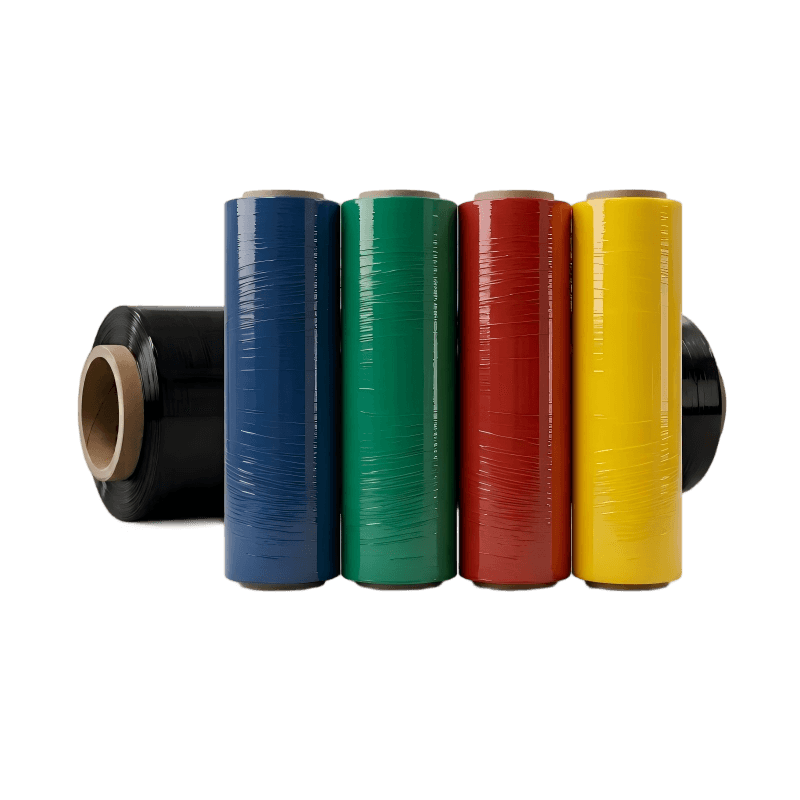
Colored Stretch Film
Custom color options for product identification, privacy protection and branded packaging needs.
Learn More →
VCI Shrink Film
Specialty packaging film providing corrosion protection for metal products during storage and transportation.
Learn More →
Pre-Stretch Film
Lightweight pallet wrapping solution helping reduce material consumption while maintaining load security.
Learn More →
Hand Stretch Film
Flexible manual wrapping solution designed for warehouses, logistics and general pallet applications.
Learn More →