Heavy Duty Stretch Wrap: How to Choose Pallet Wrap for Heavy and Irregular Loads
Quick answer
- Heavy duty stretch wrap is pallet wrap chosen for loads that tear, puncture or shift ordinary film: heavy pallets, sharp edges, irregular shapes and tall stacks.
- Thickness is only a starting point. For cast machine film on a powered pre-stretch wrapper, Tuosheng Packaging starts at 80–90 gauge (20–23 µm) for 1,800–2,400 lb pallets and 90–120 gauge (23–30 µm) above 2,400 lb, then confirms the choice in a trial.
- Sharp edges need edge protection first; extra layers of film rarely stop a corner that cuts every wrap.
- Test candidate films on your own worst pallet and compare breaks, load movement, damage and film used per pallet.
For a heavy or irregular pallet, choose pallet stretch film by how it performs on your load, not by the words “heavy duty” on a roll. The film needs to survive exposed edges, hold the goods in place after wrapping, and run reliably with your wrapping method. Ask for suitable samples, then compare them on the same pallets using film breaks, load movement, product damage and film used per pallet. For an overview of film types and specifications, start with our stretch film selection guide.
If a sharp part keeps cutting through the film, protect that edge or change how the goods are stacked. More layers of film may raise your cost without fixing the point where every wrap fails.
Which Loads Need Heavy Duty Pallet Wrap?
Heavy duty pallet wrap is worth testing when ordinary film tears, punctures or lets the load move. Four kinds of load cause most of those failures, and each one needs a different first fix.
| Load | Why ordinary film fails | What to change first |
|---|---|---|
| Heavy pallets (over about 1,800 lb / 800 kg) | The load's weight pulls the film loose when the pallet brakes or turns | A heavier gauge and more base wraps locked to the pallet |
| Sharp edges and protrusions | One hard point cuts every wrap | Edge protection, then a tougher film |
| Irregular or stepped loads | The film bridges gaps and tears across exposed points | Corner boards and extra wraps at the steps |
| Tall or top-heavy stacks | The top sways and the film loosens over time | More top wraps and a film that keeps its hold after wrapping |
What should you check before buying stretch wrap for a heavy pallet?
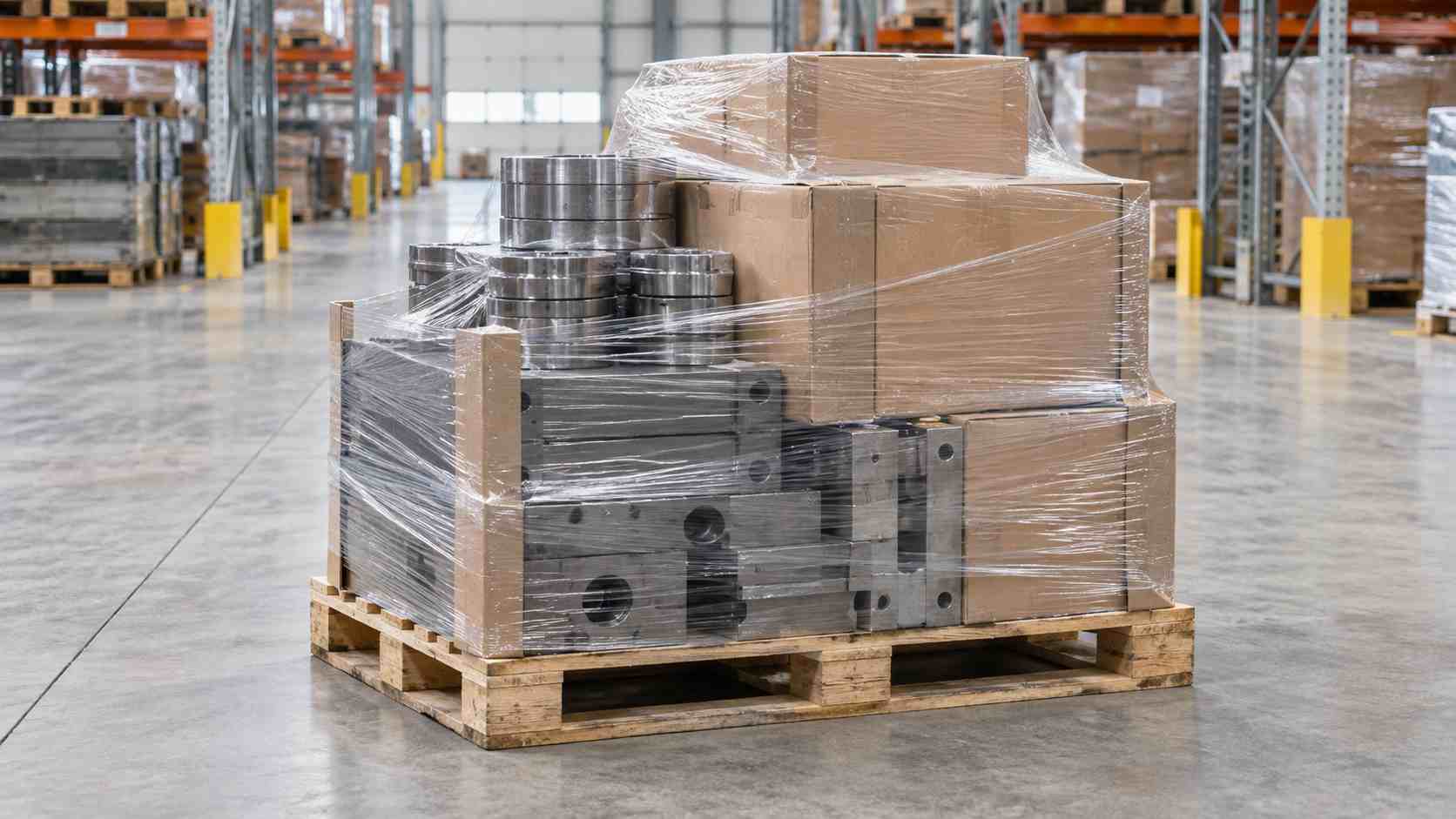
Start with the pallet that gives your warehouse the most trouble. Its weight matters, but the shape and the way the goods move matter just as much.
| What you see on the pallet | What to check during a trial |
|---|---|
| Cartons or bags shift during handling | Whether the wrapped goods stay aligned with the pallet, especially near the base |
| Metal parts, straps or hard corners protrude | Where the film first punctures or tears |
| The load has gaps, steps or overhang | Whether the film stays in contact with the goods without tearing across exposed points |
| Cartons dent under tight wrapping | Whether the film holds the load without crushing its packaging |
Photograph the load before wrapping and mark any place where the current film breaks. Tell the supplier whether the pallet is moved only within the warehouse or also travels through a distribution route. Those details make a sample recommendation more useful than pallet weight alone.
ASTM’s guide to selecting and using stretch film is intended to help buyers and sellers develop purchase specifications for indoor palletizing and transport. It does not cover outdoor exposure, so a pallet stored outside needs a separate review.
How thick should heavy-duty stretch wrap be?
Heavy duty stretch wrap usually starts at 80 gauge (about 20 µm) and goes up to 120 gauge (about 30 µm) for the heaviest pallets, but thickness alone doesn’t make a film heavy duty. Thickness tells you how much material is in the film; it doesn’t tell you whether the film will tear on your pallet’s corners or keep the load stable after application. The table below gives Tuosheng Packaging’s starting points for cast machine film on a powered pre-stretch wrapper; a trial on your own load decides the final gauge. If you are choosing between the two most common US thicknesses, see 60 vs 80 gauge stretch wrap.
| Pallet weight | Starting gauge | Approx. thickness | What it means |
|---|---|---|---|
| 800–1,800 lb (363–816 kg) | 60–80 gauge | 15–20 µm | Standard film is often enough; check the corners first |
| 1,800–2,400 lb (816–1,089 kg) | 80–90 gauge | 20–23 µm | Heavy duty range; lock the base wraps to the pallet |
| Over 2,400 lb (1,089 kg) | 90–120 gauge | 23–30 µm | Heaviest loads; test puncture resistance on your own corners |
These starting points assume mostly square loads. Sharp or irregular loads may need edge protection or a tougher film at the same weight.
Compare candidate films on two separate questions:
- Will the film survive the load? Ask for puncture or tear data measured by the same test method, then check the exposed edges during a real pallet trial. ASTM D5748 provides a low-speed protrusion puncture test for comparing stretch films. ASTM also states that the test cannot reproduce every condition in the field.
- Will the wrapped load stay together? Inspect the pallet after wrapping and after representative handling. Check for shifted cartons, a loose lower section and film that has slipped away from the pallet.
A thicker candidate may be worth testing when punctures persist. If the film remains intact but the goods still move, focus on the applied wrap and load arrangement as well. Ask the supplier what changed besides thickness when they propose a different grade. Our guide to stretch film containment force explains how to measure the holding force on the load.
Should you use hand or machine stretch film for heavy pallets?

Use a film made for the equipment you actually have. For hand wrapping, check that operators can apply it consistently around the full pallet, including the lower section. If your warehouse wraps the same heavy load repeatedly, a machine trial lets you record and repeat the settings used for each candidate. For a full comparison, see machine vs hand stretch film.
For a machine film quote, send the wrapper model, film carriage type, current roll label, core dimensions, roll size and any pre-stretch setting you use. A stretch percentage on a film specification sheet is not a setting to copy directly onto every wrapper. Run the sample on your machine and record the setting at which it wraps without frequent breaks or product damage.
What Tuosheng Packaging supplies for heavy pallets
Tuosheng Packaging makes hand stretch film and machine stretch film on a five-layer cast line, from 15 to 50 µm (about 60 to 200 gauge). Selected mLLDPE machine grades reach up to 400% stretch on powered pre-stretch wrappers. Send us your wrapper model and a photo of the difficult pallet, and we’ll recommend a specification and send a sample to test on that load.
Is Blown Film Better for Heavy Duty Stretch Wrap?
Blown stretch film resists puncture and tearing better than cast film of the same gauge, so it is worth testing on loads that still cut cast film after edge protection. Cast film is clearer, quieter and easier to stretch, and a heavier or multilayer cast grade is often enough for heavy pallets with square corners.
Tuosheng Packaging makes cast film only, so if a load still tears our heavier cast grades after the edges are protected, we recommend testing a blown sample from a blown-film supplier on the same pallets. Our guide to cast vs blown stretch film compares the two in detail.
How do you stop stretch wrap tearing on sharp or irregular corners?
Find the first tear before changing the whole film specification. A protruding bolt, a rough pallet board and an exposed carton corner call for different fixes.
If one hard point repeatedly cuts the film, cover or reposition that point and try the same film again. Edge protection can spread contact over a wider area, but it adds a material and handling step. Check that any change to the load still allows normal forklift access. For furniture, where finished surfaces also need padding under the film, see our guide to stretch wrap for furniture.
If tears appear across several corners, test a film with suitable puncture and tear performance and review the machine tension or hand-wrapping method. Record each change. Otherwise, you may end up paying for a new film when the improvement came from protecting an edge or adjusting the wrap.
How can you test stretch wrap before placing a bulk order?

Wrap the same type of real load with your current film and each candidate. Keep the pallet, goods and handling route comparable. Record the settings used for every sample; a film that needs different settings should be judged on the result it can reliably deliver in your operation.
For each candidate, record:
- Film breaks and pallets that need rewrapping
- Film used per pallet, measured in net film weight if you buy by weight
- Time spent wrapping and dealing with breaks
- Visible punctures, crushed cartons and load movement
- What happens after your usual storage, forklift handling or delivery route
Agree on what counts as an acceptable pallet before choosing a winner. A lower roll price has little value if the pallet needs another wrap or arrives with shifted goods.
For a more formal comparison, ASTM D8314 covers tests of film after it has been applied to a load by hand or machine. ASTM D5415 can compare wrapped loads under vibration, but ASTM says its results have no established direct correlation with field performance. Set acceptance criteria for your own load and route; neither standard supplies one pass mark for every heavy pallet.
What should you include in a heavy-duty stretch wrap RFQ?
Give suppliers enough information to propose a film you can test, then ask them to quote on the same basis. Include:
- A pallet photo, dimensions, weight and a description of exposed edges or shifting goods
- Your wrapping method and machine details, if applicable
- Your current film’s thickness, width, roll length or net film weight, and core size
- The failure you want to solve: punctures, load movement, carton damage, breaks or excess film use
- The performance information available for the proposed film and a sample for your load
- The quoted film specification, net film weight excluding the core, order quantity and delivery terms
Compare cost per accepted pallet after the trial. Count the film consumed and the rewrapping or handling cost you can measure, then compare that total with the number of pallets that met your agreed criteria. This gives procurement a clearer choice than price per roll alone.
To request a recommendation, send Tuosheng a photo of the difficult pallet, the current roll label and your wrapper details where relevant. Ask for a sample to test on that load before confirming the bulk specification.
Heavy-duty stretch wrap FAQs
What gauge is heavy duty stretch wrap?
Heavy duty stretch wrap is usually 80 to 120 gauge (about 20 to 30 µm). As a starting point for cast machine film, Tuosheng Packaging uses 80–90 gauge for 1,800–2,400 lb pallets and 90–120 gauge above 2,400 lb, then confirms the choice in a trial on the real load.
Is heavy duty pallet wrap the same as heavy duty stretch wrap?
Yes, heavy duty pallet wrap and heavy duty stretch wrap are the same product: a tougher or thicker stretch film for heavy, sharp or irregular pallets. Suppliers use both names.
Can one stretch film grade work for both regular and irregular pallets?
One stretch film grade can serve both load types if it passes trials on representative regular and irregular pallets. Check for film tears, load movement and packaging damage using your actual wrapping equipment or hand-wrapping method. Different loads may still need different wrapping settings. Before standardizing on one grade, compare film consumption on regular pallets as well as performance on difficult loads to see whether the simpler stockholding arrangement makes financial sense.
What should I check when a bulk stretch film order arrives?
Compare the delivered rolls with the approved purchase specification and sample. Check the film grade, width, thickness, net film weight excluding the core, and core dimensions. Inspect roll edges and winding condition, and keep the batch identification for traceability. Trial rolls from the delivery using your approved wrapping settings, then compare film breaks, consumption and load condition with your acceptance criteria. Set aside any batch with unexplained differences while the supplier investigates.
When should I retest an approved stretch film?
Retest an approved stretch film when pallet weight, load shape, product packaging or transport conditions change. A different film grade or formulation, new wrapping equipment, or changed machine settings should also trigger a review. Unexpected increases in film breaks, rewrapping or load movement are reasons to repeat the trial. Record the film specification and wrapping settings with the results, and confirm that the revised combination meets your acceptance criteria before routine use.
Recommended Tuosheng Packaging Solution
Tuosheng Packaging manufactures hand stretch film and machine stretch film in Suzhou, China, with customizable thickness, width, roll length and export packing.