60 vs 80 Gauge Stretch Wrap: What Gauge Do You Need?
60 gauge and 80 gauge are the two most common thicknesses of stretch wrap sold in the US, for both hand rolls and machine rolls. They look almost the same on the shelf, and the price gap per roll is easy to see. What is harder to see is which one your pallets actually need.
This guide is about that decision. It compares 60, 70 and 80 gauge directly, then walks through the three things that decide the gauge: how heavy and how awkward the load is, whether you wrap by hand or by machine, and how far and how rough the trip is. If you need to convert gauge to micron or mil first, our stretch film thickness guide has the full conversion chart. For a wider overview of film types and specifications, see our stretch film selection guide.
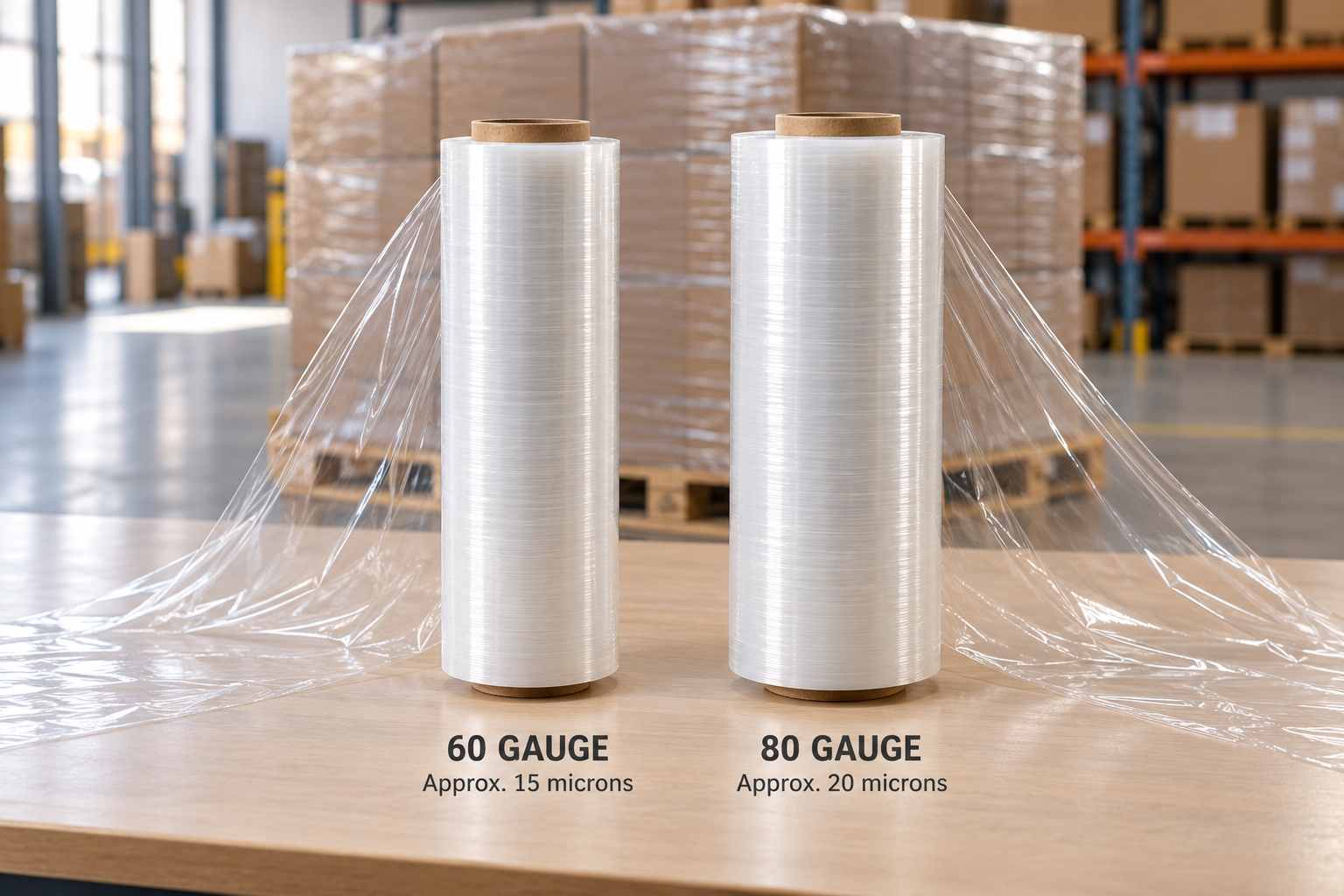
Quick answer
- 80 gauge is the safe default for most mixed carton pallets, roughly 800 to 2,000 lb, wrapped by hand or on a turntable wrapper.
- 60 gauge works for light, square, stable pallets under about 900 lb on short trips, or on machines with powered pre-stretch.
- 70 gauge is the middle option when 60 feels too thin and 80 feels like more film than you need.
- 90 to 120 gauge, or a high-performance film, is for heavy pallets over 2,000 lb, sharp edges, and rough or long export routes.
Weight is only the starting point. The right gauge is the thinnest film that passes a trial on your own pallets.
What Is the Difference Between 60 and 80 Gauge Stretch Wrap?
80 gauge stretch wrap is about 20 microns (0.8 mil) thick, and 60 gauge stretch wrap is about 15 microns (0.6 mil). 60 gauge is 25% thinner, costs less per roll and runs about 33% further per kilogram. 80 gauge has more puncture and tear margin, so it suits heavier pallets, hand wrapping and rougher transport.
| 60 gauge | 70 gauge | 80 gauge | |
|---|---|---|---|
| Thickness | approx. 15 µm / 0.60 mil | approx. 18 µm / 0.70 mil | approx. 20 µm / 0.80 mil |
| Net film weight, 18 in × 1,500 ft hand roll | approx. 2.9 kg (6.5 lb) | approx. 3.4 kg (7.5 lb) | approx. 3.9 kg (8.6 lb) |
| Film length per kg (same width) | longest | middle | shortest (60 gauge runs about 33% longer) |
| Puncture and tear margin | lowest | medium | highest of the three |
| Typical starting load range | light, stable pallets, about 500–900 lb | medium carton pallets | general warehouse pallets, about 800–2,000 lb |
| Hand wrapping | light loads only | good for medium loads | one of the most common US hand rolls |
| Machine wrapping | best with powered pre-stretch | common on turntables and pre-stretch lines | safe choice on turntables without powered pre-stretch |
| Price per roll | lowest | middle | highest |
Roll weights are calculated for true-gauge cast film. Our stretch wrap sizes guide lists weights for other standard roll sizes.
One thing the table cannot show: the cheapest roll is not always the cheapest pallet. The cost section below explains why.
What Gauge Stretch Wrap Do I Need for My Pallet Weight?
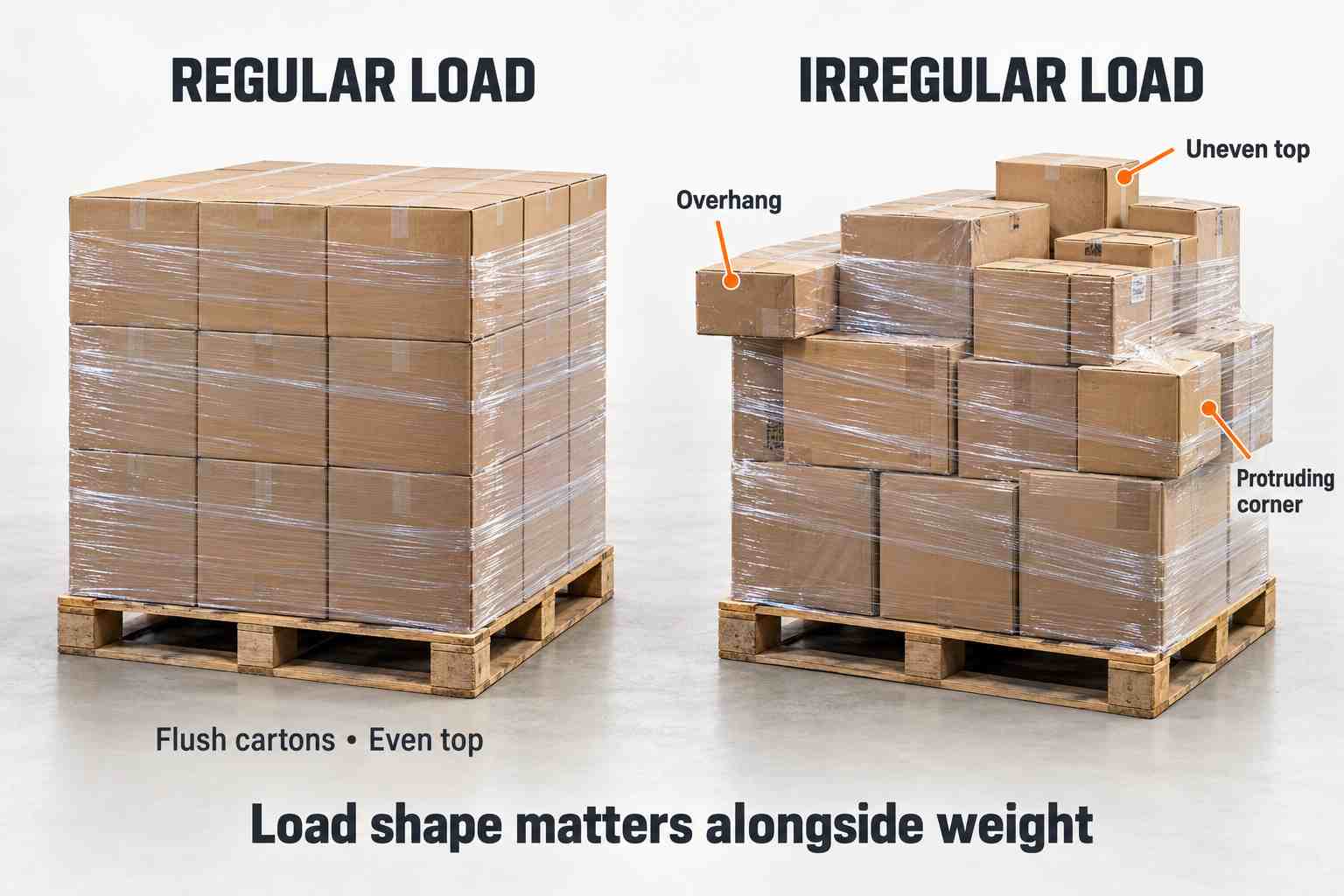
Use 60 gauge stretch wrap for stable pallets under about 900 lb, 80 gauge for mixed carton pallets of about 800 to 2,000 lb, and 90 to 120 gauge or a high-puncture film for pallets over 2,000 lb. Sharp edges, bags, liquids and tall stacks move you up a gauge. Square, evenly weighted cartons can move you down one.
- Under about 900 lb, stable cartons: 60 gauge is worth testing.
- About 800 to 2,000 lb, mixed cartons: start with 80 gauge. 70 gauge is worth a trial on the lighter, more regular end of this range.
- Over 2,000 lb: look at 90 to 120 gauge or a high-puncture film, not 60 or 80.
These ranges overlap on purpose, and the full table from 37 to 150 gauge is in the thickness guide. Within a range, the shape of the load usually decides which side you land on.
Move up a gauge when the load has:
- sharp corners, metal edges or protrusions, especially without corner boards;
- bags, sacks or other soft products that settle and loosen the wrap;
- bottles, cans or liquids that shift as a block (see stretch film for beverage pallets);
- an overhang, a tall or narrow stack, or an uneven top (fix the pallet stacking pattern first where you can);
- product that is valuable or expensive to reship.
You can often go down a gauge when the load is:
- square, flush cartons with smooth faces;
- evenly weighted, with no overhang;
- wrapped for storage or a short local delivery.
For pallets that are heavy, irregular or both, our guide to heavy-duty stretch wrap goes further than 60 or 80 gauge.
Should I Use 60 or 80 Gauge for Hand Wrapping or Machine Wrapping?
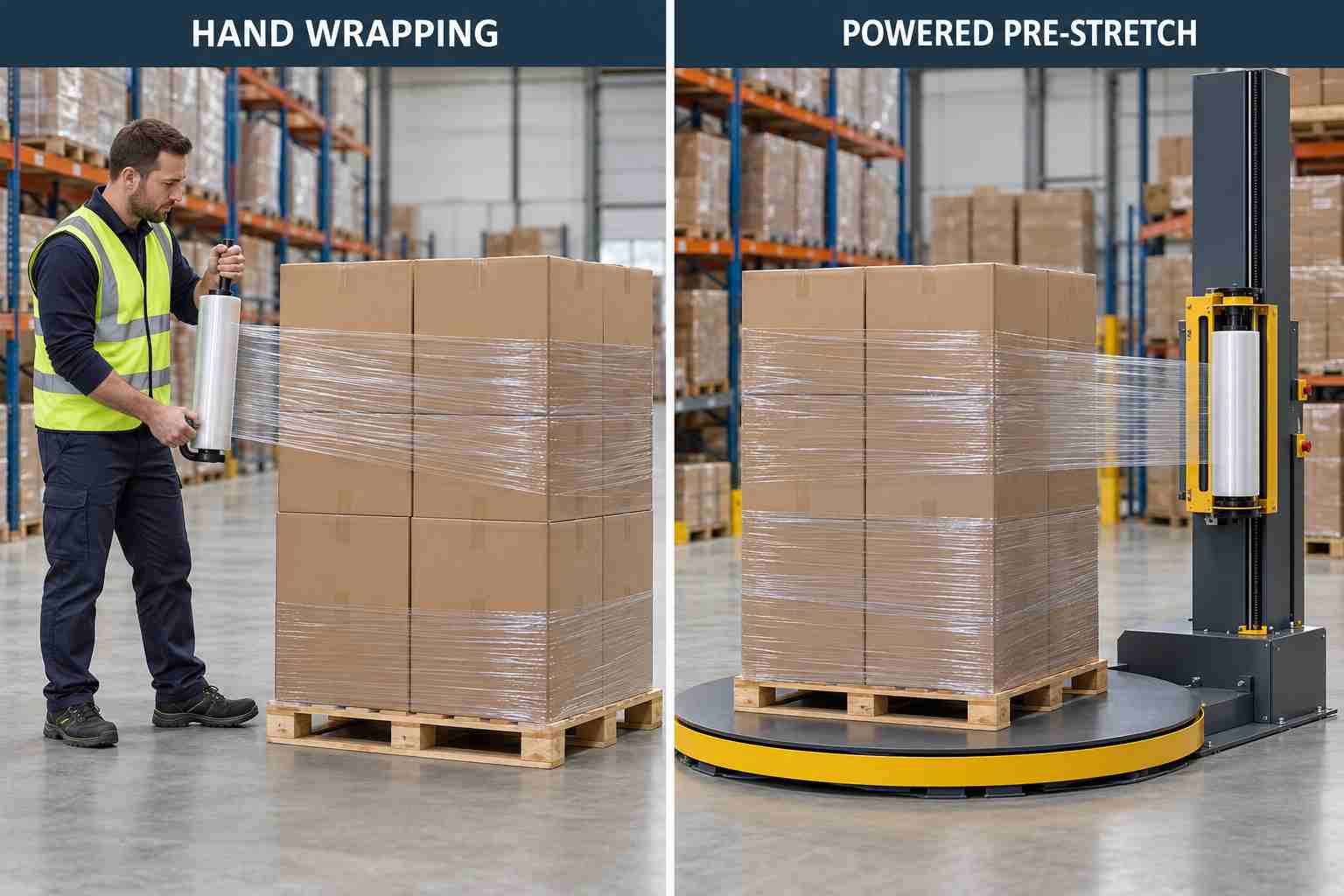
Hand wrapping usually needs 80 gauge stretch wrap, because a person cannot stretch film far or evenly. Machine wrapping can run thinner film: 70 to 80 gauge on a turntable without powered pre-stretch, and 60 to 70 gauge or a thin high-performance film on a powered pre-stretch carriage running at 200% to 300%.
Hand wrapping
A person pulling a roll around a pallet cannot stretch the film very far, and the tension changes from one wrap to the next. A thicker film is more forgiving of that. This is why 80 gauge is one of the most common hand rolls in the US: it tolerates uneven pulling, corners and a rushed operator.
60 gauge hand film works on light, regular pallets. On anything heavier, operators tend to add extra wraps to feel safe, and that erases the saving. If you want thinner hand film without losing holding force, look at pre-stretched hand film, which is stretched at the factory so the operator does not have to. Our comparison of pre-stretch vs standard stretch film explains the trade-off, and machine vs hand stretch film covers when it is time to move off hand wrapping.
Machine wrapping
A wrapper applies the same tension every time, so it can usually run a thinner film than a person can. How much thinner depends on the carriage:
- Turntable without powered pre-stretch (brake or friction tension only): the film is stretched much less, so 70 to 80 gauge is the safer choice.
- Powered pre-stretch carriage, typically 200% to 300%: the machine stretches the film before it reaches the pallet, so 60 to 70 gauge, or a thin high-performance grade, is often enough for regular carton loads.
Before you go thinner on a machine, check that the film is rated for the pre-stretch your carriage runs. A film that cannot reach the machine’s setting will neck down or break, whatever its gauge. Our article on power pre-stretch vs pre-stretched film explains the difference, and the machine stretch film guide covers matching film to equipment.
Does Shipping Distance Change the Stretch Wrap Gauge I Need?
Yes. The more often a pallet is handled and the longer it travels, the thicker the stretch wrap should be. Warehouse storage and local delivery can use thinner film, LTL freight usually needs one gauge more, and export pallets in sea containers should start at 80 gauge or above and be confirmed by a trial.
Two pallets of the same weight can need different films because of what happens after wrapping. Every forklift move, truck stop and transfer works the film.
- Storage in your own warehouse, or a local delivery: low risk. Go thinner if the load allows it.
- Full truckload, dock to dock: moderate risk. Stay in the middle of your load’s range.
- LTL or parcel freight networks: pallets are handled many times, cross-docked and stacked next to other freight. Go a gauge thicker or add wraps at the base.
- Export by sea container: weeks in transit, temperature and humidity swings, and several handling points at both ends. Start at 80 gauge or above and decide by trial.
- Cold storage or freezers: film behaves differently at low temperature. See stretch film for cold storage before you choose.
Which Stretch Wrap Gauge Should I Use? A Quick Decision Table
For most buyers the answer is 80 gauge for mixed carton pallets, 60 to 70 gauge for light, regular loads or powered pre-stretch machines, and 90 gauge or more for heavy, sharp-edged or export pallets. Find your situation in the table for a starting gauge to trial.
| Your situation | Starting gauge | Why |
|---|---|---|
| Light, square cartons under 900 lb, hand wrapped, local delivery | 60 | Low load, low risk; extra thickness is wasted film |
| Light, square cartons, powered pre-stretch wrapper | 60–70 | The machine supplies the stretch and the holding force |
| Mixed cartons, 900–1,500 lb, turntable without pre-stretch | 70–80 | More thickness makes up for the low stretch |
| Mixed cartons, 800–2,000 lb, hand wrapped, LTL freight | 80 | Tolerates uneven pulling and repeated handling |
| Beverage, bottled water or canned goods | 80 or higher | Heavy and prone to shifting as a block |
| Bags or sacks (feed, resin, building materials) | 80 or higher | Loads settle and loosen the wrap |
| Over 2,000 lb, sharp edges, metal parts | 90–120 or high-puncture film | 60 and 80 gauge are too easy to puncture |
| Export pallets in sea containers | 80 and above, set by trial | Long transit and many handling points |
Treat the table as a starting point for a trial, not as a guarantee. Film formulation matters as much as thickness: a well-made 70 gauge film can outperform a poorly made 80 gauge film.
Is 60 Gauge Stretch Wrap Cheaper Than 80 Gauge?
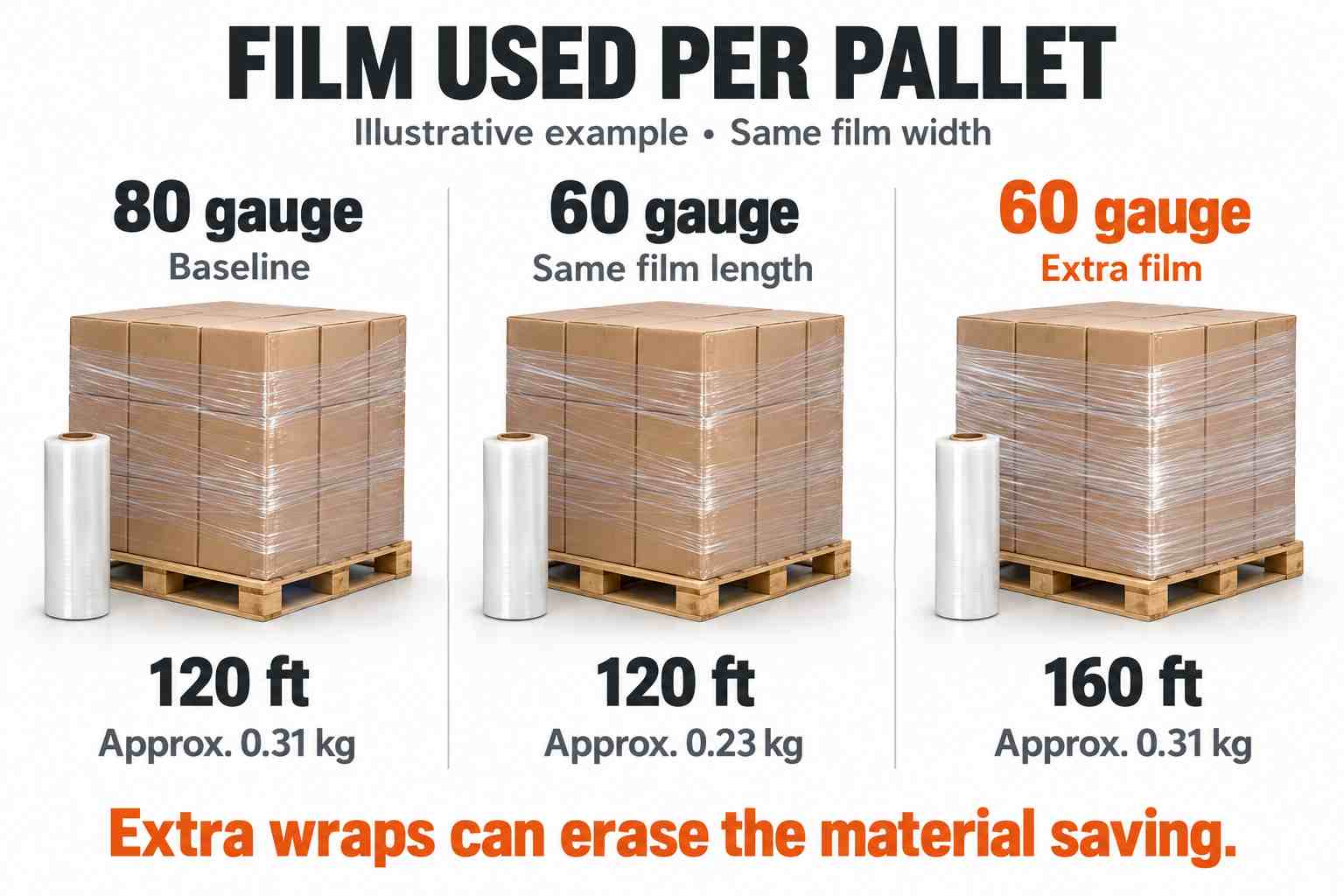
60 gauge stretch wrap uses about 25% less film per roll than 80 gauge, so it is cheaper per roll. It is only cheaper per pallet if it holds the load with the same number of wraps. If operators need about a third more film to feel safe, the saving disappears.
Here is an illustrative example for a hand-wrapped pallet using an 18 in × 1,500 ft roll:
| 80 gauge | 60 gauge, same wraps | 60 gauge, extra wraps | |
|---|---|---|---|
| Film used per pallet | 120 ft | 120 ft | 160 ft |
| Film weight per pallet | approx. 0.31 kg | approx. 0.23 kg | approx. 0.31 kg |
| Pallets per roll | approx. 12 | approx. 12 | approx. 9 |
| Film saving vs 80 gauge | — | about 25% | none |
If 60 gauge holds your load with the same number of wraps, you save about a quarter of the film. If it needs extra wraps, the saving is gone and you are also changing rolls more often. Add the cost of film breaks, rewrapping and damaged loads, and the thinner film can end up costing more.
So compare film weight and cost per pallet, not price per roll. Our guide to calculating stretch film usage and cost per pallet shows how to measure it on your own line.
Is 70 Gauge Stretch Wrap a Good Middle Option?
Yes, for medium carton pallets where 80 gauge already holds the load with margin to spare. 70 gauge stretch wrap is about 18 microns thick and uses about 12% less film than 80 gauge at the same number of wraps, which makes it a lower-risk first step than going straight to 60 gauge.
European buyers will recognise 70 gauge as roughly the common 17 to 18 micron grade. On US quotes it is less common than 60 or 80 gauge, so ask your supplier for it by name if you want to trial it.
What Does “80 Gauge Equivalent” Stretch Wrap Mean?
“80 gauge equivalent” stretch wrap is physically thinner than 80 gauge, but is claimed to perform like it. These high-performance films use better resins or a multilayer structure to make up for the lower thickness. The label is a performance claim, not a measurement, so ask for the actual micron value, measured to a standard such as ASTM D6988 or ISO 4593, and test the film on your loads.
Equivalent films can be a good way to cut film weight without dropping holding force. The thickness guide explains true gauge vs equivalent film in detail, and our stretch film quotes guide shows how an “equivalent” label can make two quotes look comparable when they aren’t.
How Do I Know If My Stretch Wrap Gauge Is Wrong?
Stretch wrap that is too thin tears at corners, breaks during wrapping and lets loads shift in transit, and operators start adding wraps on their own. Stretch wrap that is too thick is hard to stretch by hand, goes on loose, and uses more film without making loads any more stable.
Signs the film is too thin:
- the film tears at pallet corners or punctures on edges;
- the roll breaks during wrapping, or the machine film breaks at the carriage;
- loads lean or shift by the time they arrive;
- operators add extra wraps “to be safe” without being told to.
Signs the film is too thick:
- operators struggle to stretch hand film and leave it loose;
- film consumption is high but loads are no more stable than before;
- you are paying for thickness that never gets tested by the load.
If you are seeing breaks or loose wraps, the cause is not always the gauge. Our hand stretch film troubleshooting and machine stretch film troubleshooting guides cover tension, wrap pattern and roll problems, and containment force and pallet stability explains what actually holds a load together.
How Do I Test 60 vs 80 Gauge on My Own Pallets?
Wrap the same representative pallets with each gauge using identical settings, weigh the film used per pallet, record breaks and rewraps, and check how the loads arrive after a normal shipment. Switch to the thinner gauge only if it passes without extra wraps or extra damage.
- Pick representative pallets. Use your real product, weight and stacking pattern, including the awkward loads.
- Keep everything else the same. Same wrapper settings or operators, same number of wraps, same top and bottom reinforcement.
- Weigh the film. Weigh the roll before and after a set number of pallets to get film weight per pallet.
- Record what goes wrong. Note breaks, tears, rewraps and wrapping time.
- Check the loads at the other end. Look at how the pallets arrive after a normal shipment, not just how they look on the dock.
If the thinner film needs extra wraps, compare the cost per pallet before switching. The thickness guide has a full specification and trial checklist.
Is 80 gauge stretch wrap the same as 20 micron?
Close enough for buying. 80 gauge works out to 20.3 microns, or 0.8 mil, and is usually sold as 20 micron film in metric markets. Check whether the figure is true thickness or an “equivalent” rating.
Is 60 gauge stretch wrap strong enough for pallets?
For light, square, stable pallets, often yes, especially on a wrapper with powered pre-stretch. For heavy, sharp-edged or long-haul loads, 60 gauge usually needs so many extra wraps that 80 gauge or a high-performance film is the better buy.
What gauge stretch wrap do most warehouses use?
80 gauge is one of the most common general-purpose hand wraps in the US because it handles a wide range of pallets. Warehouses that wrap by machine with powered pre-stretch often run 60 to 70 gauge or a thinner high-performance film.
What gauge stretch wrap do I need for heavy pallets?
For pallets over about 2,000 lb, look at 90 to 120 gauge or a high-puncture film, and protect sharp corners with edge boards. See our guide to heavy-duty stretch wrap.
Is 70 gauge stretch wrap a good compromise?
Yes, for medium carton pallets where 80 gauge has plenty of margin. It uses about 12% less film than 80 gauge at the same wraps and is a lower-risk first step than going straight to 60.
Is 60 vs 80 gauge shrink wrap the same as stretch wrap?
No. Shrink wrap is a different product that is heated so it shrinks tight around the product, and its gauges are chosen differently. This guide covers stretch wrap only. See stretch wrap vs shrink wrap for how the two compare.
Get a Gauge Recommendation and Samples
Tuosheng Packaging manufactures hand stretch film and machine stretch film in Suzhou, China, from 15 to 50 microns (about 60 to 200 gauge). We produce standard US sizes such as 18 in × 1,500 ft hand rolls and 20 in × 5,000 ft machine rolls in 60 to 80 gauge, as well as European metric sizes.
Send us your pallet weight and dimensions, how you wrap, the film you use now and your shipping route, and we will recommend a gauge to trial. Samples are free: you usually pay the shipping cost up front, and it is deducted from your first bulk order.
Recommended Tuosheng Packaging Solution
Tuosheng Packaging manufactures hand stretch film and machine stretch film in Suzhou, China, with customizable thickness, width, roll length and export packing.