Pallet Stacking Patterns: Column vs Interlocking Before Stretch Wrapping
Pallet stacking patterns decide how cartons share the weight and how well the layers hold together before any film goes on. Column stacking keeps the most box strength, interlocking keeps the load most stable, and the stretch wrap has to make up for whatever the pattern leaves out.
At Tuosheng Packaging, we set the stacking pattern for each export pallet by product and roll weight, and we explain how we build them further down. This guide compares the four common patterns, what overhang and underhang do to a load, and how each choice changes the job your stretch wrap has to do.
Quick answer
- The four common pallet stacking patterns are column, interlock (brick or split-row), pinwheel, and a mixed stack with column layers at the base and interlocked layers on top.
- Column stacking keeps the most carton compression strength, but the layers barely lock together, so the stretch wrap carries more of the containment job.
- Interlocked stacking ties the layers together but can cut carton compression strength by about 35%–55%, according to studies reviewed in a 2017 Virginia Tech thesis.
- Cartons should sit flush with the pallet edge, because overhang weakens the boxes and is where stretch film tears first.
What Are the Main Pallet Stacking Patterns?
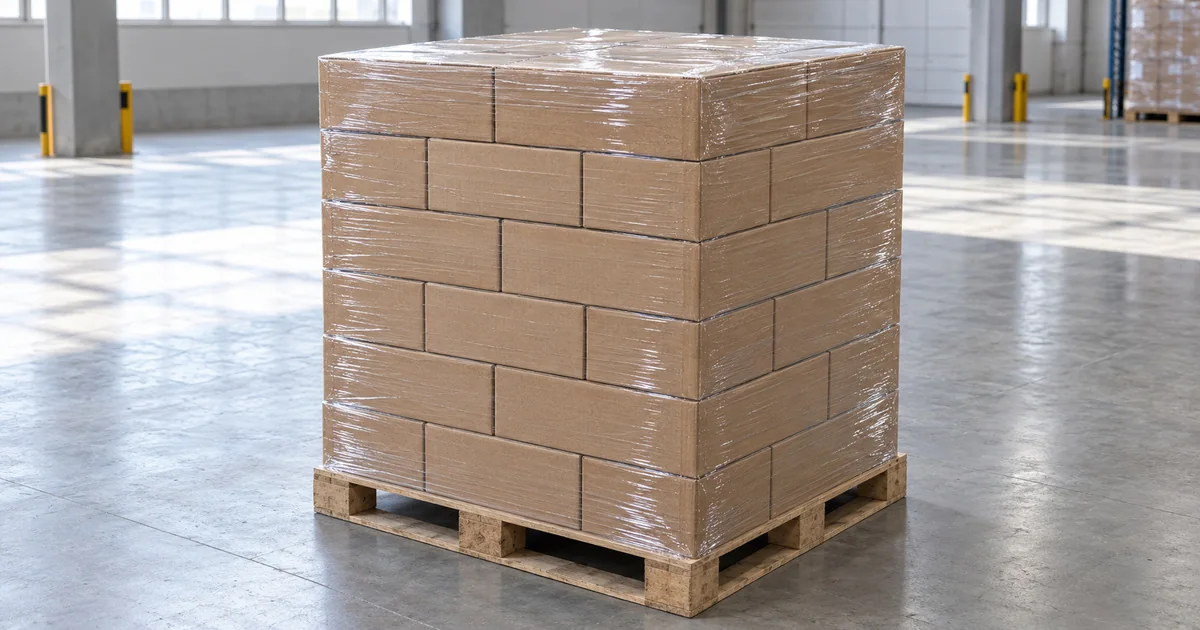
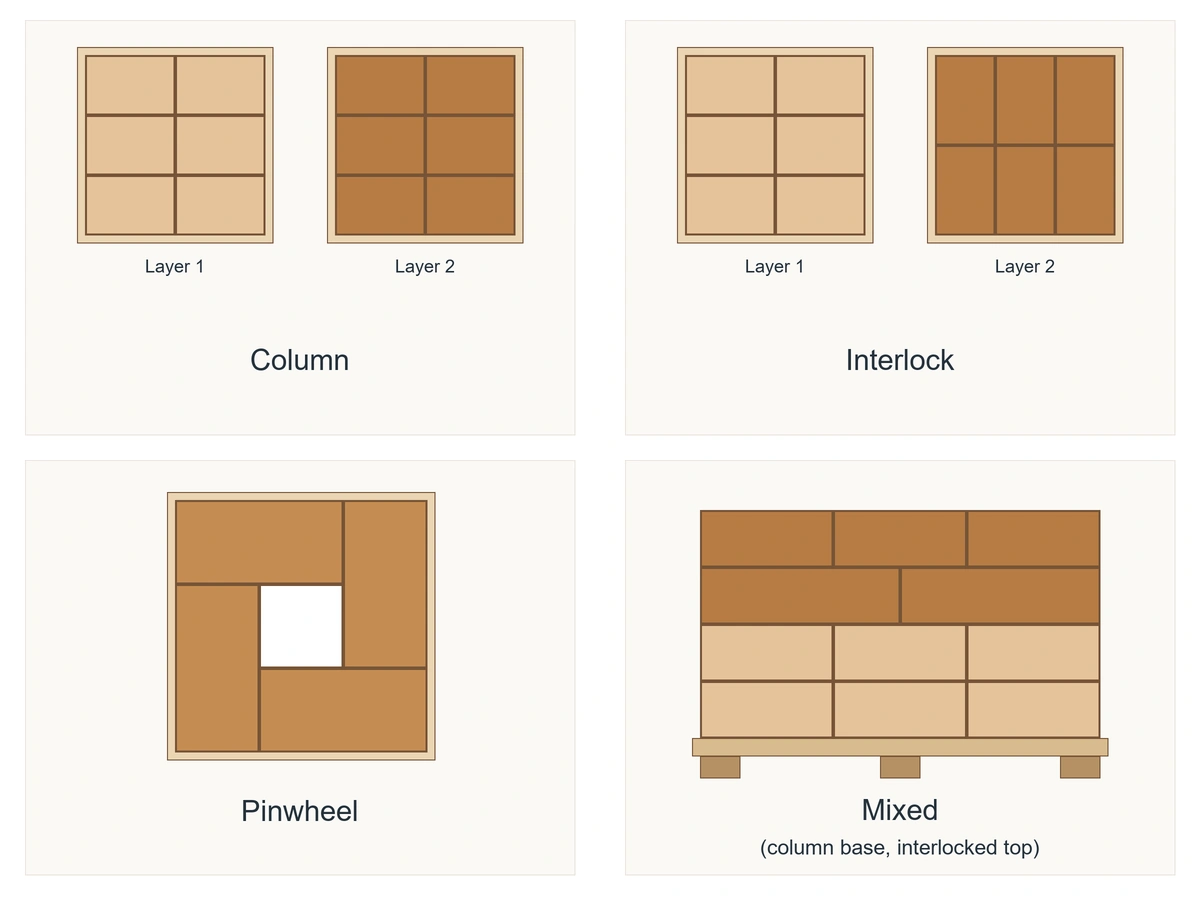
The main pallet stacking patterns are column, interlock, pinwheel and mixed. They differ in one thing: whether a box rests on a single box below it or bridges two or more.
A 2017 Virginia Tech thesis on unit loads by Eduardo Molina compared exactly these designs: a column stack, a split-row interlock, a pinwheel interlock, and two mixed stacks with column layers at the bottom and interlocked layers above.
| Pattern | How it’s built | Box strength | Load stability | What it means for the stretch wrap |
|---|---|---|---|---|
| Column | Each box sits directly on the box below, corners lined up | Highest | Lowest: the columns can split apart | The film has to hold separate columns together over the full height |
| Interlock (brick or split-row) | Each layer is turned or offset, so a box rests on two or more boxes below | Lower: weight moves from the corners onto the box walls | Higher: the layers lock together | The film mainly ties the load to the pallet and holds the top layer |
| Pinwheel | Boxes in each layer are turned around the pallet’s center, with the direction switched layer by layer | Lower, like interlock | High; works best on square footprints | Same as interlock; check for a gap in the center on some box sizes |
| Mixed (column base, interlocked top) | Lower layers are column-stacked, upper layers interlocked | Keeps strength where the weight is greatest | Better than a pure column stack | Watch the layer where the pattern changes; base wraps still matter |
Is Column Stacking or Interlocking Better?
Column stacking is stronger and interlocking is more stable. The better choice depends on whether your loads tend to fail by crushing or by shifting.
The reason is the way a corrugated box carries weight. Most of the load goes down through the four corners. In a column stack the corners line up layer after layer, so each box works at close to full strength. Interlocking moves part of the load off the corners and onto the box walls, which are weaker. The studies reviewed in Molina’s thesis put the loss in box load capacity from interlocking at roughly 35% to 55%, depending on test conditions.
Interlocking pays that back in stability. In the same thesis, interlocked loads cut pallet bending by up to 53% compared with a column stack, with the biggest gain on low-stiffness pallets. Column stacks also leave straight seams running through the whole load. The column pattern tested there had seven such seams across the load, against one for the interlocked patterns, and a seam is where a stack splits in transit.
| If your load is… | Lean toward | Why |
|---|---|---|
| Light, uniform cartons, or boxes stacked close to their crush limit | Column | Keeps the corners lined up; the wrap holds the columns together |
| Heavy, dense product such as cans, bottles or rolls in cartons | Interlock | The layers lock together and resist shifting |
| Mixed carton sizes | Interlock, heaviest cartons at the bottom | Spreads the weight and avoids loose single columns |
| Heavy, with weak bottom boxes | Mixed: column base, interlocked top | Strength at the bottom, a tied-together top |
| Double-stacked in storage | Check box strength first; column is the safer start | The bottom boxes carry the pallet above as well |
Drinks are the classic shifting load, since whole layers can slide as a block; our guide to stretch film for beverage pallets covers that case. And whichever pattern you pick, the load still needs stretch wrap.
How Does the Stacking Pattern Change the Way You Stretch Wrap?
A column-stacked pallet needs the film to hold separate columns together over the full height of the load. An interlocked pallet needs the film mainly to lock the load to the pallet and hold the top layer in place.
- Column stacks: containment has to reach the middle of the load, where columns bulge apart, not just the top and base. Keep the overlap even so no band of the stack is left with fewer layers. Our guide to containment force covers setting top, middle and bottom targets.
- Interlocked stacks: the base wraps that tie the bottom layer to the pallet deck do most of the work, along with a firm top. The steps are in our guide to how to stretch wrap a pallet.
- Unstable stacks: fix the stack before you change the film. Thicker film is for loads that stay heavy or irregular after they are stacked well; our 60 vs 80 gauge and heavy-duty stretch wrap guides cover those choices.
The outer face of the stack matters as much as the pattern. Cartons that sit flush give the film an even surface to grip. A carton that sticks out or sits back takes the film’s pull on one corner, and that corner is where the web is most likely to split. Machine stretch film troubleshooting lists the other causes to rule out when film keeps breaking.
What Are Pallet Overhang and Underhang?
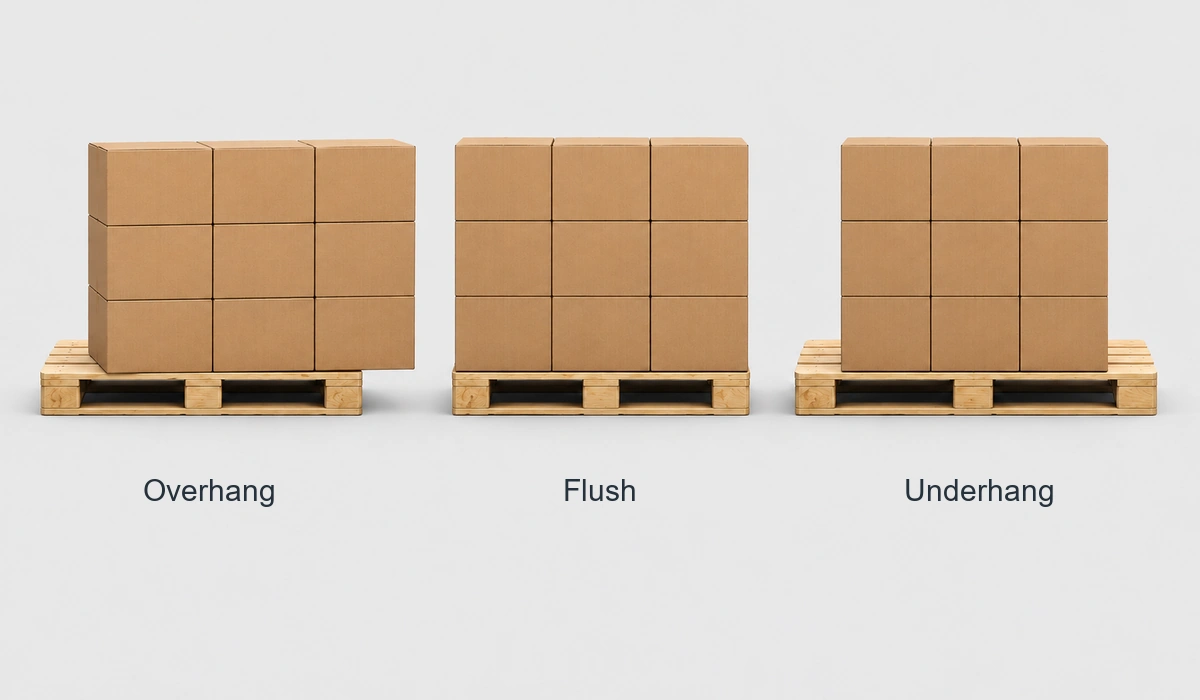
Pallet overhang and underhang describe how the load’s footprint compares with the pallet deck. Overhang is the one that costs box strength.
What is pallet overhang?
Pallet overhang is when cartons extend past the edge of the pallet deck, so part of each bottom box has nothing under it.
What is pallet underhang?
Pallet underhang is when the load sits inside the pallet edge, leaving a strip of exposed deck around the stack.
Small overhangs count. Researchers at Virginia Tech’s Center for Packaging and Unit Load Design tested this for the Fibre Box Association. A 1-inch overhang on one side cut a single box’s effective compression strength by 3.79% to 19.27%. With 1 inch over two adjacent sides, the loss rose to 21.60% to 37.85%, because the box lost support under three corners instead of two. Across all the setups tested, losses reached about 40%. The project’s 2024 follow-up report found that box height and ECT grade made no significant difference to the loss. What mattered was how far the box overhung and on which sides.
Retailers treat overhang as a defect too. Walmart’s supplier packaging standards define a pallet overhang defect as freight that exceeds the footprint of the pallet.
For the stretch wrap, an overhanging carton corner is where the film’s force concentrates, which makes it a likely tear point. The film also has a weaker hold between the load and the pallet when the bottom layer doesn’t line up with the deck.
Underhang doesn’t weaken the boxes the same way, but a large one leaves a step between the load and the pallet that the base wraps have to bridge, and it wastes space in the truck or container.
The target is a flush fit: cartons in line with the pallet edge, never past it.
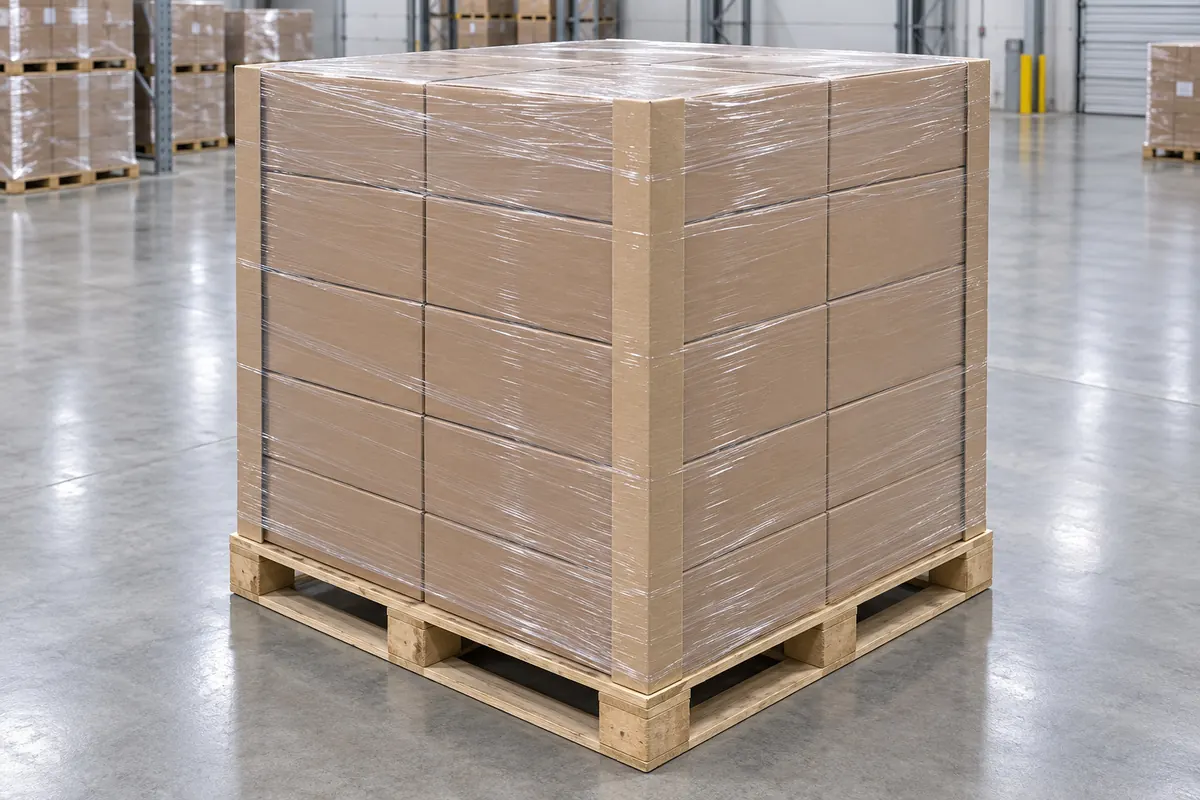
How Tuosheng Packaging builds export pallets At Tuosheng Packaging, there is no single stacking pattern for export pallets. The pattern and the number of layers depend on the product and on the weight of each roll, even for the same stretch film. Our cartons and pallets are sized to match, so a pallet packed to our standard has no overhang, and all four vertical corners are protected with corner posts. Roll and carton sizes are in our guide to stretch wrap sizes.
How Do You Build a Pallet Before Stretch Wrapping?
Build the pallet in this order before any film goes on: sound pallet, the right pattern, heavy cartons low, flush edges, flat top.
- Check the pallet for broken boards, missing blocks and protruding nails.
- Choose the pattern for the load, using the table above.
- Put the heaviest cartons on the bottom layer.
- Keep every layer flush with the pallet edge: no overhang and as little underhang as the carton size allows.
- Keep the top layer flat, and protect exposed vertical corners with corner boards.
- Wrap, starting with the base wraps that lock the load to the pallet. Our guide to how to stretch wrap a pallet has the full sequence.
Pallet Stacking Patterns FAQ
What is the best pallet stacking pattern?
No single pallet stacking pattern is best for every load. Column stacking suits light or weak cartons, interlocking suits heavy or mixed loads, and heavy loads on weak boxes can use a column base with interlocked layers on top.
Is column stacking stronger than interlocking?
Yes, column stacking is stronger, because the box corners stay lined up and carry the weight. Studies reviewed in a 2017 Virginia Tech thesis put the loss in box load capacity from interlocking at about 35%–55%.
How much overhang is acceptable on a pallet?
Aim for no overhang at all. A Virginia Tech study for the Fibre Box Association found that a 1-inch overhang on one side can cut a box’s compression strength by up to about 19%, and by up to about 38% when two adjacent sides overhang.
Does stretch wrap fix a badly stacked pallet?
No, stretch wrap can only contain what the stack allows. A loose column stack or an overhanging layer will still shift or tear the film, so fix the stack before you add wraps or move to thicker film.
What is a pinwheel stacking pattern?
A pinwheel stacking pattern turns the boxes in each layer around the center of the pallet and switches direction from one layer to the next, so each box rests on several boxes below.
Match the Stretch Film to the Pallets You Build
Tell us your pallet size, load weight, stacking pattern and whether you wrap by hand or by machine. We’ll recommend a hand stretch film or machine stretch film spec and send samples to test on your own loads.
Recommended Tuosheng Packaging Solution
Tuosheng Packaging manufactures hand stretch film and machine stretch film in Suzhou, China, with customizable thickness, width, roll length and export packing.