
Table of contents
Start machine stretch film troubleshooting with the symptom
Why machine stretch film breaks
Why stretch wrap has poor cling or unwinds irregularly
Why a wrapped pallet is still unstable
A step-by-step diagnostic isolation process
Prevent repeat failures and give the supplier useful evidence
When a wrapping line starts breaking film, leaving loose tails or sending unstable loads out to the warehouse, the film gets blamed first. Sometimes the film really is the problem. Just as often it turns out to be a nicked roll edge, a dirty pre-stretch carriage, a tension setting nobody wrote down, thin overlap, or a pallet profile that changed weeks ago and never got flagged.
Troubleshooting a wrapper is mostly a matter of isolating variables in the right order. Bumping up film thickness and adjusting four settings at once can make the symptom disappear without telling you anything about the cause, and it will come back. Find where the failure happens, look at the film and the carriage, write down the settings, then change one thing.
This guide covers film breaking on the machine, poor cling between layers, and unstable pallet loads. It applies to turntable, rotary-arm and other automatic or semi-automatic systems. For product selection, start with the Machine Stretch Film Complete Guide. Follow the wrapper manufacturer’s safety instructions before inspecting anything that moves.
Start machine stretch film troubleshooting with the symptom
Before you touch the wrapping program, write down what the operator can actually see. “The film is bad” is not a diagnosis. “The web tears at the same edge right after it leaves the pre-stretch rollers” gives you somewhere to start.
| Symptom | Likely areas to check first | Avoid doing first |
|---|---|---|
| Film breaks before reaching the pallet | Roll-edge damage, film threading, dirty or damaged carriage rollers | Increasing film thickness before you have looked at the machine |
| Film breaks at a carton corner | Force-to-load tension, sharp pallet corners, protrusions, film puncture resistance | Backing off every machine setting at once |
| Film becomes unusually narrow | Excessive payout tension, too much stretch for the film grade, roller slip | Adding revolutions instead of correcting neck-down |
| Applied layers do not cling | Wrong cling-side orientation, dust, condensation, cold film, not enough layer contact | Assuming every cast or blown film has the same cling design |
| Load is loose at the base | Weak film-to-pallet connection, thin base reinforcement, poor load placement | Adding only top wraps |
| Pallet leans or shifts in transit | Low containment force, thin overlap, wrong wrap pattern, unstable load construction | Treating total film weight as proof of load stability |
| Film use suddenly increases | Low effective pre-stretch, excessive overlap or reinforcement, neck-down, breaks and rewrapping | Comparing price per roll without measuring film per pallet |
One distinction prevents a lot of wrong adjustments: pre-stretch and force-to-load tension are not the same thing. Primary pre-stretch happens between the driven carriage rollers. Force-to-load, also called payout or secondary tension, acts between the carriage and the pallet. Film can pass through the rollers perfectly and still tear on the load because that second force is set too high. I have watched people chase this for a full shift.
Record both settings where the machine lets you. Add wrapper speed, carriage travel speed, film width before and after application, wrap count, load dimensions and the point where the failure happens. That baseline is what makes the next test worth running.
Why machine stretch film breaks
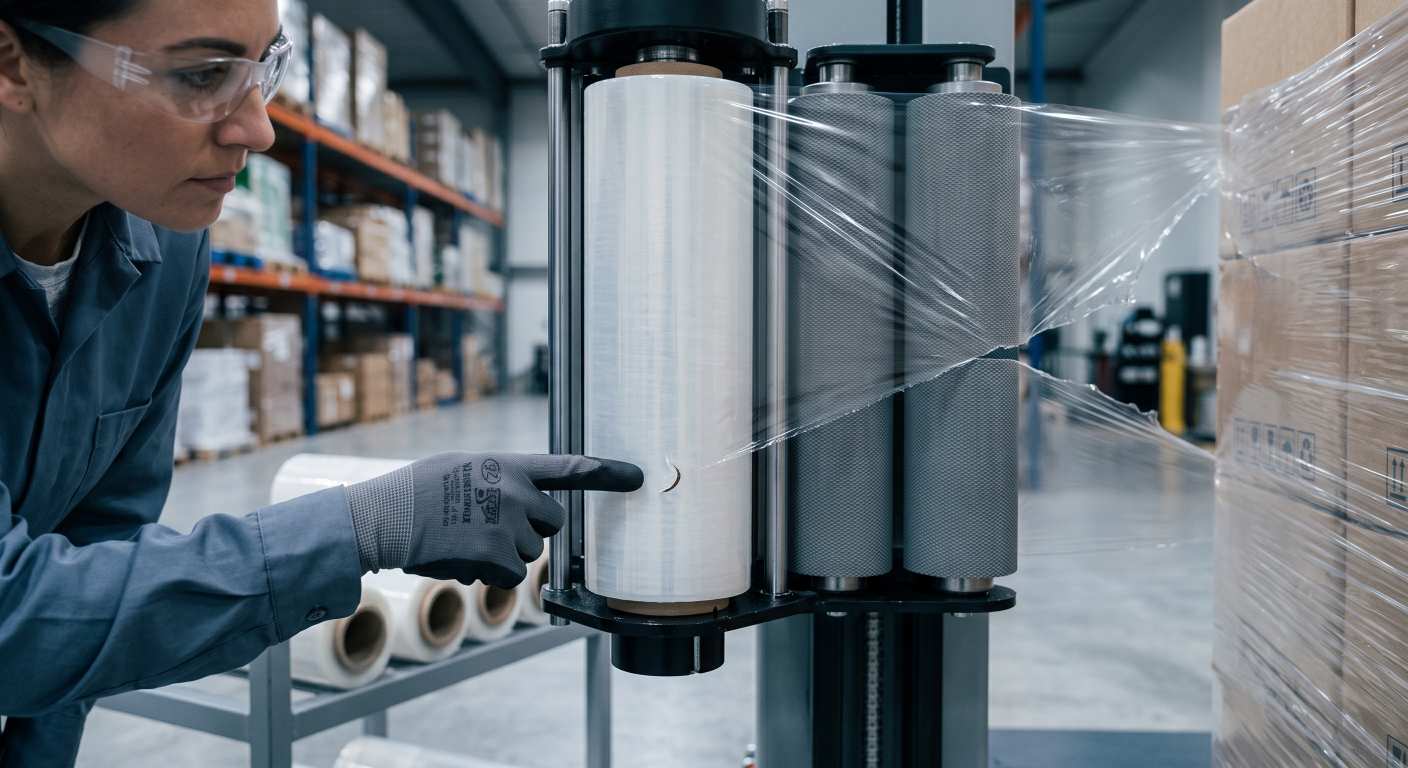
Breaks start in one of three places: the roll, the pre-stretch carriage or the load. Working out which one is far more useful than deciding straight away that the film is too thin.
Inspect the roll and pre-stretch carriage first
Start with the film roll while the machine is safely stopped. Look closely at both roll edges. A roll that has been dropped, dragged across a rough floor or knocked during handling can pick up a small nick that is almost invisible while the roll sits still. Under machine stretch, that nick is where the tear begins.
Swap the suspect roll for a known-good roll of the same specification. If the problem goes away, go back and inspect the original for edge damage, telescoping, an out-of-round shape or a crushed core. If several rolls break in the same position, the carriage is the more likely culprit.
Check that the film follows the correct threading path and that the rollers turn freely. Dust, adhesive residue and resin build-up all change the grip of a rubberized roller. A cut, a worn patch or a contaminated strip can make one part of the web stretch more than the rest, and you will usually see the stress line it leaves behind. Clean the rollers only with materials and procedures the machine manufacturer approves. The wrong solvent will ruin the roller surface.
Then look at roller alignment, nip pressure, bearings and whatever the machine uses for tension control. If a tear keeps starting on the same side, compare it against the matching roll edge and roller surface. A repeatable location almost always means a physical defect or an alignment problem, not a formulation problem.
Separate pre-stretch problems from load-side tension
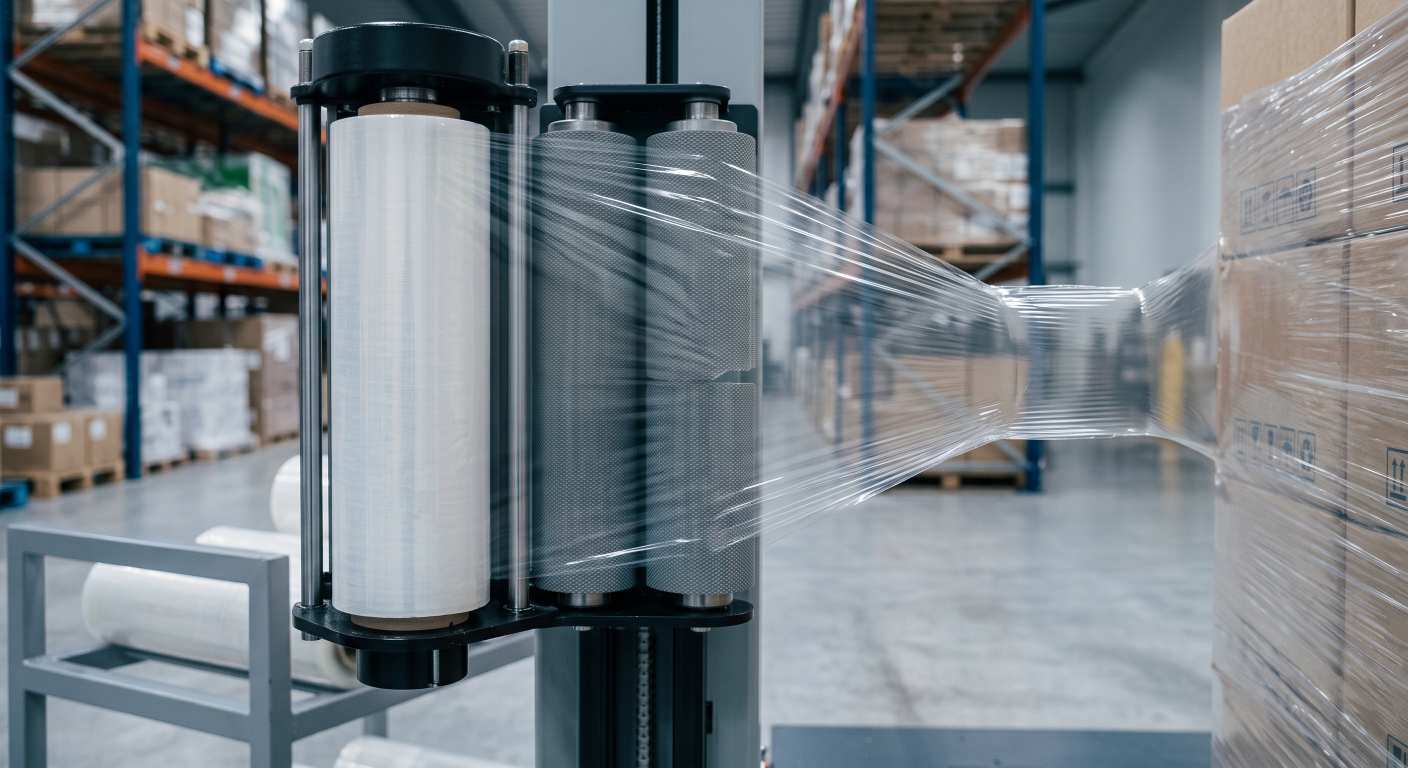
If the film leaves the carriage intact but breaks somewhere between the carriage and the pallet, reduce force-to-load tension in small steps and run the same load cycle again. Resist the urge to drop the primary pre-stretch ratio at the same time. One variable at a time is the only way to know which setting fixed it.
Watch the effective film width while you do this. Severe neck-down tells you the applied tension or stretch demand is probably too high for the film, especially if the web narrows sharply just before it touches the load. Excessive neck-down costs you coverage and pushes more stress onto carton corners. What you end up with is punctures, poor overlap and higher film use, all while the machine happily reports a high stretch setting.
Next, look at the pallet itself. Sharp pallet corners, protruding boards, exposed staples, crushed cartons and product overhang will puncture a film that runs fine on a uniform test load. Fix or protect the hazard before you reach for thicker film. Where sharp or irregular product is unavoidable, test a film grade with stronger puncture and tear resistance and consider corner protection. Blown film is often evaluated for demanding irregular loads, while cast film is frequently chosen for controlled stretch, clarity and quiet unwind. Actual performance still comes down to the formulation and the line conditions. The cast vs. blown stretch film guide covers the trade-offs.
Finally, confirm the film specification suits the wrapper. Thickness, resin blend, stretch capability, roll dimensions and winding consistency all matter here. A higher pre-stretch percentage is not automatically better, and thicker film will not fix a damaged roller or an aggressive force-to-load setting. For specification context, see the stretch film thickness guide.
Why stretch wrap has poor cling or unwinds irregularly

When layers separate or the film tail comes loose, work out first whether you are dealing with genuinely poor cling, not enough contact between layers, or a roll installed the wrong way round.
Check cling orientation, contact and storage conditions
Some machine films have differential cling: one side is designed to grip more than the other. Install or thread the roll backwards and the cling surface faces away from the previous layer. Confirm the correct unwind direction against the roll specification or with your supplier before you start changing machine settings.
Cling also needs clean surfaces and real contact. Carton dust, powder from bagged product, moisture, condensation and general warehouse debris all get between the layers. Check whether the issue hits every pallet or only the dusty, cold or moisture-exposed ones. A tail that fails only at the end of the cycle usually points to inadequate wipe-down or a cut-and-clamp issue rather than the film formulation.
Temperature history matters more than people expect. A cold roll behaves differently from one that has been sitting in the wrapping area. Compare rolls after they have reached the normal operating environment, and keep stored film out of direct sunlight, heat, moisture and harm’s way.
Treat cast vs. blown film cling as a formulation question
Cast vs. blown cling usually gets reduced to a claim that one process always clings better. That is not reliable enough to troubleshoot with. Cling can be one-sided or two-sided, and it is created through different layer designs and additive systems. The question worth asking is whether the grade you selected still delivers the cling you need after storage, stretching and application in your own environment.
If poor cling persists with the correct orientation and clean surfaces, compare an unopened roll from the same batch, then a verified roll from a different batch. Record the storage history and note whether the problem changes as the roll is consumed. Report blocking, unusual noise, layers that separate too easily, or cling that varies across the web. Those details give a supplier something to work with. “Not sticky” does not.
Do not try to compensate for weak cling with more tension. Extra force may press the layers together for a while, but it also brings neck-down, corner punctures and breaks. Sort out orientation and surface condition first, then confirm the film grade and the wrapping recipe actually match.
Why a wrapped pallet is still unstable

A pallet can look completely covered and still have nowhere near enough containment force. Coverage tells you where the film is. Containment force tells you how well that film holds the load together over time. Stability comes from the film, the applied tension, the wrap pattern and the way the load was built in the first place.
Check the base, overlap and wrap pattern
Start at the bottom. The film has to make a solid connection between the load and the pallet without sitting in forklift entry points or across sharp deck-board edges. Three or four controlled base revolutions is a reasonable place to start in many operations, but the right number has to be verified against the actual load and the distribution risk. Bottom roping (narrowing part of the web into a stronger band) can strengthen the film-to-pallet connection where the machine and load allow it. It is not a way to hide a damaged pallet or a badly built load.
Then check overlap. If the carriage travels too fast relative to turntable or rotary-arm speed, the web leaves gaps or lays down weak bands. Something around one-third to one-half of the film width is a common starting range, not a rule. What you actually need depends on load height, profile, film width, tension and your containment target. Marking the film edge or shooting slow-motion video will show you whether the programmed overlap is being achieved, which is not always the same as what the display says.
Look at the transitions between base, middle and top as well. Stable lower cartons tell you nothing about the top layer, and piling film around the middle can leave the base free to shift. A controlled wrap recipe puts reinforcement where the load needs it instead of spreading the same number of layers everywhere.
Match containment to the load profile
A working method that holds up on the floor is to sort loads by profile. Type A loads are regular and square, with smooth sides and little protrusion. Type B loads are moderately irregular: small projections, voids, mixed carton sizes. Type C loads are the difficult ones, with sharp points, severe overhang or product that can shift on its own.
Those labels help organise trials, but they do not hand you a machine setting. A heavy Type A load often wraps more predictably than a lighter Type C load. The more irregular the profile, the more weight falls on puncture resistance, reinforcement, corner protection and load preparation.
Measure containment at several heights rather than one convenient spot. Compare bottom, middle and top right after wrapping, then again once the film has had time to recover. After that, run a controlled handling or transport trial that reflects how the load actually travels. If the pallet still moves, work out whether the cause is low applied force, loss of holding force over time, thin reinforcement, or how the goods were stacked. The containment force and pallet stability guide goes deeper on this.
A step-by-step diagnostic isolation process
Use the same order every time. That is how you avoid mistaking a machine problem for a film problem.
- Make the equipment safe. Stop and isolate the wrapper per the manufacturer’s instructions before you touch the carriage, rollers or sensors.
- Define the symptom precisely. Where does the web break, which edge fails, does cling loss affect the whole load, which pallet layer moves.
- Photograph and keep the roll label. Record thickness, width, roll dimensions, batch information and storage history. Keep a section of the failed film when you can.
- Inspect the roll. Both edges, the core, winding shape, telescoping, and any sign of impact or compression.
- Inspect the film path and carriage. Confirm threading, roller condition, alignment, cleanliness and free movement, following the machine maker’s maintenance procedure.
- Run a known-good control roll, same specification where possible. If the failure stays in the same place, the machine or the load moves to the top of the list.
- Run a standard test pallet. Film that works on a uniform pallet but fails on production loads points you at protrusions, sharp edges, overhang and load construction.
- Record the active recipe: primary pre-stretch, force-to-load tension, wrapper speed, carriage speed, overlap, top and bottom revolutions, reinforcement settings.
- Change one variable at a time. Small adjustment, same pallet, record the result. Changing film, tension, speed and wrap count together tells you nothing.
- Verify the finished load. Measure film used per pallet, check containment at several heights, and look for breaks, holes, loose tails and movement.
For anything recurring, keep a log by film batch, machine, load type and shift. The pattern usually only shows up once you have several events to compare. Roll price on its own will never show you what line stops, wasted film and rewrapping actually cost. The stretch film usage and cost-per-pallet guide explains how to measure material used on each completed load.
Prevent repeat failures and give the supplier useful evidence
Once the immediate fault is fixed, save the recipe that worked by load family instead of running one program for every pallet. Protect roll edges in transport and storage, rotate inventory, keep the wrapping area clean, and put the carriage and sensors on the preventive maintenance schedule. When you change film thickness or grade, run a controlled line trial before that specification goes out across production.
A supplier request that actually gets you somewhere includes:
· wrapper type, model and pre-stretch carriage information;
· current film label, actual thickness, width, core and roll dimensions;
· primary pre-stretch and force-to-load settings;
· pallet dimensions, weight and load profile;
· photographs of the pallet before and after wrapping;
· a close-up of the roll edge and the point where the film fails;
· a short video of the failure when it can be recorded safely;
· film consumption per pallet and recent changes in the wrapping recipe;
· storage temperature and time between storage and use.
That evidence is what separates roll damage from machine condition, wrong settings and genuine film-specification limits. It also lets a supplier recommend a sample that fits the application instead of defaulting to thicker film.
Tuosheng Pack machine stretch film is available in different thicknesses, roll configurations and performance grades for automatic and semi-automatic pallet wrapping. If a line keeps breaking film, losing cling or shipping unstable loads, send the wrapper information, current roll specification, pallet details and failure photos to Tuosheng Pack. The team can review the application and suggest a film specification for a controlled production-line trial.
Need Help Choosing the Right Stretch Film?
Every packaging application has different requirements. Share your wrapping method, load type and specifications, and Tuosheng Pack can help recommend a suitable stretch film solution for your business.
Suggestions based on product type, wrapping method and performance needs.
Support for thickness, width, roll size, color and packaging requirements.
Working with distributors, wholesalers and industrial packaging buyers.
Recommended Tuosheng Pack Solution
For buyers looking for reliable stretch film solutions, Tuosheng Pack supplies hand stretch film, machine stretch film, pre-stretched film and specialty packaging films with customizable thickness, width, roll length and packaging options.
Hand Stretch Film
Flexible manual wrapping solution designed for warehouses, logistics and general pallet applications.
Learn More →
VCI Shrink Film
Specialty packaging film providing corrosion protection for metal products during storage and transportation.
Learn More →
Machine Stretch Film
High-performance film designed for automated pallet wrapping operations with consistent load stability.
Learn More →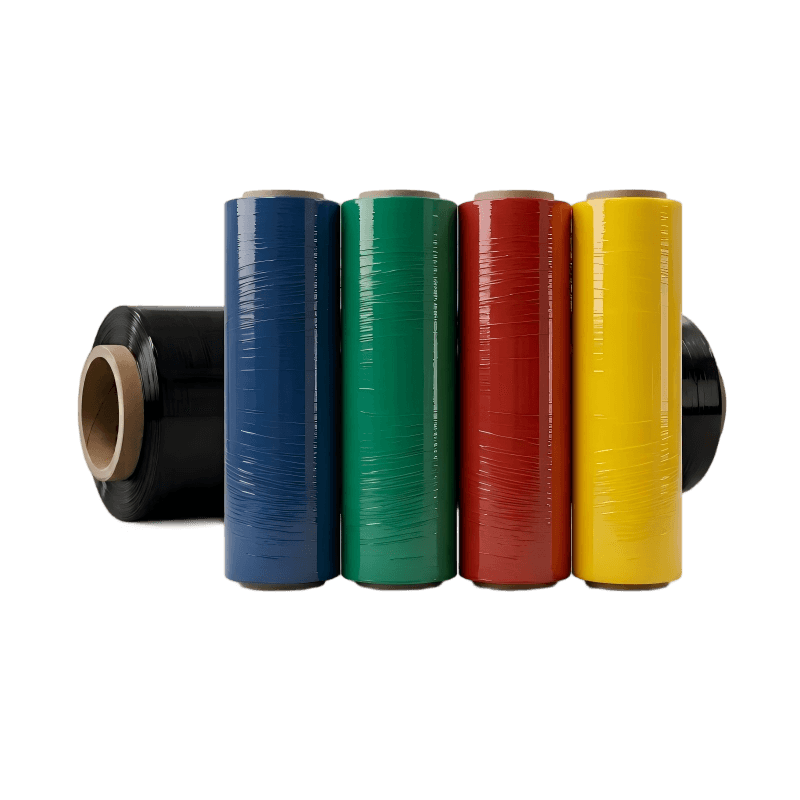
Colored Stretch Film
Custom color options for product identification, privacy protection and branded packaging needs.
Learn More →