Which Stretch Film Does Your Stretch Wrapper Need?
The right stretch wrapper film depends on the wrapper it runs on. Turntable, rotary arm, rotary ring, horizontal orbital and robot wrappers all pull film around a load under tension, and that’s where the similarity ends. A turntable turns the pallet at a steady 10 to 15 RPM. A ring wrapper on a high-speed line sends the film around the load at 40 RPM or more, then cuts and seals it by itself. Put the same roll on both and you can get a clean wrap on one and a jammed carriage on the other.
This guide matches the film to the machine: the thickness, roll format and pre-stretch each wrapper needs, and what goes wrong when film and machine don’t match. We’re Tuosheng Packaging, a stretch film manufacturer in Suzhou, China. We make film for all of these machines, but we don’t build or sell the machines.
Quick answer
- Turntable: standard cast film, 17–23 µm (about 70–90 gauge), on 20 in × 5,000–6,000 ft or 500 mm × 1,500 m rolls.
- Rotary arm: similar thickness, but the film must unwind smoothly at higher carriage speeds.
- Rotary ring or high-speed line: a high-stretch mLLDPE grade rated for 250–300% pre-stretch or more, with tight control of roll weight and diameter.
- Horizontal orbital: narrower rolls, with width and cling chosen for the product.
- Robot (self-propelled): standard machine rolls, as long as the roll weight suits the machine.
- Stretch hood: not stretch wrap at all. It uses a thicker tubular film on a dedicated hooding machine.
What Are the Main Types of Stretch Wrappers?
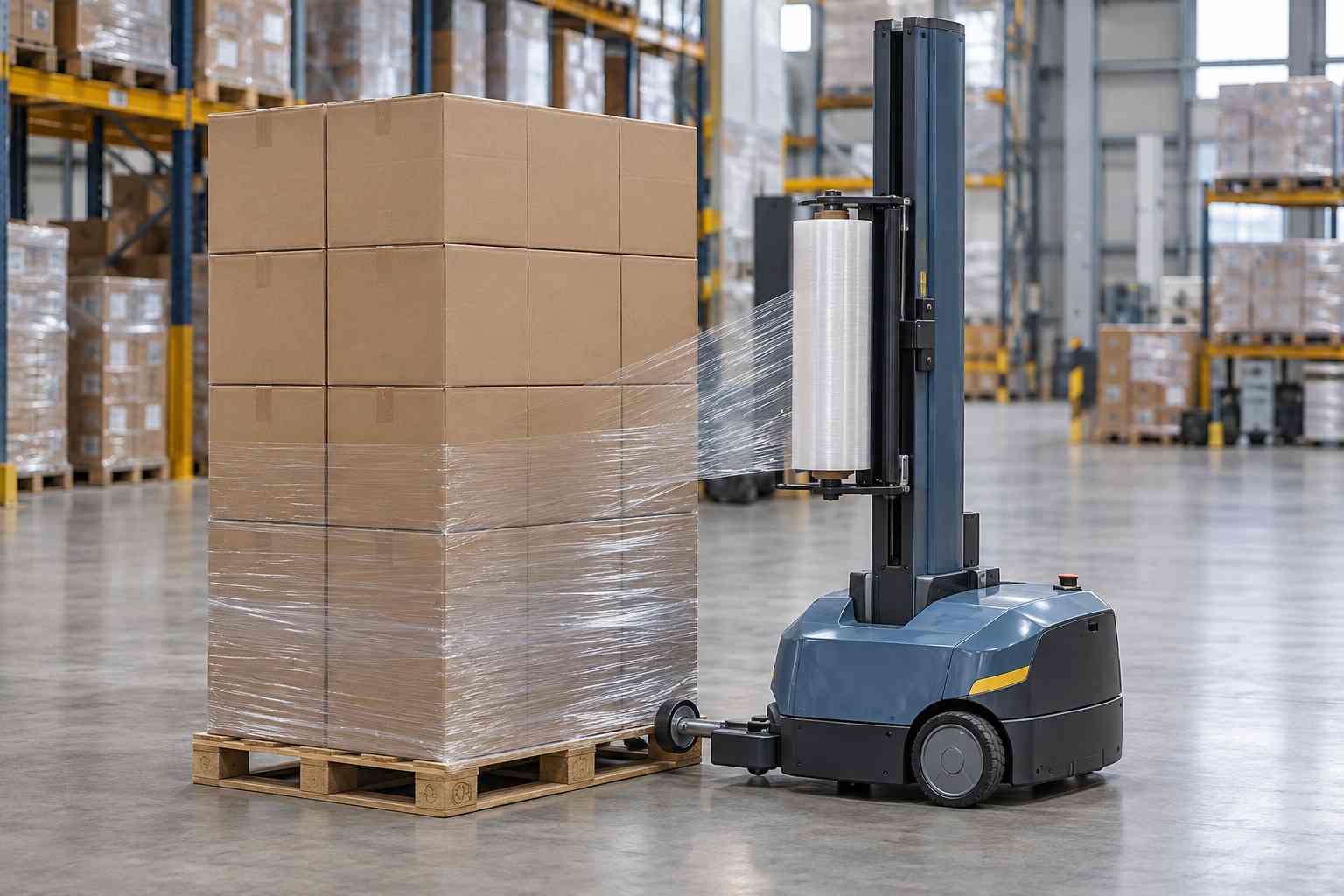
The five main types of stretch wrappers are turntable, rotary arm, rotary ring, horizontal orbital and mobile robot. The difference is what moves: on a turntable the pallet rotates, while on the others the film travels around a load that stays still or passes through the machine.
- Turntable: the pallet rotates on a powered table while the film carriage travels up and down a fixed mast. It is the most common type, at roughly 45% to 62% of semi-automatic stretch wrappers depending on the report (Emergen Research, 2024; Towards Packaging, 2025).
- Rotary arm: an overhead arm carries the film around a stationary pallet. It suits loads too unstable, or too heavy, to spin.
- Rotary ring: the film carriage rides on a ring around a stationary load, on automatic high-output lines.
- Horizontal orbital: a ring wraps long products such as profiles, pipes and boards as they pass through.
- Mobile robot: a self-propelled unit drives around the pallet wherever it stands, useful for oversized loads.
Common makers include Lantech, Wulftec, Robopac and Orion, and most build several of these types.
Each type can be semi-automatic, where an operator attaches and cuts the film, or automatic, where the machine clamps, cuts and seals the tail itself. On automatic machines the film’s cling and the way it cuts become part of the line’s uptime.
Which Stretch Film Fits Each Wrapper Type?
Most stretch wrappers run cast machine film between 17 and 23 microns (about 70 to 90 gauge). What changes from one type to the next is the pre-stretch the film must handle, the roll format, and how consistent each roll must be.
| Wrapper type | Typical film thickness | Typical pre-stretch | Roll format | Film grade | Check before ordering |
|---|---|---|---|---|---|
| Turntable, brake or friction tension | 18–23 µm (70–90 ga) | low; set by brake tension | 20 in × 5,000–6,000 ft; 500 mm × 1,500 m | standard cast | do not go too thin without powered pre-stretch |
| Turntable, powered pre-stretch | 15–20 µm (60–80 ga) | 200–250% | as above | standard or high-stretch cast | film rated for the carriage’s ratio |
| Rotary arm | 17–23 µm (70–90 ga) | 200–300% | as above | standard or high-stretch cast | maximum roll weight and diameter of the arm carriage |
| Rotary ring / high-speed line | 15–20 µm (60–80 ga), high-performance | 250–300%+ | as specified by the line | high-stretch mLLDPE | roll tolerance, cling side, cut and tail sealing |
| Horizontal orbital | set by the product | low to medium | narrow rolls, from 250 mm (10 in) at Tuosheng | cling and width matched to the product | width and core for the orbital head |
| Mobile robot | 17–23 µm (70–90 ga) | 200–250% on powered models | standard machine rolls | standard cast | maximum roll weight |
For heavy, uneven or sharp-edged loads on any machine, move to a 23–30 µm (about 90–120 gauge) high-puncture grade and protect corners with edge boards. Treat every number here as a starting point: the wrapper manual sets the roll limits, and a trial on your own line settles the rest.
What Stretch Film Does a Turntable Wrapper Need?
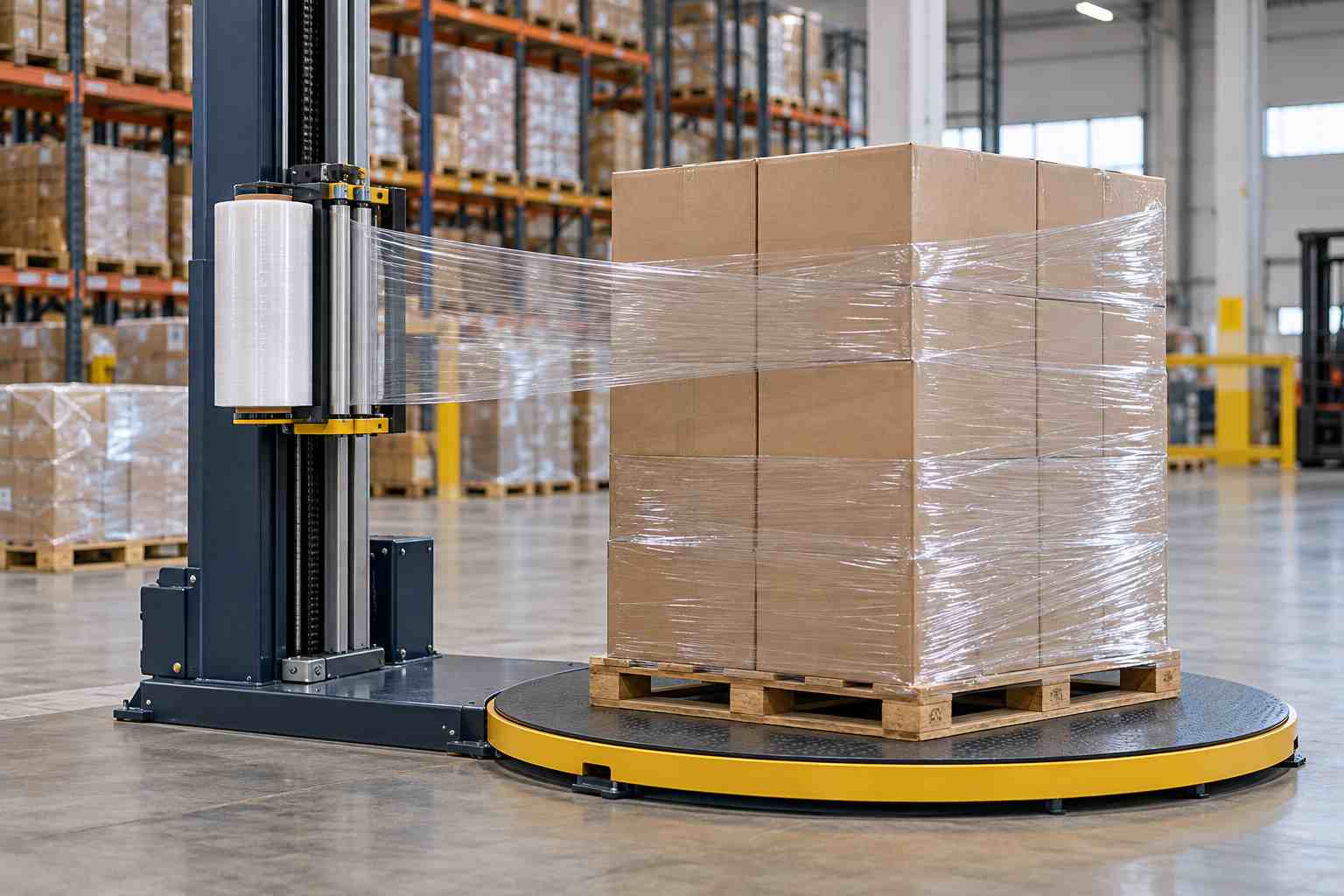
A turntable wrapper usually needs standard cast machine film of 17 to 23 microns (about 70 to 90 gauge). For most mixed carton pallets, 18 to 20 µm (70 to 80 gauge) works well, and light, regular loads on a powered pre-stretch carriage can often run 15 µm (60 gauge). See 60 vs 80 gauge stretch wrap for choosing between the two most common gauges.
Entry-level turntables use a brake or friction roller, which stretches the film only by pulling against the load. Powered pre-stretch carriages stretch it between two rollers first. Wrapper maker Lantech says machines can be set from about 100% to 300%, and most companies run 200% to 250%.
Common mistake: going thinner on a brake-tension turntable without a trial. With no powered pre-stretch, a thin film gets little help from the machine and tears at corners and tier sheets. Loading hand film because the width matches is a close second; see machine vs hand stretch film.
What Stretch Film Does a Rotary Arm Wrapper Need?
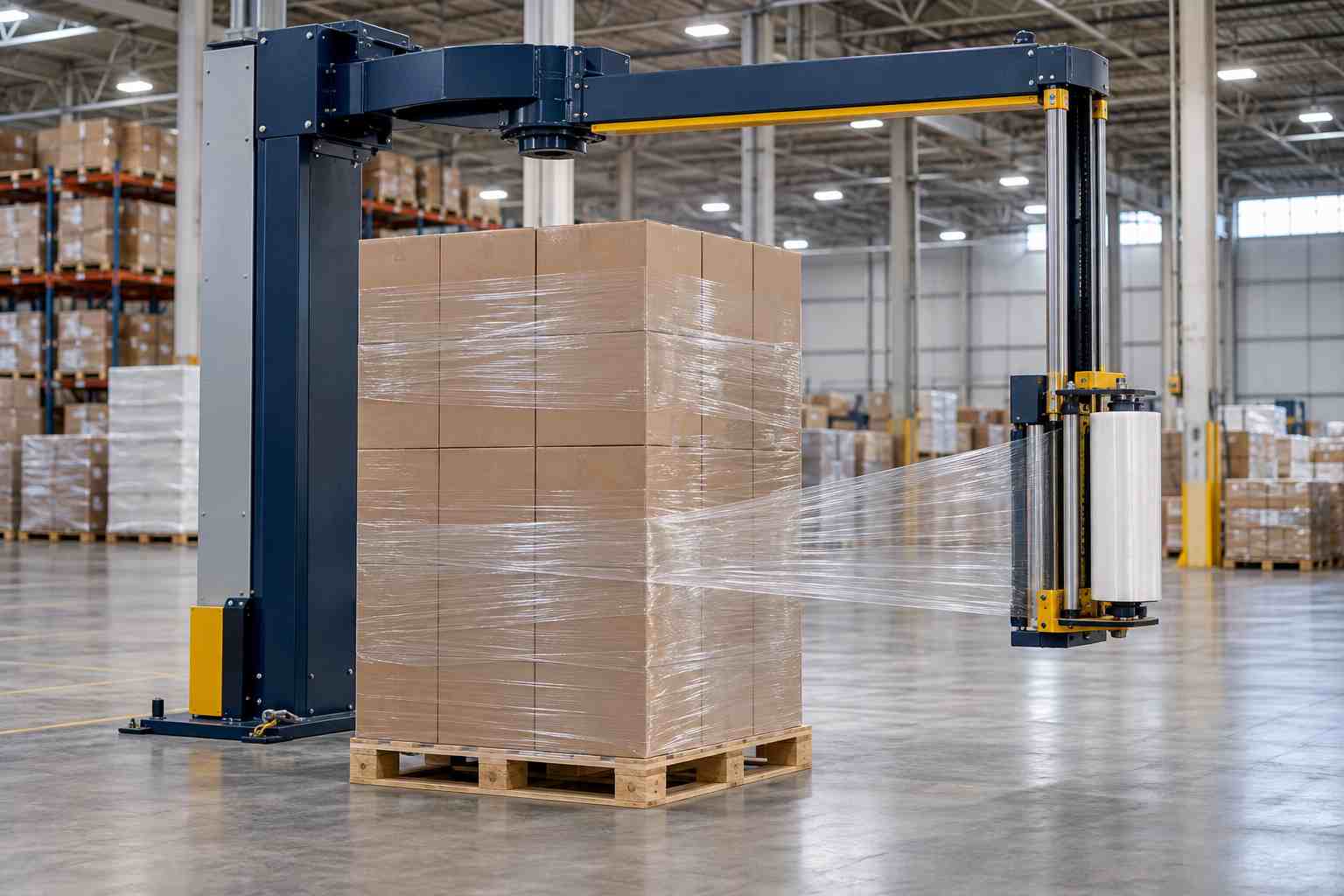
A rotary arm wrapper uses the same 17 to 23 micron range as a turntable, usually with powered pre-stretch at 200% to 300%. The difference is speed: the arm swings the film around the pallet at around 15 to 35 RPM, so the film must unwind smoothly and resist tearing as it changes direction at each corner. Check the maximum roll weight and diameter the arm carriage accepts before ordering longer rolls.
Common mistake: reaching for thinner film when a light, unstable load leans or crushes. The usual fix is a lower force-to-load setting, not a weaker film.
What Stretch Film Does a Rotary Ring Wrapper or High-Speed Line Need?
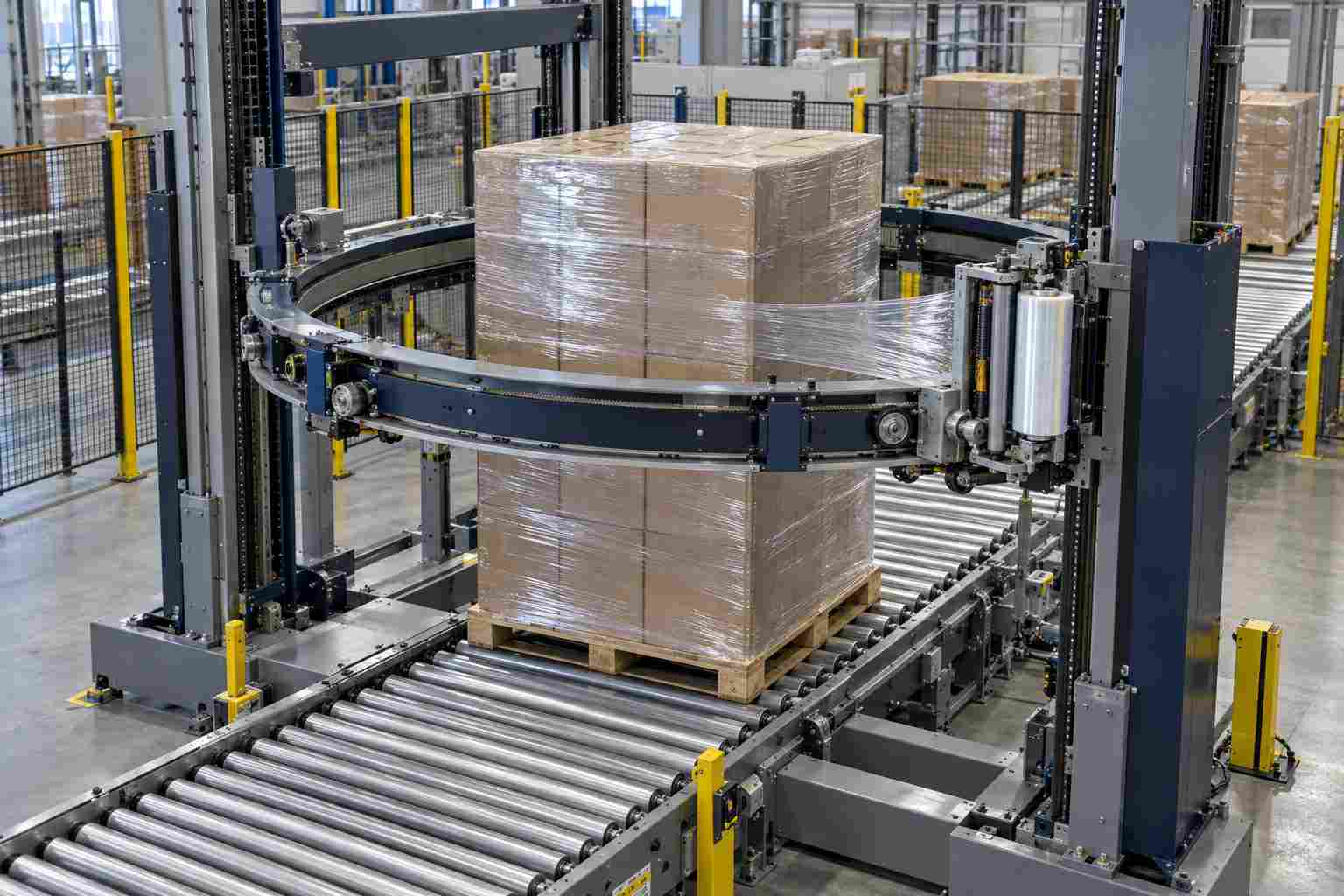
A rotary ring wrapper or high-speed automatic line needs a high-stretch mLLDPE film that runs reliably at 250% to 300% pre-stretch or more, on rolls with very consistent weight, diameter and winding. These lines change rolls, cut and seal the film automatically, so small variations in the roll turn straight into stoppages. Consistency matters more here than the gauge on the label. Our selected mLLDPE grades reach up to 400% pre-stretch.
Common mistake: approving a film on a semi-automatic machine and sending it straight to the automatic line. The automatic line also tests the cut, the clamp and the tail seal, which depend on the film’s cling and which side it faces. Trial on the line itself.
What Film Do Orbital and Robot Wrappers Use?
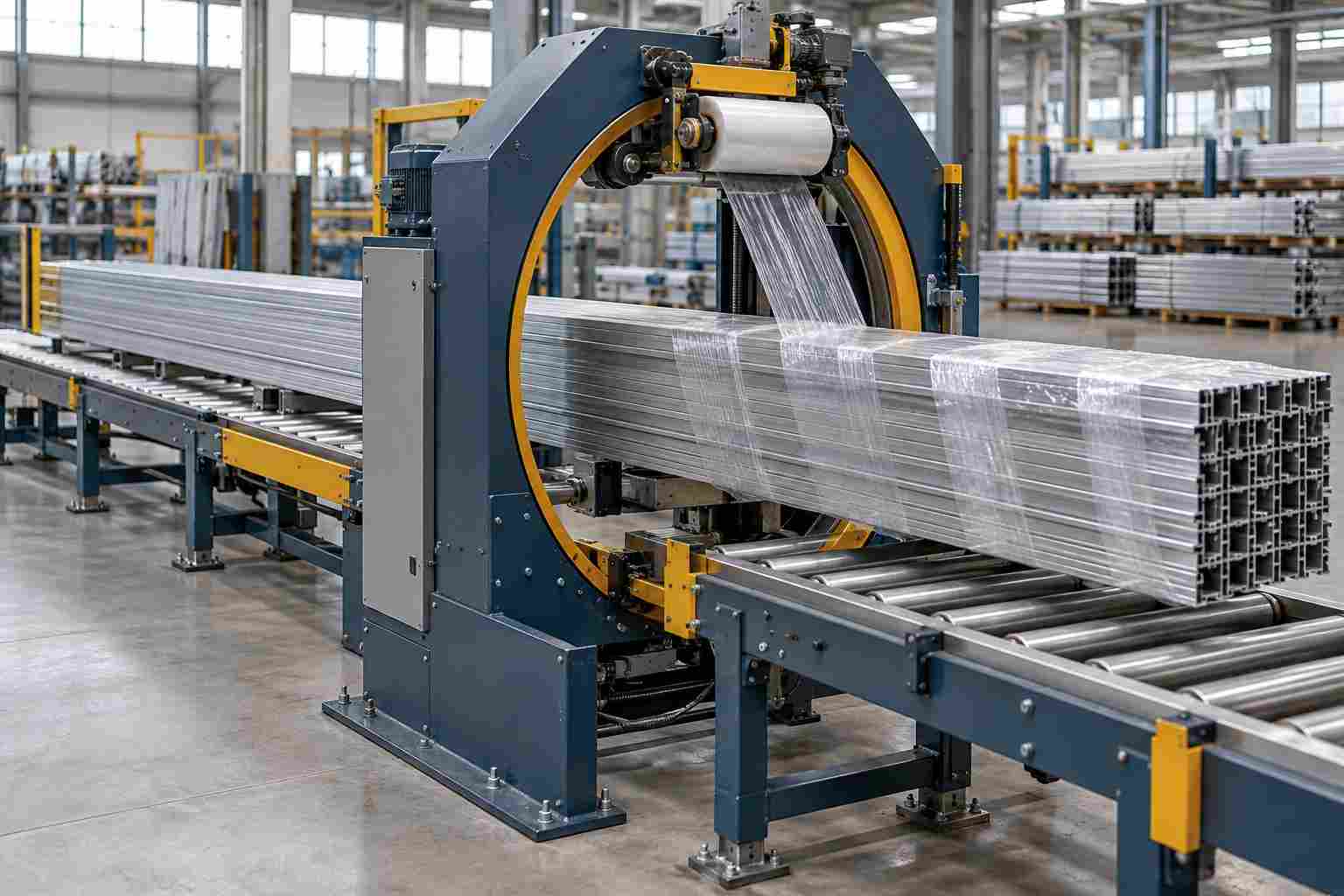
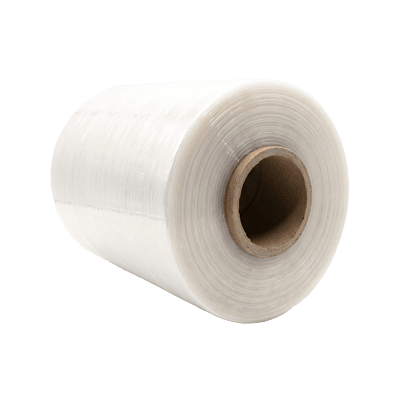
Horizontal orbital wrappers use narrower rolls than pallet wrappers, with width and cling chosen for the product’s cross-section. Tuosheng supplies orbital rolls from 250 mm (about 10 in) wide, with the same thickness range and 76 mm core as our machine film. For doors, panels and other furniture parts, see our guide to stretch wrap for furniture.
Robot wrappers don’t need special film. They run standard 500 mm (20 in) machine rolls. Because the robot carries the roll around the pallet, the limit to check is the roll weight and diameter it can take.
What Usually Goes Wrong When You Trial a New Film on a Wrapper?
Three problems come up most often when a new stretch film goes on a wrapper: breaks at pallet corners, film wrapping around the pre-stretch rollers, and cutting or tail failures on automatic lines. Most of them come from machine settings that were not adjusted for the new film, rather than from the film itself.
Breaks at corners and tier sheets. Maintenance technicians commonly report this after a switch to thinner, cheaper film, and Lantech estimates that load-profile hazards such as sharp corners cause about 27% of film breaks. Check whether force-to-load was lowered for the thinner film, and look for dented roll edges, which break at the same point every revolution.
Film wrapping around the rollers. Static and cling make the film rope up or stick to a pre-stretch roller. Technicians tell a familiar story: an operator clears the jam with a box cutter, the blade scores the roller, and the scored roller then grabs every film that follows, good or bad. Check roller condition before blaming the film, and consider an anti-static bar.
Cut and tail failures on automatic lines. The hot wire or blade doesn’t cut the new film cleanly, or the tail won’t stay down. Check that the cling side faces the way the machine expects, then retune the cut and wipe-down settings.
Our machine stretch film troubleshooting guide covers each of these step by step.
How Much Film Does a Pallet Wrapper Use?
How much film a pallet wrapper uses depends mostly on the pre-stretch ratio, the number of wraps and the pallet size, not on the type of machine. At 250% pre-stretch, one meter of film from the roll becomes 3.5 meters on the load. Here is an illustrative example for a pallet that needs 60 m of stretched film, using 500 mm, 20 µm film:
| Pre-stretch | Film taken from the roll | Film weight per pallet |
|---|---|---|
| 100% | 30 m | approx. 276 g |
| 200% | 20 m | approx. 184 g |
| 250% | 17 m | approx. 158 g |
| 300% | 15 m | approx. 138 g |
Real savings come in below this, because film narrows as it stretches. But that is what a “low film consumption” pallet wrapper means: a powered carriage running high pre-stretch, with a film that can take it. To measure your own line, see calculating stretch film usage and cost per pallet.
How Heavy Is a Machine Stretch Film Roll?
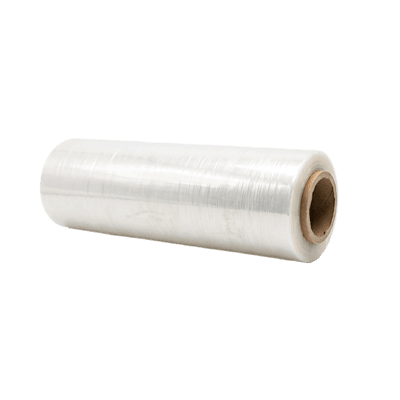
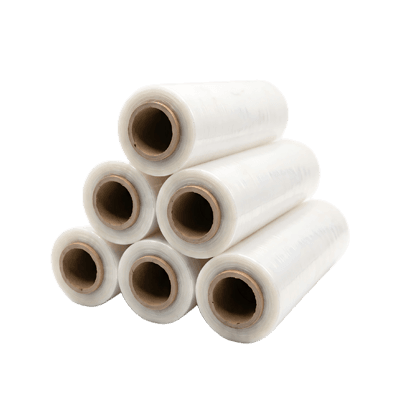
A standard machine stretch film roll holds about 11 to 18 kg of film, plus 1 to 1.5 kg for the paper core. Wrapper manuals usually list a maximum roll diameter rather than a weight, so check both against your machine.
| Roll size | 60 gauge (15 µm) | 80 gauge (20 µm) |
|---|---|---|
| 20 in × 5,000 ft | 10.9 kg (24 lb) | 14.5 kg (32 lb) |
| 20 in × 6,000 ft | 13.0 kg (29 lb) | 17.4 kg (38 lb) |
| 500 mm × 1,500 m | 11.7 kg (26 lb) at 17 µm | 15.9 kg (35 lb) at 23 µm |
Net film weights for true-gauge film; the formula is in our stretch wrap sizes guide.
Someone lifts every one of these rolls onto the carriage by hand. The NIOSH lifting equation puts the recommended limit at 51 lb (23 kg) under ideal conditions, and many sites set their own limit lower, so a longer roll isn’t automatically a better one.
Should You Use a Stretch Hood Instead of a Stretch Wrapper?
A stretch hood makes sense for high-volume automatic lines with uniform pallet sizes that need full weather protection, such as building materials, bagged chemicals or beverages stored outdoors. A stretch wrapper is the better choice when pallet sizes vary, volumes are low to medium, or you need extra wraps where a load is weak.
A hooding machine stretches a tube of thick film open, pulls it down over the pallet and lets it contract, with no heat. It covers the top and all four sides. Stretch wrap covers only the sides unless you add a top sheet.
| Stretch wrapper | Stretch hood | |
|---|---|---|
| Film | 15–30 µm stretch film on a roll | tubular hood film, several times thicker |
| Protection | sides only; top needs a sheet | top and four sides |
| Flexibility | any pallet size | best with uniform pallets |
| Equipment cost | low to high | high |
Film cost is where hoods surprise people. In a 2017 UK comparison published by Packaging Scotland, stretch wrapping a pallet with 23 µm film plus a top sheet cost about £1.14 in film, against about £0.64 for a 90 µm hood. The hood machine costs far more, so compare total cost per pallet over several years, not film price alone. Tuosheng doesn’t make stretch hood film, so we have nothing to sell you here.
What Is the Difference Between a Shrink Hood and a Stretch Hood?
A shrink hood is a loose bag placed over the pallet and heated until it shrinks tight. A stretch hood is a tube of film stretched over the pallet that tightens by elastic recovery, with no heat. Industry sources report that stretch hooding uses 25% to 30% less film than shrink hooding at the same thickness, and it removes the heat source and its fire risk. For stretch film versus shrink film more broadly, see stretch wrap vs shrink wrap.
What Should You Tell Your Film Supplier When You Change or Buy a Wrapper?
When you change or buy a stretch wrapper, give your film supplier the machine details, the roll limits and the load, so they can match the film instead of guessing:
- wrapper make and model;
- carriage type (brake or powered pre-stretch) and the ratio it runs;
- maximum roll weight and outside diameter;
- core size and film width;
- automatic cutting, and the cling side the machine expects;
- pallets per hour, load type and pallet weight.
The full list is in our machine stretch film RFQ checklist, and the machine stretch film guide explains wrapper settings.
Is a pallet wrapper the same as a stretch wrapper?
Yes. Pallet wrapper, stretch wrapper, stretch wrap machine and pallet wrapping machine all describe the same kind of machine: one that applies stretch film around a palletized load.
Can I use hand stretch film on a stretch wrapping machine?
Usually not. Hand film is not designed for machine pre-stretch and tension, so it tends to break or neck down on a wrapper.
Can the same film run on a turntable and a rotary arm wrapper?
Often, yes, if the width, core, roll weight and pre-stretch rating suit both machines. Trial it on each machine before switching completely.
Does Tuosheng sell stretch wrapping machines?
No. Tuosheng Packaging manufactures stretch film only. We match our machine film to the wrapper you already use and send free samples for a trial on your line.
Get a Film Matched to Your Wrapper
Tuosheng Packaging manufactures machine stretch film in Suzhou, China: cast LLDPE and mLLDPE, 15 to 50 microns (about 60 to 200 gauge), 250 to 2,000 mm wide (500 mm standard), on 76 mm (3 in) cores. Most standard grades run at 200% to 300% pre-stretch, and selected mLLDPE grades reach up to 400%.
Send us your wrapper model, its pre-stretch ratio and a photo of your current roll label. We will recommend a specification and send a free sample for a trial on your own line. You usually pay the shipping cost up front, and it is deducted from your first bulk order
Recommended Tuosheng Packaging Solution
Tuosheng Packaging manufactures hand stretch film and machine stretch film in Suzhou, China, with customizable thickness, width, roll length and export packing.