Hand Stretch Film Troubleshooting: Common Problems, Causes and Fixes
Most hand stretch film problems come from one of three places: damage to the roll before it is used, the way the film is pulled by hand, or how the film was chosen and stored. Three complaints come up again and again in warehouses: film that tears off in a narrow spiral from a dented edge, film that breaks at pallet corners or leaves the load loose, and operator fatigue. This hand stretch film troubleshooting guide explains each one, how to tell a film fault from a wrapping mistake, and what to fix first.
Using a stretch wrapper instead? See our machine stretch film troubleshooting guide.
Key facts
- A small dent or nick on the edge of a hand stretch film roll can make the film tear off in a narrow spiral strip, a failure often called barber-poling.
- Most hand-wrapped film breaks at pallet corners, where sharp edges and sudden jerks concentrate force on a small area of film.
- Hand wrapping relies on the operator’s arm strength, so stretch and load tightness often drop as operators tire during a shift.
- Film stored in hot warehouses or containers can stick layer to layer, which makes the roll hard to unwind and more likely to tear at the edge.
- Stretch film cling is weaker on cold or dusty surfaces, which is a common reason film tails lift after wrapping.
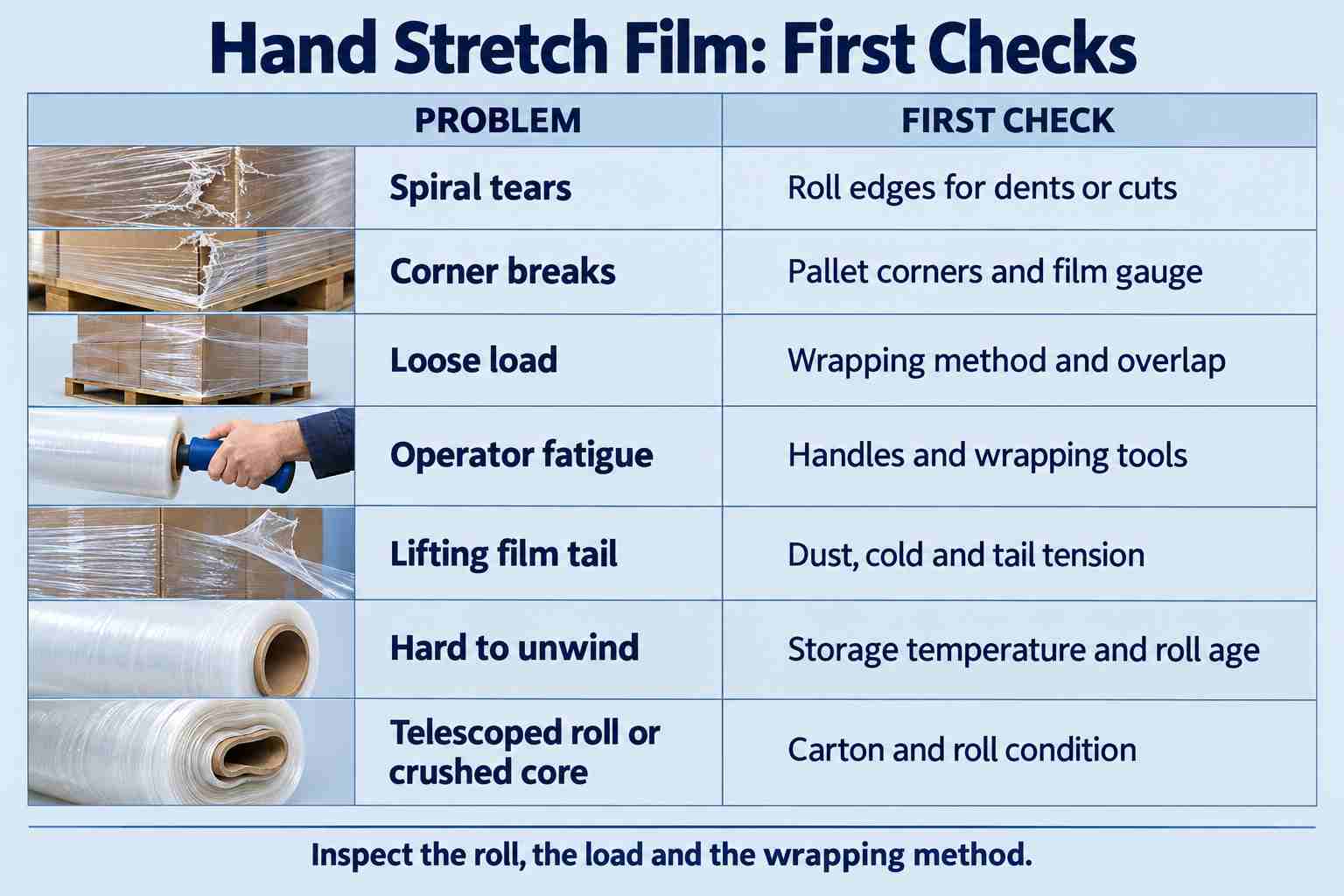
Quick Reference: Hand Stretch Wrap Problems at a Glance
| Problem | Most likely cause | First thing to check |
|---|---|---|
| Film tears off in a narrow spiral strip | Dented or nicked roll edge | Roll ends for dents and cuts |
| Film breaks at pallet corners | Sharp corners, jerking, film too thin for the load | Pallet corners and film gauge |
| Load still loose after wrapping | Film laid on instead of stretched, too few wraps | Wrapping method and operator fatigue |
| Sore hands, back strain, dizziness | Bare core, no handle, bending at the base | Tools at the wrapping station |
| Film tail won’t stay down | Dust, cold, tail pulled too tight | Load surface and roll temperature |
| Hard to unwind or noisy | Heat in storage, high-cling grade | Storage temperature and roll age |
| Telescoped roll or crushed core | Winding, carton stacking, drops | Carton condition before opening |
Why Does Hand Stretch Film Tear Off in Strips?
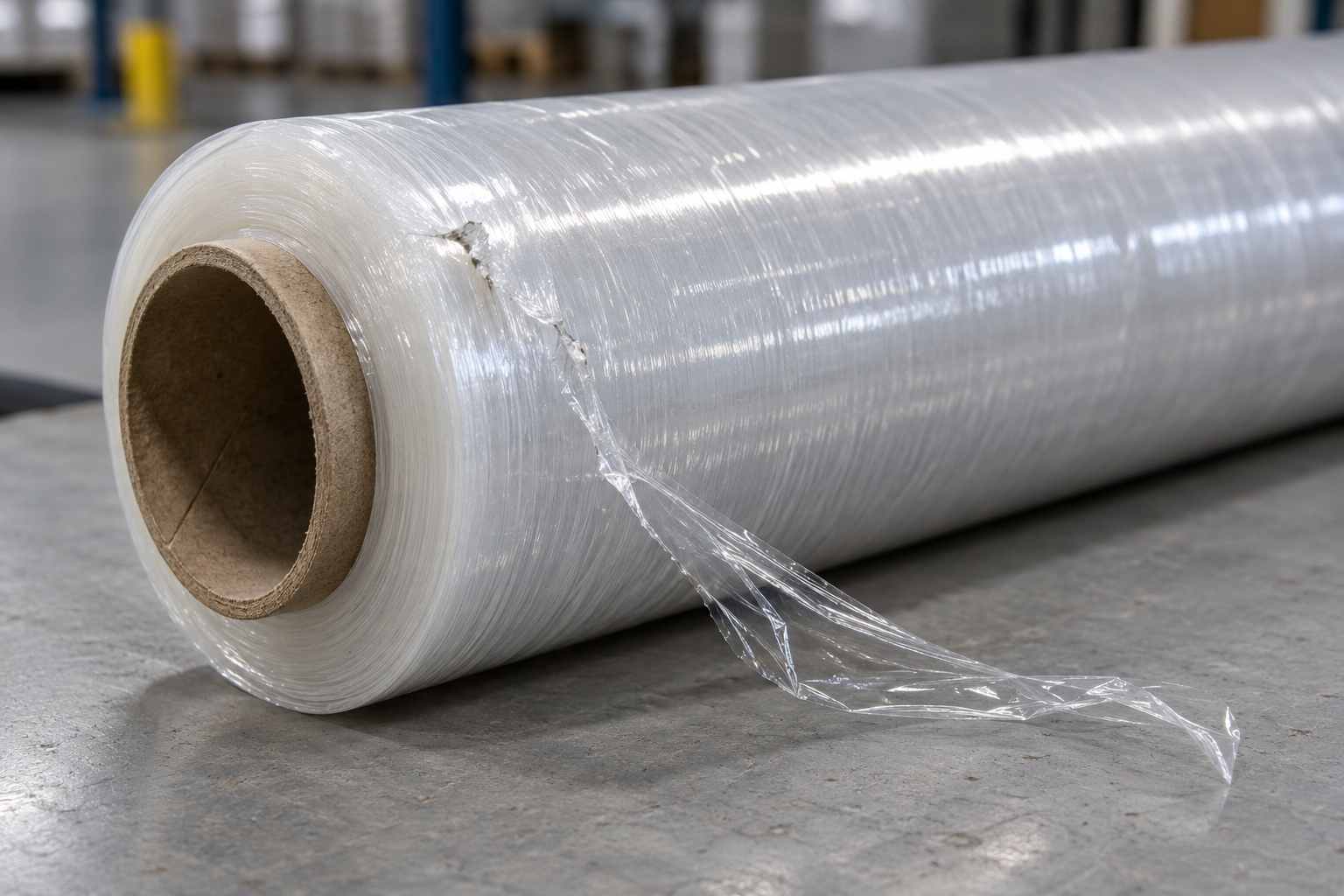
Hand stretch film tears off in narrow strips when the roll edge has a dent or nick. Every time the operator pulls, the tear starts again at the damaged point and runs diagonally across the film, so only a thin spiral strip comes off. Warehouse teams call this barber-poling, after the stripes on a barber’s pole, and it is a frequent complaint about hand wrap.
The damage usually builds up through many layers. To find a clean film surface again, the operator has to cut away several layers, sometimes more than ten, and that film is wasted. A badly dented roll may not be usable at all.
What causes edge tears and barber-poling?
| Handling and storage causes | Film and packing causes |
|---|---|
| Roll dropped on a concrete floor | Uneven slitting at the roll edge |
| Roll knocked against a forklift, racking or pallet edge | Carton too weak to protect the roll in transit |
| Partly used roll thrown down or left lying on its end | |
| Roll stored too long in a hot warehouse or container, so layers stick together and tear at the edge when pulled |
Rule out handling damage first. A roll is heavy for its size, and when it is dropped, the film edge takes the impact.
How to check and fix it
- Inspect both ends of the roll. Look for flattened areas, dents or small cuts on the film edge.
- Compare with other rolls from the same carton. If only one roll is affected, damage after packing is the likely cause. If every roll tears the same way, report it to your supplier.
- Cut back the damaged layers in one go. Use a safety cutter to slice through the damaged area until you reach an undamaged layer, rather than tearing off strips one by one.
- Store rolls properly. Keep rolls in their carton or upright on a shelf between uses, never on the floor, and keep them out of hot areas. Our stretch film storage guide covers temperature and handling in detail.
- Check rolls on arrival. Open a few cartons when the shipment arrives and photograph any edge damage before the rolls go into use.
Why Does Hand Stretch Wrap Break at Corners or Leave the Load Loose?
Corner breaks and loose loads often go together. An operator who pulls hard at the corners breaks the film. An operator who is afraid of breaking it pulls too gently, and the pallet leaves the dock loose. You need a film that can take the pull and a wrapping method that is the same on every pallet.
Why does hand stretch film break at pallet corners?
Hand stretch film usually breaks at pallet corners because a sharp edge and a sudden jerk put the full pulling force on a very small area of film. Thin film used on heavy loads or pallets with sharp corners, protruding boards or splinters has little puncture resistance left once it is stretched, so it breaks at the first corner.
Common causes:
- Film too thin for the load. Light-gauge film that works on uniform cartons may not survive heavy or sharp-edged loads.
- Jerking at the corners. Pulling hard at each corner briefly exceeds what the film can stretch.
- Film defects. Gels (small specks of unmelted resin) or uneven thickness create weak spots. These break anywhere on the pallet, not only at corners.
How to fix it (check the load and the roll before you change to a thicker film):
- If the film always breaks at the same corner of the load, look for the sharp edge, splinter or protruding item at that point first.
- If the tear always starts at the film edge, check the roll edge for damage (see edge tears) and make sure the roll unwinds freely.
- Pull the film steadily around each corner instead of jerking it.
- Fit edge protectors (corner boards) on loads with sharp edges.
- Only then, if corners and rolls are fine, use a heavier gauge for heavy or sharp-edged loads. 80 gauge hand stretch wrap (about 20 µm) is a common general-purpose choice, and our stretch film thickness guide explains when to go heavier.
Film or method? If the film breaks only at corners, the cause is usually the load or the wrapping method. If it breaks across the face of the pallet or you can see gels in the film, the film itself may be at fault.
Why is the load still loose when the film hasn’t broken?
A hand-wrapped pallet is usually loose because the film was laid on the load rather than stretched. Unstretched film has little force pulling back on the load, so the cartons can shift when a forklift lifts the pallet or a truck brakes.
Hand wrapping depends entirely on the operator’s strength. The first pallets of a shift are often wrapped tightly. After a few hours the operator’s arms are tired, the pull gets lighter, and the film is simply draped around the cartons. Because the pull changes as the operator moves up and down the load, one pallet can be tight on the sides but loose at the top. Too few wraps, poor overlap and a base that is not locked to the pallet make it worse.
Adding more wraps is not always the answer. Extra wraps use more film but may leave the same weak zone at the top, the base or the middle of the load. Film sticking to itself does not mean the load is held to the pallet. Check both.
How to fix it:
- Set a standard wrapping pattern: number of base wraps, overlap and top wraps. Our guide on how to stretch wrap a pallet correctly gives a step-by-step method.
- Rotate operators on long wrapping runs.
- Consider pre-stretched film, which needs much less pulling force by hand (see pre-stretch vs standard stretch film).
- Read how containment force keeps a load stable, and check a few pallets at the end of a shift, not only at the start.
How Can Operators Reduce Fatigue When Wrapping Pallets by Hand?

Hand wrapping is tiring because operators grip a bare paper core, bend down to wrap the pallet base, and walk backwards around the load many times. A handle, an extended-core roll or pre-stretched film reduces the effort. It also helps load quality, because tired operators wrap looser pallets.
Three complaints come up again and again among people who wrap pallets by hand:
- Sore or burned hands. Holding the roll by its paper core means the core edge rubs against the fingers and palms as the roll turns.
- Back strain. The base wraps are the most important ones, and they are done bent over.
- Dizziness. Walking backwards in tight circles around pallet after pallet makes some operators dizzy.
This is not only a comfort issue. In its warehousing hazards and solutions guidance, the US Occupational Safety and Health Administration (OSHA) lists the force needed to stretch wrap orders as a strain risk for workers and suggests a mechanical stretch wrapper as one solution. It also names bending and repetitive tasks among warehouse ergonomic risk factors.
Ways to reduce the strain:
| Option | What it does |
|---|---|
| Handle or hand stretch wrap dispenser | Holds the roll, keeps hands off the core and gives steadier tension |
| Extended-core stretch film (stretch wrap with handle) | The core sticks out of both ends of the roll and works as a built-in handle |
| Pre-stretched film | Stretched before it is wound, so it needs much less pulling force |
| Stretch wrapping machine | Worth considering once hand wrapping takes up a large part of a shift |
If your team wraps many pallets a day, our comparison of machine vs hand stretch film helps decide when to move to a machine.
Why Won’t the Stretch Wrap Tail Stay Down?
A stretch wrap tail lifts after wrapping when the film cannot cling to the surface below it or when it was pulled too tight at the end. Dust on the film or the cartons, a cold roll and a tail cut under full tension are the usual causes.
A loose tail is not just untidy. It can get caught in forklift wheels or conveyor rollers.
- Ease off the tension on the last half wrap so the film does not spring back.
- Press the tail flat onto a smooth area of film, not onto a carton edge.
- Keep rolls clean and indoors. Cling is weaker when the film is cold, so let rolls from a cold truck or cold store warm up before use. See stretch film storage for details.
Why Is Hand Stretch Film Hard to Unwind or Noisy?
Hand stretch film is hard to unwind when the layers have stuck together, which usually happens when rolls are stored in heat, for example in a hot warehouse or a shipping container in summer. A high-cling grade also takes more force to unwind than a low-cling grade.
A roll that is hard to unwind is also more likely to tear at the edge, so this problem often shows up together with barber-poling.
Noise on its own is not a defect. Blown film is naturally louder than cast film when it unwinds. Our article on cast vs blown stretch film explains the difference.
Why Are Rolls Telescoped or Cores Crushed on Arrival?
Telescoped rolls and crushed cores almost always come from winding, packing or handling, not from the film formula. A telescoped roll has layers that have slid sideways into a cone shape. A crushed core is flattened so that a handle or dispenser no longer fits.
Common causes are uneven winding tension, cartons stacked too high, and cartons that were dropped or hit in transit. A crushed core can make an otherwise good roll unusable for hand wrapping.
Photograph the carton and the roll before you open or use it, then report it with the details listed below.
Hand Stretch Wrap Problems: Is It a Film Fault or a Wrapping Mistake?
Before you call your supplier, use this table to see where the problem most likely comes from.
| What you see | More likely the film | More likely handling, method or storage |
|---|---|---|
| Other rolls from the same batch fail the same way | ✔ | |
| Only one roll fails, and its edge is dented | ✔ handling | |
| Film breaks only at load corners | ✔ method or load | |
| Loads are loose only for one operator or late in the shift | ✔ fatigue | |
| Problem appears only in summer or in one warehouse | ✔ storage | |
| Gels or uneven thickness visible in the film | ✔ | |
| A different batch of the same specification works fine | ✔ |
What Should You Send Your Supplier When Reporting a Problem?
Clear evidence lets a supplier find the cause quickly. Send:
- A photo of the roll label (specification and production date)
- Photos or a short video of the problem, including the roll edges
- The number of rolls affected out of the total received
- How the rolls were stored and how they are applied
- One or two unopened rolls kept aside for testing
Our stretch film storage guide explains how to build a complete claim record.
How Does Tuosheng Packaging Check Hand Stretch Film Before Shipping?
Tuosheng Packaging has made stretch film since 2012. For hand stretch film we check:
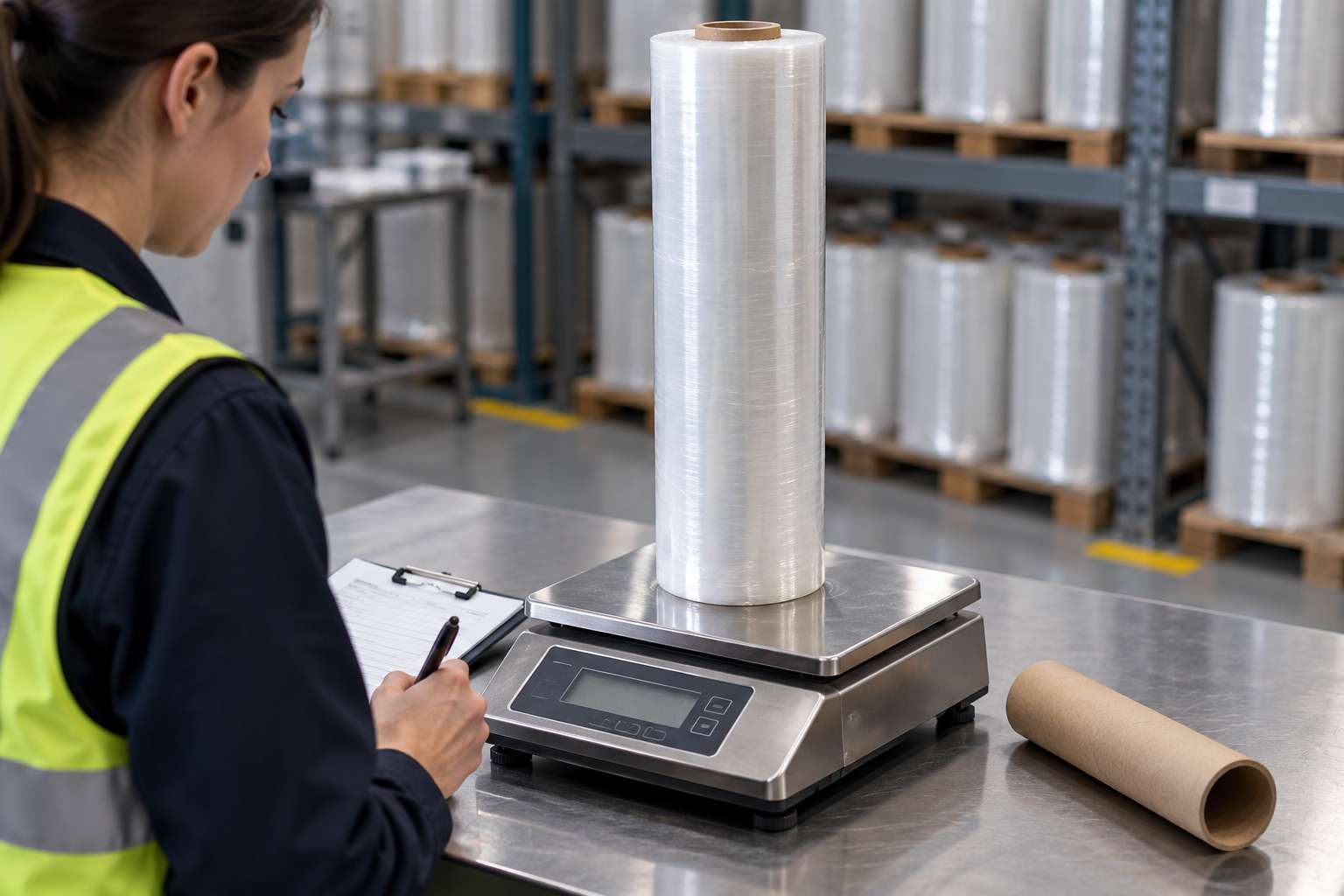
- Net film weight:Before production we spot-check the core weight for the batch, then spot-check finished roll weights, and calculate net film weight as the difference. Roll weights we quote exclude the core, which matters when you compare stretch film quotes from different suppliers.
- Thickness and stretch: We test film thickness and tensile and stretch force with instruments in our own factory.
What gauge hand stretch wrap tears less at corners?
Heavier gauges resist corner tears better. 80 gauge (about 20 µm) is a common general-purpose hand stretch wrap. 60–70 gauge suits light, uniform cartons, and heavier film suits heavy or sharp-edged loads. Edge protectors often solve corner breaks without changing the film. Our 60 vs 80 gauge guide compares the two by pallet weight and wrapping method.
Does a stretch wrap handle or dispenser reduce tearing?
Often, yes. A handle or hand stretch wrap dispenser keeps the operator’s hands off the core and makes tension steadier, so there are fewer sudden jerks at corners. Extended-core rolls give a similar benefit without a separate tool.
Does cold weather affect hand stretch film?
Yes. Cold film is stiffer and clings less, so tails lift and the film may tear more easily. Let rolls warm to room temperature before use. Our stretch film storage guide covers temperature effects in detail.
Should I switch to pre-stretched stretch wrap?
Pre-stretched film is worth trying if operators struggle to stretch standard film or loads end up loose late in a shift. It needs much less pulling force by hand. Test it on your own pallets before switching.
Can a dented hand stretch film roll still be used?
Usually, yes. Cut through the damaged layers in one go until you reach undamaged film, then wrap as normal. If the dent is deep or the core is crushed, the roll may not be worth saving.
When should a warehouse switch from hand wrapping to a stretch wrapper?
Consider a machine when hand wrapping takes up a large part of a shift, loads must be consistently tight, or operators report strain. A stretch wrapper gives repeatable tension that hand wrapping cannot.
Need a Hand Stretch Film That Fits Your Loads?
If the same problem keeps coming back, send us your roll label and a photo of the issue. Tuosheng Packaging can match the specification of your current hand stretch film and send a free sample to test on your own pallets.
Recommended Tuosheng Packaging Solution
Tuosheng Packaging manufactures hand stretch film and machine stretch film in Suzhou, China, with customizable thickness, width, roll length and export packing.