
Stretch film is usually the cheapest component in a pallet-wrapping line, and it’s the one most often bought on thickness and price alone. That’s backwards. In an automated operation the film, the pre-stretch carriage, the wrapping recipe, and the load itself behave as one system. Film that runs beautifully on a uniform beverage pallet can shred on sharp metal components. A high-yield film that cuts material use on one wrapper will break every third load on another if the rollers are worn or the force-to-load is cranked too high.
So the goal isn’t the cheapest roll. It’s a repeatable containment force at the lowest verified cost per pallet, with damage, downtime, and plastic consumption all under control. Getting there means looking at resin structure, thickness tolerance, puncture and tear behavior, elastic recovery, cling, roll geometry, and machine compatibility together. Any one of those numbers read in isolation will mislead you.
This guide covers how to evaluate machine stretch wrap for semi-automatic and fully automatic systems: cast and blown films, multilayer metallocene formulations, gauge conversions, lab and transport testing, Type A through C pallet profiles, powered pre-stretch mechanics, troubleshooting, and total cost of ownership. Treat every figure here as an engineering starting point. Your real settings and pass/fail limits come out of controlled trials with your actual product, pallet pattern, wrapper, storage conditions, and route.
- What machine stretch film is and how it stabilizes a pallet
- Cast vs blown stretch film and multilayer construction
- Specifications, gauge conversions, and roll yield
- Performance metrics and ASTM testing
- Selecting film for Type A, Type B, and Type C loads
- Wrapper compatibility, pre-stretch ratio, and application settings
- Troubleshooting web breaks and unstable pallets
- Cost per pallet and building a procurement specification
What machine stretch film is and how it stabilizes a pallet
Machine stretch film is an elastic polyethylene film made to be applied by powered wrapping equipment. Most industrial grades are built on linear low-density polyethylene (LLDPE), usually blended with other polyethylene grades and performance additives across a multilayer structure. The film gets elongated before or as it meets the load, and its tendency to snap back is what creates inward holding force.
That holding force is the whole point. It keeps cases aligned, limits movement between layers, and ties the load down to the pallet. Film gives you some dust and moisture protection as a side effect, but it is not a barrier package and it is not a weatherproof outdoor cover. I’ve seen people treat it as both and pay for it.
Machine film, pre-stretch film, and hand film are not interchangeable
Machine rolls are longer and heavier than hand rolls and run on a standard 3-inch core. They’re built to unwind under controlled tension at repeatable line speeds, which puts real demands on resin formulation, winding quality, edge condition, and roll concentricity. A roll has to survive being accelerated through a powered carriage without flinching.
The term pre-stretch film causes more confusion than any other phrase in this category. It can mean film mechanically elongated during manufacture and delivered thin and ready to apply. It can also be shop-floor shorthand for ordinary machine film after the carriage has stretched it. Say which one you mean in your procurement documents. A powered machine-grade roll and a factory-prestretched roll often need different tension settings, and swapping one for the other without re-qualifying is how you get a bad Monday.
Hand wrapping is a legitimate backup when the line is down. It does not reproduce the control, consistency, or output of a machine recipe, so qualify film and equipment for the job they’re actually doing.
Containment force matters more than wrap count
Three terms get mixed together constantly, and the distinction is worth holding onto. Pre-stretch is the elongation created between the powered carriage rollers, before the film ever touches the load. Force-to-load is the tension applied between the carriage and the pallet after that. Containment force is the accumulated inward force the applied film exerts at a specified height on the finished load. Only the third one describes what’s actually holding your pallet together. For a deeper explanation of measurement points, holding force, and load movement, see our guide to stretch film containment force and pallet stability
More revolutions can raise containment, but wrap count on its own proves nothing about stability. The result depends on achieved stretch, film width, overlap, neckdown, film path, load geometry, and elastic recovery. Too much force crushes cartons or drags a light load off center. Too little lets the top layers walk during braking, cornering, and road vibration.
As rough trial starting points, some operations begin near 18 to 25 pounds of force per linear inch on conventional 1,000 to 2,000 lb loads, and 25 to 35 PLI on heavy or irregular ones. Those aren’t acceptance limits. Measurement device, location, film pattern, product strength, transport mode, and when you take the reading all move the useful target. A specification worth having records the containment force required at the top, middle, and bottom of each validated load family.
Cast vs blown stretch film and multilayer construction
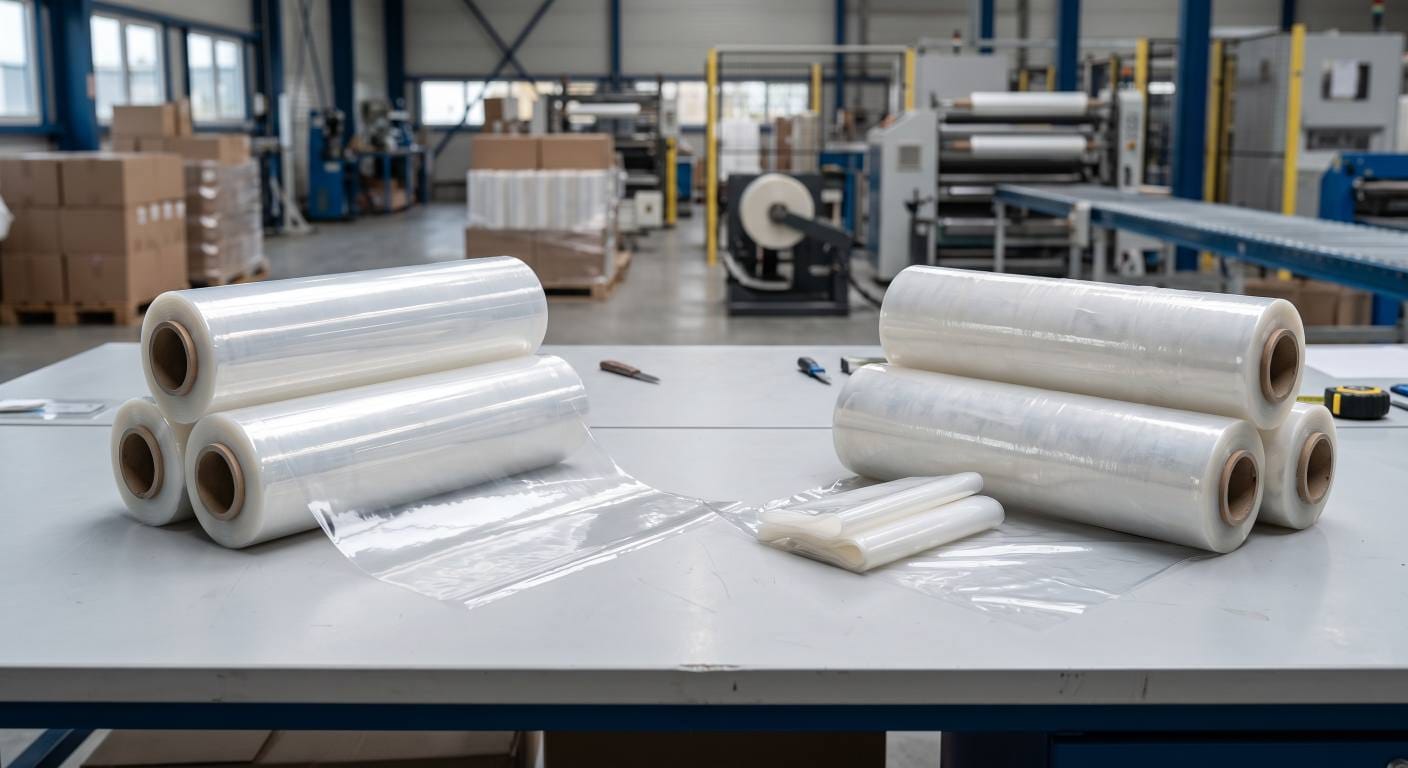
Cast vs blown has no universal winner, and anyone who tells you otherwise is selling one of them. The two processes produce different combinations of optics, unwind behavior, stretch response, and damage tolerance. Your load hazard and your wrapping line decide which set of tradeoffs you want.
The two processes solve different operating problems
Cast film is cooled fast against a chill roll. That generally gives you consistent thickness, high clarity, smooth unwind, and less noise. Worth a lot when operators or scanners need to read labels through the wrap, when the area is already loud enough, or when high-speed equipment wants a uniform web.
Blown film is formed through an air-cooled bubble. The orientation and slower cooling typically buy strong puncture resistance and better resistance to tear propagation in the directions that matter. It’s the usual candidate for irregular loads, sharp edges, cold conditions, or routes with rough handling. You pay in unwind noise, haze, and a different stretch response.
| Selection factor | Cast machine film | Blown machine film |
|---|---|---|
| Clarity and label visibility | Usually higher | Usually lower |
| Unwind noise | Usually quieter | Usually louder |
| Gauge uniformity | Typically very consistent | May show more variation by formulation and process |
| Puncture and tear behavior | Strong in engineered high-performance grades | Often favored for severe puncture and tear propagation resistance |
| High-speed line suitability | Common because of smooth, predictable unwind | Must be matched carefully to carriage and speed |
| Best starting use case | Uniform to moderately irregular loads | Irregular, abrasive, or puncture-prone loads |
Those are tendencies, not purchase specifications. A modern multilayer cast film can beat a basic blown film in a given puncture test, and a well-designed blown film can run fine at high speed. Compare the actual technical data and the applied-load trials.
Why 3-, 5-, and 7-plus layer films enable downgauging
Coextrusion lets the converter hand different jobs to different layers. A three-layer A/B/A structure might use the skins for cling, slip, or puncture response and the core for strength and cost control. Five, seven, and higher layer counts give more freedom to place complementary resins where they earn their keep instead of asking every layer to do everything.
Metallocene LLDPE is the workhorse in high-performance machine film. Its controlled molecular architecture can improve tensile behavior, toughness, and consistency at lower thicknesses. C4, C6, and C8 LLDPE grades each strike a different balance of processability, elongation, and puncture resistance. What makes a multilayer design good is the whole formulation and how the layers are allocated. Layer count printed on a box is a marketing number.
Published supplier data cites formulation-specific gains of up to 50% higher dart-drop impact resistance and roughly 10% higher ultimate stretch against a conventional C4 LLDPE reference, plus examples where a 47-gauge-equivalent film is offered against the containment performance of conventional 80-gauge. Don’t generalize those numbers to every multilayer product. “Equivalent gauge” is a performance claim, not a thickness. Ask for actual gauge, nominal performance grade, test method, test result, and load-trial evidence as five separate fields, because suppliers will happily collapse them into one.
Downgauging works only when the thinner structure still survives the highest pre-stretch you actually use, plus sharp contact points, sustained vibration, and normal temperature swings. Here’s where I see it go wrong most often: a Type C load with severe projections gets assigned an ultra-thin film because the tensile number on the datasheet looks strong. Tensile strength is not puncture resistance. That load may need tougher blown film, more layers, lower pre-stretch, corner boards, roping, or some combination.
Specifications, gauge conversions, and roll yield
Good stretch film specifications kill ambiguity. At minimum, state film type, physical thickness, width, net film weight, roll length, core dimensions, winding orientation, cling configuration, color, target pre-stretch range, and the test methods you both agree to. “Heavy duty,” “high performance,” and “equivalent 80 gauge” tell you nothing you can hold a supplier to.
Gauge, mil, and micron conversion
Gauge dominates in North America, microns in international sourcing. The dimensional relationships are exact:
Microns = gauge × 0.254
Gauge = microns ÷ 0.254
1 mil = 100 gauge = 25.4 microns
To go from microns to gauge, divide by 0.254. The other direction, multiply.
| Gauge | Mil | Microns (µm) | Typical evaluation context (not a load guarantee) |
|---|---|---|---|
| 47 | 0.47 | 11.94 | High-performance downgauged applications on controlled loads |
| 50 | 0.50 | 12.70 | Light, uniform loads after machine validation |
| 60 | 0.60 | 15.24 | Light-to-medium uniform loads |
| 70 | 0.70 | 17.78 | General medium-duty evaluation |
| 80 | 0.80 | 20.32 | Common conventional reference thickness |
| 100 | 1.00 | 25.40 | Heavy or demanding load evaluation |
| 120 | 1.20 | 30.48 | Severe or puncture-prone applications, often with reinforcement |
This chart converts physical dimensions and nothing else. It establishes no equivalence between resin formulations. Twelve microns works out to about 47.2 gauge, and that tells you exactly nothing about its containment, puncture, or stretch behavior. You still have to test.
Common machine roll widths run around 20 inches (500 mm) and 30 inches (750 mm). Standard core ID is 3 inches (76.2 mm), but usable roll outside diameter, roll mass, core length, and maximum carriage load all vary by wrapper. Confirm every dimension before ordering, especially on automatic roll-change systems where a roll that’s 10 mm too large simply won’t load.
Calculating roll length and usable yield from net weight
The length printed on the label is useful. Net film weight gives you an independent check. Exclude the paper core and packaging, then:
Film mass (kg) = width (m) × length (m) × thickness (m) × density (kg/m³)
Rearranged:
Estimated length (m) = net film mass ÷ [width × thickness × density]
Take a 500 mm wide, 20.32 µm film with 14.3 kg of net polyethylene, working from a density assumption of 920 kg/m³:
Length = 14.3 ÷ (0.500 × 0.00002032 × 920) ≈ 1,530 m
Call it 5,020 ft. It’s an estimate, since blend density, gauge tolerance, and winding tension all vary. When the number matters commercially, ask for the formulation density or a certified roll-length method.
Powered pre-stretch multiplies applied web length:
Stretched length = original length × (1 + pre-stretch percentage)
At 200% pre-stretch, 1 m of roll film becomes roughly 3 m of stretched web before secondary elongation and neckdown. At 300%, about 4 m. So 150% to 400% pre-stretch is theoretically 2.5 to 5.0 times the original length. Do not book that multiplier as pallet yield. Unusable tail, startup waste, web breaks, overlap, roping, and the stretch you actually achieve rather than the stretch on the gearbox label all come off the top.
Performance metrics and ASTM testing
A datasheet value is only useful when it’s tied to a defined method, direction, conditioning environment, and reporting unit. A big number with no method behind it can’t be compared across suppliers, and I’ve watched procurement decisions get made on exactly that.
Translating lab properties into operating behavior
Ultimate stretch is the elongation at which the web fails under a defined test, and your operating pre-stretch has to sit below it with margin for edge defects, acceleration, temperature, and roll-to-roll variation. Tensile strength describes resistance to tensile loading; tensile yield and ultimate strength help characterize stress response, but neither one proves a wrapped pallet will stay standing. Dart-drop impact gives comparative evidence of toughness and speaks to puncture resistance, though real corners and protrusions concentrate stress in ways a falling dart doesn’t.
Elastic recovery is the film’s ability to come back after extension, which is what lets the wrap follow a load that settles or deforms briefly in transit. Stress retention tells you how much force is left after the film has been held at strain, and it’s the property most directly tied to containment over a long haul. Cling retention keeps overlapping layers and the final tail attached: too little and the wrap unravels, too much and unwind tension climbs until the web breaks. Neckdown is the width the film loses as it stretches, and excessive neckdown quietly reduces coverage and changes how many effective layers you have at any given height.
Measure dynamic containment after the load has been wrapped, stored, handled, and taken through its expected temperatures. Not at the wrapper exit. A film can post strong initial force and shed too much of it during relaxation. Pushing initial force to the maximum is just as easy to get wrong, since you can crush cartons without improving transport performance at all.
Using ASTM methods as a qualification package
ASTM standards give you comparable procedures. They do not give you a universal film grade or a containment target. The current catalog lists these 2025 editions:
| Standard | What it contributes | Practical procurement use |
|---|---|---|
| ASTM D4649-20(2025) | Guide for selecting, specifying, and applying stretch films for indoor unitization | Build the film specification and align buyer/seller terminology; validate separately for outdoor exposure and extreme temperatures |
| ASTM D5459-95(2025) | Machine-direction elastic recovery, permanent deformation, and stress retention | Compare candidate films at agreed extension levels and relaxation times |
| ASTM D5416-95(2025) | Comparative abrasion resistance during vibration | Compare a candidate with a proven control using the plant’s wrap pattern, abrasion surfaces, and failure definition |
| ASTM D5458-95(2025) | Peel cling between two film layers in stretched and unstretched conditions | Set a cling window that secures overlaps and tails without causing roll blocking |
D5459 evaluations are commonly run at 50%, 100%, and 200% strain with a grip separation rate of 5 in/min (127 mm/min) and relaxation periods from 60 seconds out to 24 hours. Confirm those details against the licensed edition before you write them into an RFP or a lab instruction. Same goes for D5416: define vibration duration and failure criteria in your own test plan rather than copying someone else’s pass/fail rule. ASTM calls it a comparative procedure and deliberately leaves the important application factors to you.
A qualification sequence that works: verify roll dimensions and gauge uniformity, compare tensile, dart-drop, recovery, stress-retention, and cling data, run the candidate on the intended wrapper, measure applied film mass and containment at several heights, then put it through handling, vibration, abrasion, and route trials against an approved control film. Log web breaks, tail failures, product damage, and load movement alongside the lab values. The failure log usually teaches you more than the datasheet did.
Selecting film for Type A, Type B, and Type C loads
Start with the pallet, not the supplier’s grade name. Weight matters, but geometry, product rigidity, friction between layers, center of gravity, and puncture hazards are what usually set the hard requirement.
Classify the physical load profile
| Load profile | Practical description | Primary risks | Sensible starting strategy |
|---|---|---|---|
| Type A | Uniform, flush, stable faces with no sharp edges | Layer slip or insufficient top-to-bottom containment | Cast high-yield film may provide clarity, quiet unwind, and efficient pre-stretch |
| Type B | Irregular sides or protrusions up to about 3 in (76 mm) | Local thinning, moderate puncture, uneven force | Tough multilayer cast or blown film; test gauge, overlap, and reinforced zones |
| Type C | Severe irregularity, sharp corners, or projections over about 3 in | Puncture, tear propagation, film cutting, toppling | Heavier or tougher film, often blown, plus corner protection, roping, or other reinforcement |
The A through C model is a screening tool, not a site risk assessment. A dense, sharp Type B load can be harder to wrap than a light, awkward Type C one. Go look at the worst contact points and the weakest layers in the stack.
On unstable loads the pattern matters as much as the grade. More bottom wraps improve the pallet-to-load bond. Extra top wraps hold light upper layers down. Roping concentrates film into a narrow band where you need reinforcement, and corner boards spread concentrated force while protecting vulnerable edges. One-sided cling puts the tack inward and leaves the outside less likely to drag against the pallet next to it in the trailer.
Build a trial instead of guessing a gauge
- Group pallets into repeatable load families, including the lightest, heaviest, tallest, most irregular, and most fragile examples.
- Document weight, dimensions, overhang, underhang, protrusions, sharp edges, center of gravity, pallet condition, and route hazards.
- Define required containment at top, middle, and bottom, plus acceptable product compression and lean.
- Choose a conservative baseline film and machine recipe. Record actual pre-stretch, force-to-load, revolutions, overlap, film width after neckdown, and applied film mass.
- Change one variable at a time: formulation, physical gauge, pre-stretch gear ratio, force setting, wrap count, or reinforcement.
- Validate after storage and transport simulation, not just at the wrapper.
For a Type A load, the cheapest answer is often a thin, high-yield multilayer cast film at a high but stable pre-stretch. For Type B, a moderate gauge with better puncture behavior prevents breaks and can cut total film use. For Type C, a thicker film plus edge protection usually beats snapping an ultra-thin web every few pallets or eating the damage claims.
Specify additives only when the route needs them: UV stabilization for controlled outdoor exposure, VCI formulations for compatible metal protection, anti-static for sensitive environments, tinted or opaque film for identification and security. Then check that the additive hasn’t compromised cling, stretch, recycling acceptance, or product compatibility. That last check gets skipped a lot.
Wrapper compatibility, pre-stretch ratio, and application settings
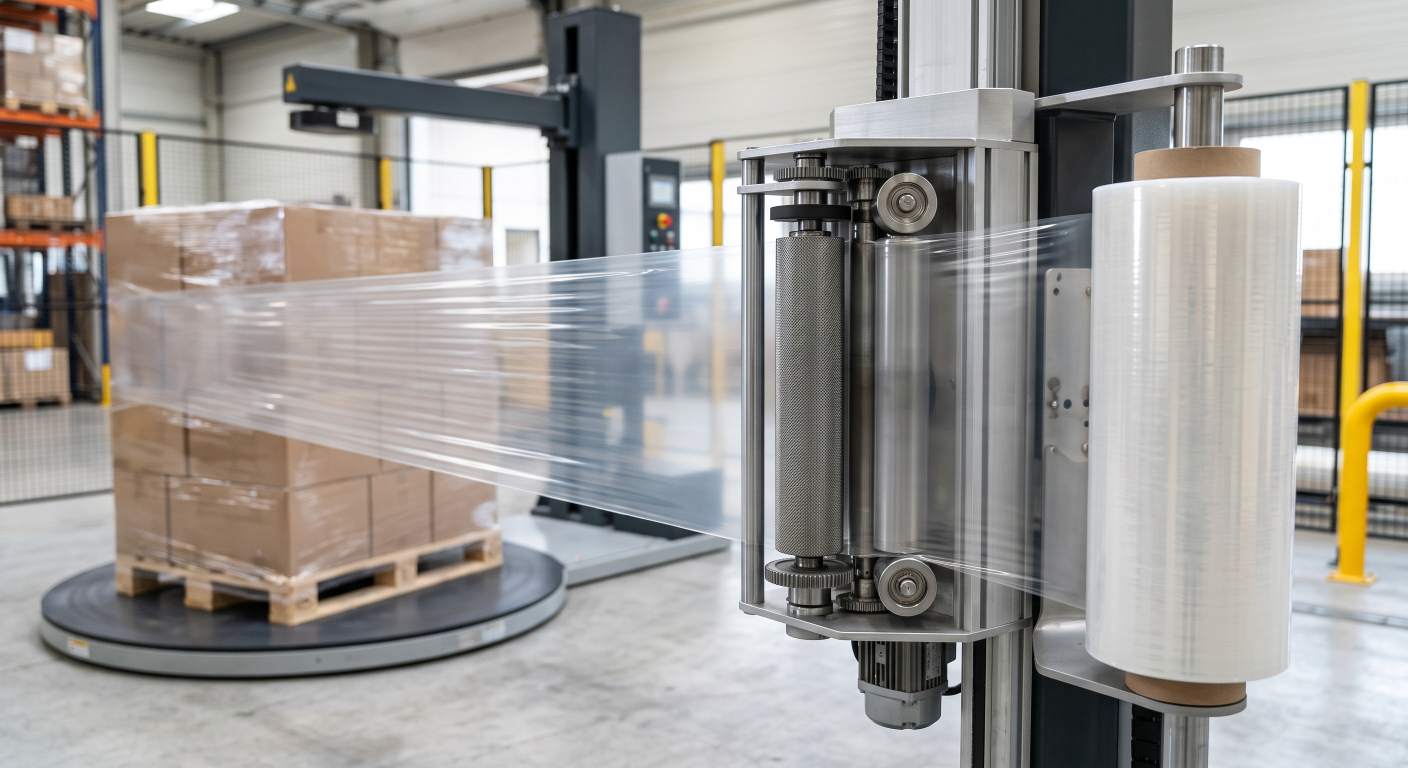
Film and wrapper get qualified together or not at all. A roll that behaves on a 12 RPM turntable can act differently on a fast rotary arm or ring, because acceleration, roll inertia, dancer response, and carriage cleanliness all change the stress the web sees.
Match film behavior to the wrapper class
| Wrapper class | Load motion and common use | Indicative operating range | Film considerations |
|---|---|---|---|
| Turntable | Pallet rotates; common semi-automatic format | About 10–15 RPM | Load must tolerate rotation; broad film compatibility when acceleration is controlled |
| Rotary arm | Arm rotates around a stationary pallet | About 15–35 RPM | Useful for light, unstable, or very heavy loads; film must handle faster directional changes |
| Horizontal orbital | Ring travels around long products or bundles | Application-dependent | Requires width, cling, and tension tuned to product shape and orbital path |
| Continuous rotary ring | Ring and carriage rotate around a stationary load on high-output lines | About 40–60+ RPM; some lines exceed 100 pallets/hour | Demands excellent roll consistency, edges, unwind, splice control, and automation compatibility |
Those speeds are references, not machine limits. Follow the wrapper manufacturer’s rated roll size, carriage design, safety instructions, and operating envelope. Automatic systems add their own requirements around tail treatment, film clamp behavior, roll-change features, and cling orientation.
Powered pre-stretch and secondary tension
A powered dual-roller carriage runs two rollers at different surface speeds. If the second delivers film three times as fast as the first, nominal pre-stretch is 200%: one unit of film in, three units of stretched web out. Common nominal ratios are 150%, 200%, 250%, and 300%, and some film-and-carriage combinations are built for 400%.
Nominal gear ratio is not achieved pre-stretch. Roller slip, wear, contamination, film stiffness, roll drag, and web tracking all pull the real number down or make it unstable. Verify it: mark a known distance on the unstretched film, measure the same marks after the carriage, following your site’s lockout and safe-access procedures. This is a ten-minute check that regularly explains a month of mysterious breaks.
After the carriage, force-to-load adds secondary tension. Too little leaves loose corners and weak containment. Too much brings web breaks, heavy neckdown, crushed cartons, or an off-center pull. The recipe you want works the film’s elastic range without sitting so close to ultimate stretch that ordinary variation tips it over.
Lock down these settings per load family:
- pre-stretch ratio or gear set;
- force-to-load by wrap zone;
- carriage speed and overlap;
- turntable, arm, or ring speed and acceleration;
- top and bottom wrap counts;
- roping or banding positions;
- photo-eye height detection and top overwrap;
- clamp, cut, wipe, and tail-seal performance.
Then keep the recipe under change control. When operators compensate for a weak load by dialing in extra revolutions, consumption climbs and you lose the ability to tell whether the real problem was film, equipment, pallet pattern, or product compression.
Troubleshooting web breaks and unstable pallets

Good troubleshooting separates material defects from mechanical damage and bad settings. Save the failed roll label and a sample. Record line, carriage, recipe, load type, temperature, failure location, and time. A pattern across several rolls from one lot points at material or winding. A pattern on one carriage across several lots points at the machine.
| Symptom | Likely causes | Checks and corrective actions |
|---|---|---|
| Repeated break at one web edge | Damaged roll edge, slitting micro-nick, burr or sharp guide, misaligned roll | Inspect both roll edges and every contact surface; remove damaged roll; repair and clean carriage parts |
| Break during acceleration or corners | Pre-stretch exceeds film capability, force-to-load too high, poor dancer response, cold/stiff film | Reduce one setting at a time; review actual pre-stretch; stabilize storage temperature; test a tougher grade |
| Film sticks on the roll or jerks during unwind | Excess cling, heat-related cling blooming, telescoping, roll compression, incorrect cling orientation | Condition rolls, inspect winding and storage, confirm inside/outside cling, compare unwind force by lot |
| Narrow web and uncovered bands | Excessive stretch or tension, roller slip, poor web tracking | Measure neckdown and achieved stretch; clean rollers; realign carriage; adjust overlap |
| Tail releases after wrapping | Insufficient cling, dusty/wet surface, weak wipe-down, short tail | Test cling; clean contact area; adjust cut-and-wipe sequence and tail length |
| Cartons crush or corners dish inward | Excess force-to-load or too many concentrated wraps | Reduce zone force; spread containment; strengthen packaging or use corner boards |
| Pallet leans or tips off center | Load already unstable, turntable acceleration too high, asymmetric tension, poor pallet bond | Correct pallet pattern; slow acceleration; center the load; balance force; increase effective bottom anchoring |
| Holes grow during vibration | Inadequate puncture/tear resistance, sharp edges, insufficient reinforcement, pallet-to-pallet abrasion | Test tougher or heavier film; shield edges; use roping or corner boards; review trailer loading |
Edge nicks deserve special attention. Stretch concentrates stress right at the defect, and once a tear starts, a fast carriage will run it clean across the web. The instinct is to back off the stretch. Inspect the roll, rollers, guides, and thread path first, because lowering stretch just hides a burr that’s going to keep cutting film.
Temperature, maintenance, and recycled content
Above roughly 35°C, cling additive migration and surface tack shift, which shows up as roll blocking or erratic unwind. Cold storage below about −10°C makes some formulations less forgiving during rapid elongation. The exact effect depends on resin, additive package, conditioning time, and wrapper settings, so run temperature-conditioned trials instead of applying a universal correction factor. ASTM D4649 makes the same point about extreme temperatures degrading performance.
Preventive maintenance: clean the pre-stretch rollers, check bearings and drive components, look for burrs, verify roller alignment, confirm the dancer moves freely, and measure actual pre-stretch on a schedule. Roll handling counts too, since a dropped roll can take an edge hit that never shows up as visible deformation.
For films with post-consumer recycled resin, ask for the recycled-content documentation and performance data together. For guidance on Scope Certificates, Transaction Certificates, and supplier verification, see our GRS-certified recycled stretch film buyer’s guide. Do not assume a blend above 30% PCR will match virgin metallocene film at 300% pre-stretch or higher.
Cost per pallet and building a procurement specification
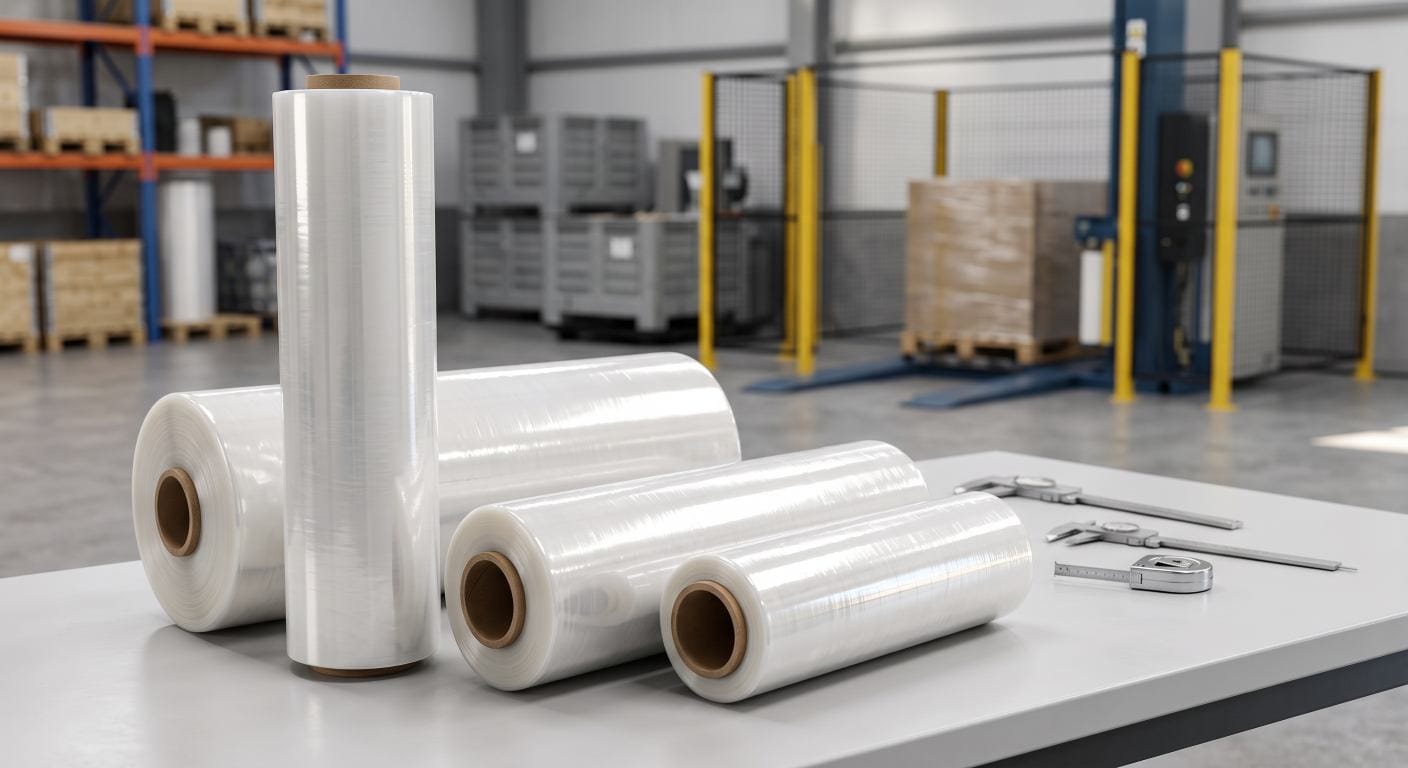
Roll price hides everything that determines operating economics. A pricier high-yield roll can cost less per load, and a cheap roll can generate consumption, break waste, downtime, and freight damage that swamps the savings. Compare on applied film mass and verified pallet output.
Calculating true cost per pallet
For a step-by-step cut-and-weigh method, roll yield calculation, and worked cost example, see how to calculate stretch film usage, yield and cost per pallet
Material first:
Film cost per unit weight = delivered roll cost ÷ net film weight
Material cost per pallet = applied film mass per pallet × film cost per unit weight
Then the losses:
True cost per pallet = material cost + break/startup waste + attributable downtime + damage/rework allowance + disposal cost
An illustrative trial:
| Metric | Conventional 80-gauge film | Downgauged performance film |
|---|---|---|
| Delivered roll price | $70 | $78 |
| Net film weight | 32 lb | 32 lb |
| Film cost per lb | $2.19 | $2.44 |
| Measured applied mass per pallet | 0.80 lb | 0.55 lb |
| Material cost per pallet | $1.75 | $1.34 |
| Theoretical pallets per roll | 40.0 | 58.2 |
The performance film costs more per roll and more per pound, and still lands about 23% lower per pallet. That’s the case for downgauging in one line. It’s also fragile. If the thinner film breaks more often, needs extra revolutions, or lets loads arrive damaged, the advantage reverses fast. It can also go the other way, where fewer breaks and less rehandling save more than the material math predicted. Which is why the number has to come from your floor, not from a table like this one.
For a trial you can trust, weigh at least 20 to 30 wrapped loads per film family, or pull stable wrapper consumption data across a representative production period. Include the full tail and any roped sections. Match loads, recipes, operators, and conditions between the films. Track pallets per roll, web breaks per 100 pallets, minutes of downtime, containment readings, and damage claims.
Cutting material also helps on sustainability, as long as product loss doesn’t rise to pay for it. LLDPE stretch wrap is a mono-material polyethylene stream in principle, but whether it actually gets recycled depends on local collection, cleanliness, labels, pigments, additives, and what your recycler will take. Keep used film clean and segregated, strip non-PE contamination where required, and confirm the receiving program exists. Recycled content and recyclability are two separate claims and neither one proves the other.
Final buyer checklist
For a copy-ready supplier questionnaire and commercial sourcing framework, use our machine stretch film specification and RFQ checklist. At minimum, an RFQ or qualification sheet should ask for:
- cast or blown process and physical gauge, not “equivalent” gauge;
- layer architecture description and resin-performance category, without demanding proprietary recipes;
- nominal and tolerance values for thickness and width;
- roll length, net film weight, gross roll weight, core ID, core length, and outside diameter;
- winding orientation, one- or two-sided cling, color, and additive requirements;
- recommended and maximum qualified pre-stretch range;
- tensile strength and elongation by direction, dart-drop or agreed puncture result, elastic recovery, stress retention, cling, and the test methods behind each;
- roll-edge, telescoping, splice, and winding-quality acceptance criteria;
- compatibility with the intended turntable, rotary arm, orbital, or ring wrapper;
- sample rolls from normal production, lot traceability, certificate of analysis expectations, and change-notification terms;
- measured containment and cost-per-pallet trial targets for each load family;
- packaging, storage, shelf-life, recycled-content, and end-of-life documentation.
Approve on the plant trial and the distribution validation, not the datasheet. The film you want hits your required containment at the top, middle, and bottom of a real pallet, runs at validated speed without abnormal breaks, protects the product through the route, and produces the lowest repeatable cost per pallet when you count the breaks and the damage.
And when film alone can’t safely stabilize a load, stop pushing a downgauged web past its tested range. Use corner boards, strapping, stretch hooding, or a qualified reusable wrap. I’d rather add a $0.40 corner board than explain a toppled pallet at a receiving dock.
Need Help Choosing the Right Stretch Film?
Every packaging application has different requirements. Share your wrapping method, load type and specifications, and Tuosheng Pack can help recommend a suitable stretch film solution for your business.
Suggestions based on product type, wrapping method and performance needs.
Support for thickness, width, roll size, color and packaging requirements.
Working with distributors, wholesalers and industrial packaging buyers.
Recommended Tuosheng Pack Solution
For buyers looking for reliable stretch film solutions, Tuosheng Pack supplies hand stretch film, machine stretch film, pre-stretched film and specialty packaging films with customizable thickness, width, roll length and packaging options.
VCI Shrink Film
Specialty packaging film providing corrosion protection for metal products during storage and transportation.
Learn More →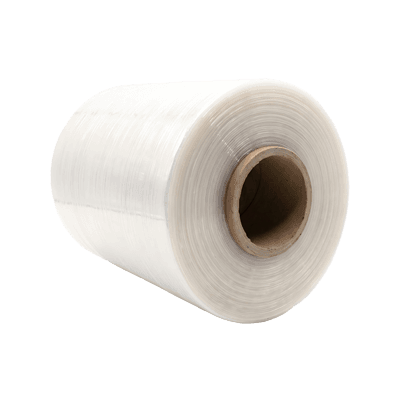
Jumbo Stretch Film
Large-format stretch film rolls designed for high-volume packaging requirements.
Learn More →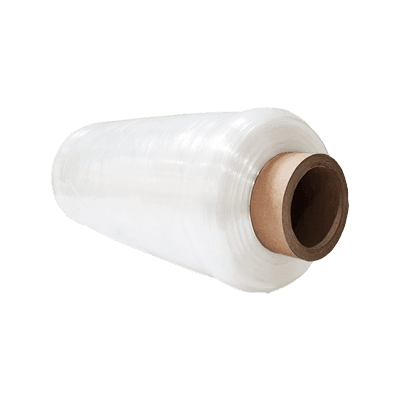
Pre-Stretch Film
Lightweight pallet wrapping solution helping reduce material consumption while maintaining load security.
Learn More →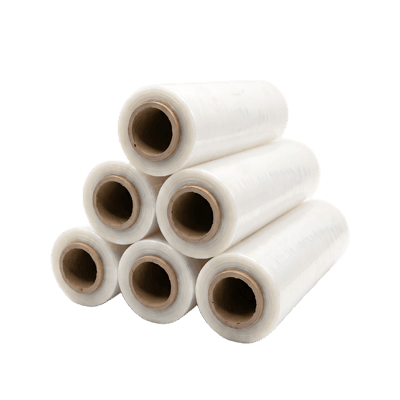
Machine Stretch Film
High-performance film designed for automated pallet wrapping operations with consistent load stability.
Learn More →