Cast Stretch Wrap: What It Is, Specs and How to Choose
Quick answer
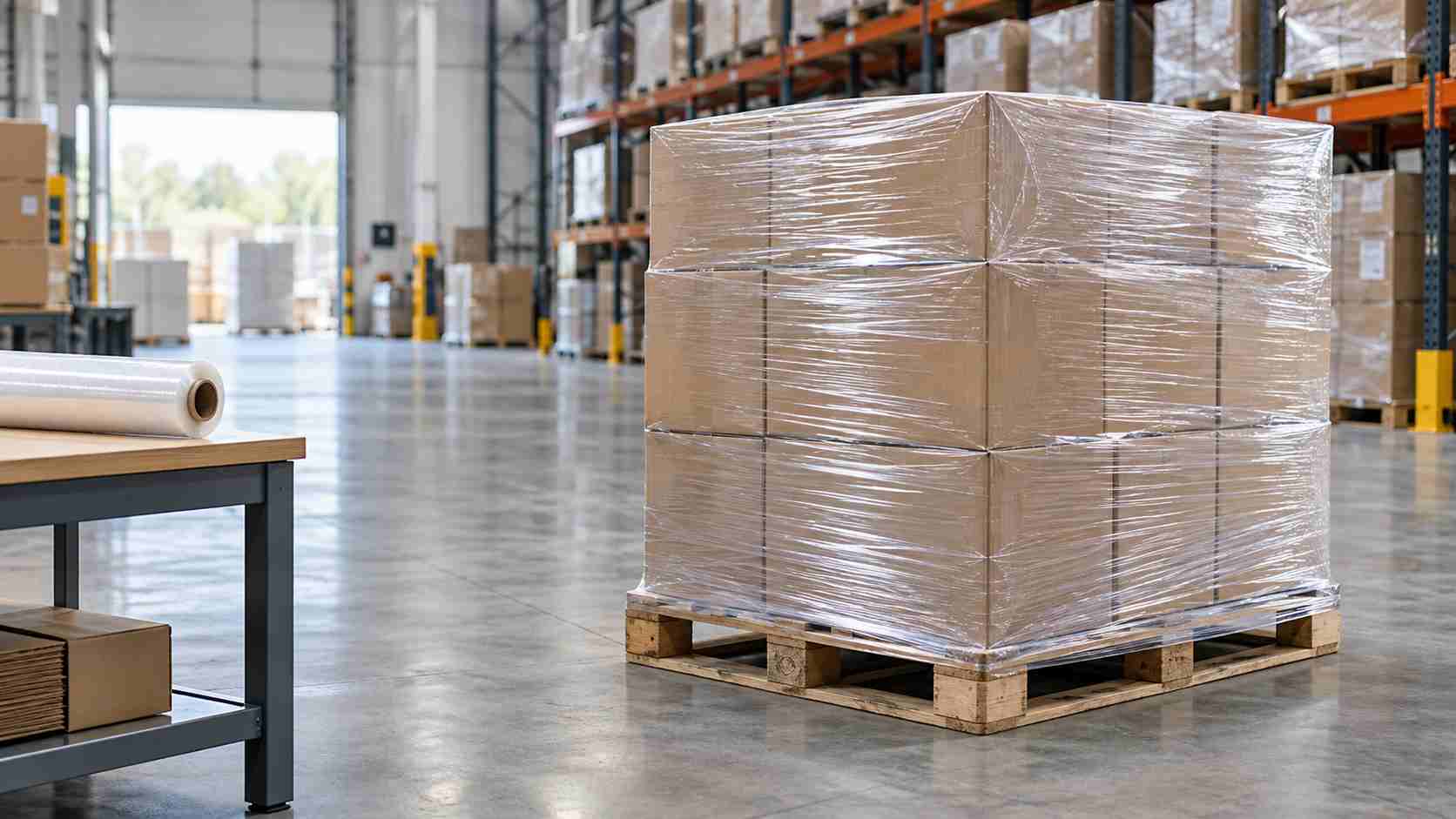
- Cast stretch wrap is LLDPE pallet film made on a cast extrusion line: the melt is pushed through a flat die and cooled fast on chilled rollers, which makes the film clear, glossy and even in thickness.
- Cast stretch wrap unwinds quietly, clings on both sides and stretches with less force than blown film, so it suits both hand wrapping and high pre-stretch machine wrapping.
- Cast film can tear at sharp protrusions; protect the edges first, and test blown film only if cast still fails.
- Tuosheng Packaging makes cast hand film and cast machine film from 15 to 50 µm (about 60 to 200 gauge) on a five-layer cast line.
Stretch wrap is a small line on the packaging budget, and it usually gets bought that way. Someone compares roll prices, picks the cheaper 80 gauge, and moves on. Then the rewrap pile at the dock grows, or a load reaches the customer with its top tier shifted two inches off the stack. Roll price is one input. Film weight per pallet and break rate on your wrapper decide the rest.
This guide is for warehouse managers, packaging engineers, and buyers choosing cast film for hand or machine use, and it mixes three kinds of statements. Unit conversions and standards are cited facts. Gauge starting points and the Type A/B/C groups are our engineering judgment, useful for a first pick and meant to be checked in a trial. Anything in dollars is an illustrative example with assumed inputs. For other film types and constructions, see our stretch film selection guide.
What Is Cast Stretch Wrap?
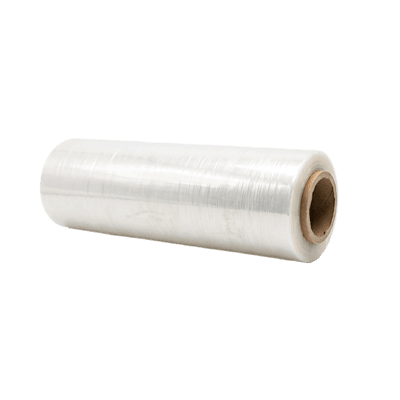
Cast stretch wrap is LLDPE film extruded as a flat sheet onto a chilled roll, which sets it almost instantly. Blown film leaves the die as a tube, gets inflated into a bubble, and cools in air. Most cast wrap is co-extruded in several layers. That lets a producer put cling on the inside face and a slicker skin on the outside, with tougher resin in the core. For each step of the process, see how stretch film is made.
Buyers tend to notice clarity first. Quick cooling against a polished roll leaves a smooth, low-haze surface, although resin choice and surface roughness move haze enough that two cast films can look quite different wrapped around the same pallet. If your pickers scan labels through the wrap, test the candidate at the layer count you’ll really apply.
The unwind is quieter and smoother. Cast rolls peel off with less noise and steadier tension than blown rolls. Some sellers call that silent. On a busy turntable you’ll still hear it, only less, and the level shifts with grade and wrapper speed.
Gauge also stays fairly even across the web, which lets a powered pre-stretch carriage pull the film hard without hitting the thin spots that start a tear.
Stretched hard over a sharp corner, many cast grades tear sooner than blown film of similar thickness. How much sooner depends on resin and layer design, and a test on your own load is the only way to find out. Our guide to cast vs blown stretch wrap compares the two side by side and explains when blown film is worth testing.
Shrink film is a separate product. Heat tightens it. Stretch wrap holds by pulling back after it’s stretched, so if a quote mentions a heat tunnel or shrink gun, you’re looking at a shrink system.
Which cast stretch wrap specifications matter most?
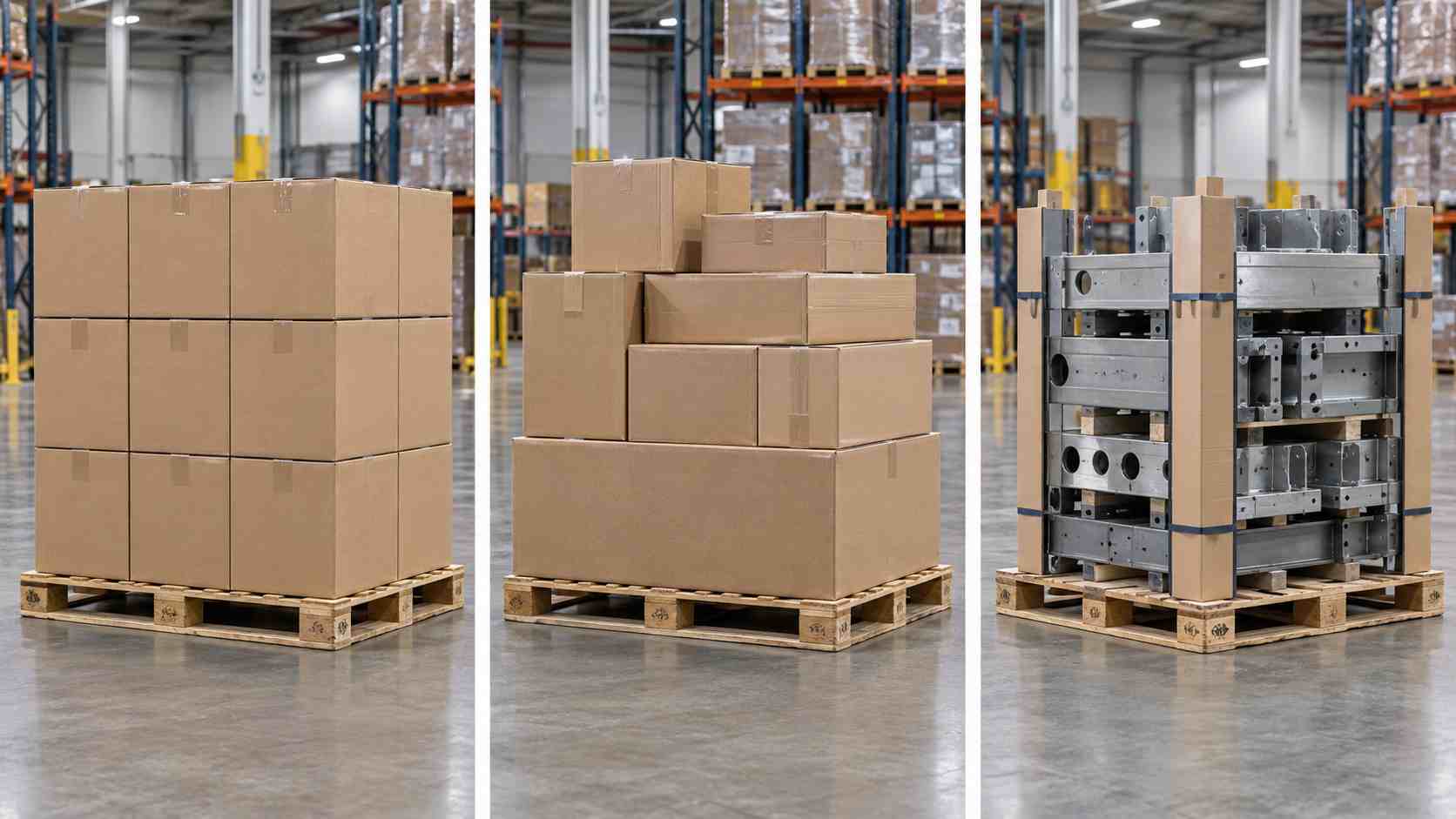
Five things decide whether a cast film fits: thickness, width, pre-stretch rating, cling, and roll format. Thickness trips people up first.
How do gauge, mil, and micron convert?
One mil is 0.001 inch, or exactly 25.4 µm (NIST Handbook 133, Appendix E). The stretch film trade counts 100 gauge per mil. So 1 gauge is 0.254 µm.
| Gauge | Mil | Microns (µm) |
|---|---|---|
| 47 | 0.47 | 11.9 |
| 60 | 0.60 | 15.2 |
| 63 | 0.63 | 16.0 |
| 70 | 0.70 | 17.8 |
| 80 | 0.80 | 20.3 |
| 90 | 0.90 | 22.9 |
| 100 | 1.00 | 25.4 |
| 120 | 1.20 | 30.5 |
Be careful with “equivalent gauge.” A roll labeled “80-gauge equivalent” can measure well under 80 gauge on a micrometer. The label is the seller’s performance claim, so ask for the measured caliper, then trial the film and decide for yourself whether the equivalence holds.
What gauge should you start with?
These are our starting points for machine cast film on a powered pre-stretch wrapper, with mostly square loads. They come from packaging practice and serve as a first pick for a trial. ASTM publishes no such table, and ASTM D4649, its guide to selecting stretch film, doesn’t tie gauge to pallet weight.
| Pallet weight | Starting gauge | Approx. µm |
|---|---|---|
| Under 800 lb (363 kg) | 47–60 ga | 12–15 |
| 800–1,800 lb (363–816 kg) | 60–80 ga | 15–20 |
| 1,800–2,400 lb (816–1,089 kg) | 80–90 ga | 20–23 |
| Over 2,400 lb (1,089 kg) | 90–120 ga | 23–30 |
The lightest band includes 47 gauge (about 12 µm), which only some high-performance films reach; Tuosheng Packaging’s thinnest cast film is 15 µm (about 60 gauge).
A 1,500 lb pallet of bagged product or tall, light cartons can be hard to hold, while a tight 2,200 lb block of cases sits happily in thinner film, so treat weight as a rough proxy.
Step up one band for hand wrap. Pre-stretch there is low and uneven. Do the same for tall or top-heavy loads, sharp edges, and rough routes such as LTL freight that passes through several cross-docks. Step down only when measured containment force and arrival inspections both hold with the thinner film. Wrapper settings move the answer too, since carriage tension, revolution count, and extra wraps at the top and base can each push the right gauge up or down a band.
How do you pick width, pre-stretch, and cling?
Hand rolls run 12 to 18 in (300 to 450 mm), and 18 in is the usual compromise between coverage and arm fatigue. Machine rolls are mostly 20 in (500 mm). A 30 in (750 mm) roll helps on tall loads if the carriage accepts it. Film narrows as it stretches, which the trade calls neckdown, so set overlap on the stretched width.
Pre-stretch percentages describe added length. At 200%, a foot of film leaves the carriage as 3 ft. At 300% it becomes 4 ft, before neckdown and breaks take their share. Powered pre-stretch carriages commonly run 200 to 300%, and brake-tension wrappers and hand wrapping get far less, with more variation from pallet to pallet. Choose a film rated comfortably above what your carriage delivers so it isn’t running at its limit on every load. Extra stretch mostly buys yield. A controlled ISTA 3E study found no link between higher pre-stretch and better load containment.
Cast stretch film clings on both sides, which helps a hand-wrap tail stay put without tape. Peel cling on stretched and unstretched film can be measured with ASTM D5458.
Color-coded SKUs call for tinted grades. Bare steel that needs rust protection is better packed in VCI shrink film. Our guide to what VCI film is and how to choose it explains when a load needs it.
How do Type A, B, and C loads change the film choice?
We use Type A, B, and C as a quick way to sort pallets by shape and puncture risk. ASTM and ISTA don’t define these classes. The shorthand is common in unit-load work: Type A is uniform, Type B has protrusions under about 3 in (75 mm), and Type C has protrusions beyond that.
| Type | Typical loads | Initial film choice | Test focus |
|---|---|---|---|
| A: regular | Same-size cases, flush with pallet edges | Standard or thinner high-performance cast, the best place to try downgauging | Containment force, film weight per pallet, tail hold |
| B: generally irregular | Mixed case sizes, stepped layers, slight overhang | Cast at the top of its gauge band or a puncture-resistant cast, plus corner boards on exposed corners | Breaks at corners, top-layer containment |
| C: sharp protrusions | Angle iron, machined parts, pipe ends, strapped crates | Puncture-resistant or reinforced cast, or blown, after edge protection | Breaks per 100 pallets, puncture, damage on arrival |
With Type C, fix the load first. Edge boards and top caps take the sharp corners out of play, and many wrappers let you drop pre-stretch or add wraps at the protrusion zone. If cast still tears after that, trial a reinforced cast and a blown film side by side on the same wrapper at the same settings. Keep whichever gives fewer breaks at a cost per accepted pallet you can live with.
For ranking candidates before a pallet trial, ASTM D5748 measures protrusion puncture force and energy with a standard probe. A probe is one shape of sharp edge. Your angle iron is another, which is why a good lab result still needs a shipping trial behind it.
How do you calculate cost per pallet?
Cost per pallet is everything you spend on wrapping, divided by the pallets that passed inspection. Weigh the roll before and after a counted run of pallets to get grams of film per pallet, then multiply by your price per kilogram and add rewrap labor and downtime.
Cost per accepted pallet = (film cost + rewrap labor + downtime) ÷ accepted pallets
A thinner high-performance cast film can cost more per kilogram and still come out cheaper per pallet if it uses less film and breaks less often. Our guide to calculating stretch film usage and cost per pallet has the full cut-and-weigh method and a worked example.
Cast Hand Stretch Wrap vs Cast Machine Stretch Film: Which Fits?
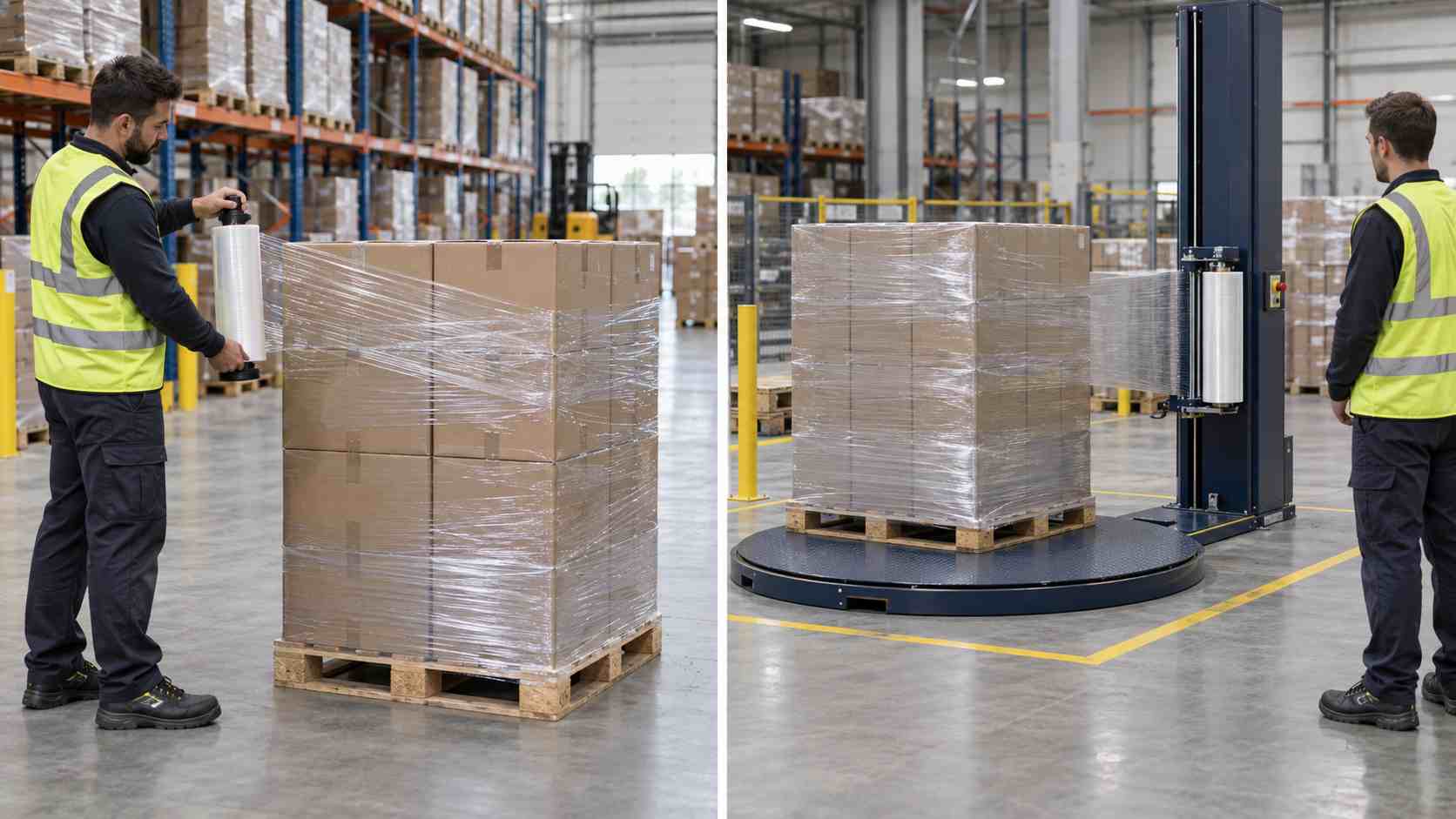
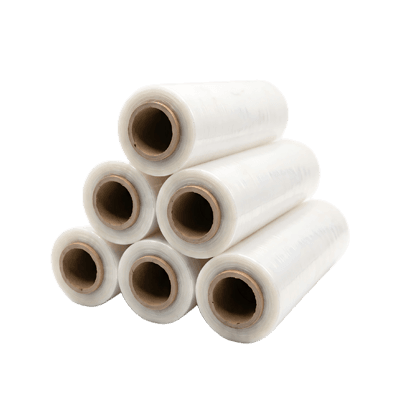
Cast hand stretch wrap fits low or uneven volume, mixed load shapes and docks with no room for a wrapper. Cast machine stretch film fits steady volume and repeat loads, where every pallet needs the same tension.
| Tuosheng cast hand stretch wrap | Tuosheng cast machine stretch film | |
|---|---|---|
| Applied by | An operator walking around the pallet | A turntable or automatic wrapper |
| Thickness | 15–50 µm (about 60–200 gauge) | 15–50 µm (about 60–200 gauge) |
| Width | 250–500 mm (about 10–20 in) | Mostly 500 mm (20 in) |
| Roll length | 150–457 m (about 490–1,500 ft) | 800–2,000 m (about 2,600–6,500 ft) |
| Core | 76 mm (3 in) paper core | 76 mm (3 in) paper core |
| Stretch | Low and set by the operator | Powered pre-stretch; selected mLLDPE grades up to 400% |
| What it means | Uses more film by weight per pallet, but needs no equipment | Uses less film per pallet once the wrapper is set up |
With hand wrap, someone walks backward around every pallet holding a roll. Tension varies from person to person and drifts over a shift. The bending and twisting add up, and OSHA lists a mechanical stretch wrapper among its controls for warehouse ergonomic risk.
Whether a wrapper pays for itself depends on your pallets per day, labor cost and film saving:
Savings per pallet = (hand film + hand labor) − (machine film + machine labor + maintenance per pallet)
Payback in months = installed equipment cost ÷ (savings per pallet × pallets per month)
Count labor savings only if the freed minutes go to other work. Our guide to machine vs. hand stretch film compares the two in more detail.
How do you choose cast stretch wrap in four steps?
Work through load, equipment, measured performance, then environment and cling.
Step 1: Assess the load. Record weight, footprint, height, Type A/B/C profile, sharp corners, overhang, and the route, whether that’s LTL, full truckload, export container, or stacked storage. Group SKUs into a few load families and trial the hardest pallet in each.
Step 2: Check the equipment. For machine film, confirm the pre-stretch type and the ratio the carriage really delivers, plus carriage width, core size, maximum roll weight and diameter, and cling face orientation. A film that doesn’t fit the carriage, or runs near its stretch limit, breaks however good it is. Film faults and wrapper faults look alike from the dock floor. Test on your own machine.
Step 3: Compare holding force, film use, and breaks. This is where you find out whether the wrap is strong enough. ASTM D8314 covers performance testing of applied stretch film in the lab or in the field and leaves the pass criteria to you. Start with a baseline on your current film. Then run each candidate at written-down settings, measuring containment force at the same spots on every pallet (top, middle, and bottom work fine) and weighing the film each one uses. Log breaks and tail failures across a few dozen pallets and at least two shifts. Last, ship some trial pallets on real routes or through a distribution simulation and look at them when they arrive.
Give wrap pattern as much attention as the film. In one published transport test, changing only the pattern changed how much the load swayed, with film weight about the same.
Step 4: Confirm environment and cling. Cold rooms, freezers, hot trailers, and dusty docks all change how film clings and stretches, so test at the temperature where the pallets will sit. If pallets will touch in transit, check that wrapped loads separate cleanly at unloading.
Before ordering, ask for a data sheet with measured thickness, width and core, roll length and net film weight, rated stretch and its test method, cling configuration, and puncture data with the method named. Tuosheng Packaging can send specification sheets and sample rolls to run against your current film through the four steps above.
What else do buyers ask about cast stretch wrap?
Is cast stretch wrap the same as cast stretch film?
Yes, cast stretch wrap and cast stretch film are the same product: LLDPE pallet film made on a cast extrusion line. Suppliers use both names.
How many pallets will one roll of cast stretch wrap cover?
Your load and wrapper settings decide it, so treat any quoted figure as a guess until you’ve weighed. Divide the roll’s net film weight by the grams one pallet uses. As an illustrative example, an assumed 16 kg net roll at 220 g per pallet covers about 72 pallets, less whatever breaks and re-wraps eat.
Can cast stretch wrap be used for outdoor storage?
Cast stretch wrap is made for indoor use, and ASTM D4649 limits its guidance to indoor unitizing, warehousing, and transport. Sunlight breaks the film down over time, so keep wrapped pallets under cover and limit how long they stand in an open yard.
Can hand stretch film run on a stretch wrapper?
Rarely well. Hand rolls tend to miss the carriage on core size, width, or roll weight, and they aren’t made for powered pre-stretch at 200% or more, so breaks pile up fast. Order a machine grade rated above the stretch your carriage delivers.
Recommended Tuosheng Packaging Solution
Tuosheng Packaging manufactures hand stretch film and machine stretch film in Suzhou, China, with customizable thickness, width, roll length and export packing.