
How to Stretch Wrap a Pallet Correctly
Freight damage from bad wraps costs billions a year. Crushed cartons, rejected shipments at the receiving dock, chargebacks from retailers, workers dodging toppled freight in the staging lane. Most warehouses never formally train their teams on wrapping pallets, and the damage claim filings reflect it every quarter.
The film itself rarely fails. Application technique does.
A pallet can look secured and still come apart 40 miles down the highway because containment force depends on three things happening together: the film bonds freight to the wooden deck, coverage runs continuous with no single-layer gaps, and the weak zones at the base, top tier, and midsection get targeted reinforcement against lateral G-forces from braking and cornering. Miss one, and even premium 80-gauge cast stretch film won’t hold a load through a rough LTL route with six stops.
This covers the correct procedure for applying pallet stretch film, from stack prep through final anchoring. Physics of containment force don’t change whether you’re using a hand stretch film roll and dispenser or a semi-automatic turntable.
Pre-Wrap Preparation: Building a Structurally Sound Stack

Misaligned cartons. Product hanging off the edge. Light boxes getting crushed under heavy ones. A bad stack defeats any film, and your wrapping procedure can only contain what the stack beneath it allows.
Stacking Pattern and Weight Distribution
Before film touches the pallet, check four things.
Column stacking (boxes directly on top of each other) works for uniform carton sizes, and brick stacking (offset like masonry courses) gives better interlocking for mixed cases. Random and pyramid stacking are never acceptable on a commercial dock. Our guide to pallet stacking patterns compares the options and what each one asks of the film.
Heaviest cases go on the bottom tier, which drops center of gravity and keeps heavy freight from crushing lighter product below. Any carton past the 48×40-inch GMA deck footprint becomes a lever arm in transit. It catches trailer air turbulence, puts point-load stress on the film, tears through eventually. Top tier needs to be flat enough for a plastic top cap or cross-corner film tie, because uneven tops let boxes walk laterally under vibration.
Load Profile Assessment
Assess what you’re wrapping before picking film and tension. This stretch film selection guide explains how film type, gauge, construction, and application method relate to different load profiles. Uniform loads (all rectangular cartons, flush surfaces) do fine with standard 80-gauge cast at normal tension. Mixed loads with minor protrusions need heavier gauge or corner edge boards at the protrusion points. Sharp or irregular loads (metal edges, exposed hardware, pointed angles) need puncture-resistant film plus corner boards together; our guide to heavy duty stretch wrap covers how to choose it.
Friction sheets between layers cut horizontal shear movement on mixed and irregular profiles.
If a load needs a full cover over the top and sides rather than a spiral wrap, compare stretch wrap vs shrink wrap before you choose the method.
Anchoring the Film and Executing Base Wraps
Wrap only around the lower cartons without bonding to the wooden deck, and the entire load slides off during transit. Lateral G-forces during braking, cornering, and road vibration create shear that separates the carton cluster from the deck surface. We see this wrapping pallet failure in damage investigations constantly, and it is the single biggest mistake in commercial shipping operations.
The Anchoring Sequence
- Thread the film tail through the pallet deck. Pull the leading edge through the gap between bottom deck boards at one corner, fold it back onto itself, press it against the lower carton face. You now have a mechanical anchor that resists pull-out.
- Execute 3 to 5 aggressive base wraps. Walk forward around the pallet with a downward film angle so each revolution catches both wooden deck boards and the lowest carton row. These wraps aren’t gentle. Firm tension creates shear-resistant bonding between pallet timber and freight above.
- Overlap each revolution by at least 50%. Double-layer coverage at the base is where you resist the highest concentration of lateral forces.
Pallets arriving at destination with shifted freight but intact film? Problem is here. Insufficient base wraps, or wraps that missed the deck boards.
LTL shipments (more stops, more handlers, more braking events) need 5 full base revolutions. Dedicated FTL with minimal handling can work with 3.
Spiral Wrapping Technique and Top Tier Protection

Once the base is locked, wrapping pallet loads from bottom to top means continuous overlapping coverage building cumulative containment force across the full stack height.
The Upward Spiral
Start from the top of your base wrap zone. Angle the film roll slightly upward, walk forward, and hold these parameters.
50% film width overlap on every revolution gives double-layer coverage on every square inch of load surface. Drop below 50% and single-layer gaps become hinge points. The load flexes inward at those weak zones, creating the “hourglassing” where the midsection pinches under compression. You can spot this on pallets before they leave the dock, and it’s a sign to rewrap.
Stretch tension must stay consistent from base to top. Steady pull, or set your dispenser brake to a fixed resistance. Inconsistent tension creates alternating tight and loose bands that trap air pockets and let the load move around locally within the wrap.
Face forward, sidestep around the pallet. Walking backward is how operators trip over dock plates, floor debris, and neighboring pallets.
Continue until you hit the top tier.
Locking the Top Tier
Upper cartons get the highest sway amplitude in transit and take full braking force.
- 2 to 3 full horizontal wraps around the top box layer. Horizontal, not spiraling. Creates a unified band stopping individual boxes from walking laterally.
- Cross-corner film tie or plastic top cap. For fragile or high-value freight at the top, fold film diagonally across the top surface corner to corner. Or place a rigid plastic or corrugated cap before final wraps. Prevents upward displacement, adds weather protection for outdoor staging. A capped pallet still isn’t rainproof on its own; see is stretch wrap waterproof for the other weak spots.
- Spiral back down with 50% overlap. Reverse direction, descend toward the base with the same overlap and tension. Adds a third coverage layer over the midsection.
Tear the film cleanly, press the tail flat. Loose tails catch on conveyors, neighboring pallets, and forklift masts.
Film Cabling: Solving the Forklift Puncture Problem

You need film as low as possible for maximum load-to-deck bonding, but forklift tines entering pallet openings puncture any flat film across the entry zone. One rip at the base and the whole pallet wrapping job is compromised.
How to Execute a Film Cable
- After base wraps, let approximately 5 inches of film web hang below the top deck boards.
- Roll that loose material upward into a tight, dense rope (the cable) with your hand or dispenser handle.
- Position the cable approximately 1 inch below the top surface of the deck boards.
- Run 2 to 3 additional revolutions with the cable rolled, locking it around the perimeter.
The cable is a dense, high-tension band anchoring load to pallet frame without exposing flat film to incoming fork tines. Forklifts enter through the lower deck opening, pass beneath the cable without touching it. You get full base anchoring without the puncture risk that plagues standard flat-wrap applications in high-traffic environments.
When to Use Cabling vs. Standard Base Wraps
Standard environments with trained operators and consistent entry angles can rely on base wraps catching the deck. High-traffic 3PL warehouses where forklift operators vary in skill need cabling as puncture insurance. Multi-handler shipments (LTL, cross-dock, intermodal) should always get cabled. Your pallet will go through operators you can’t train or supervise.
Operator Safety, Dock Audit, and Troubleshooting
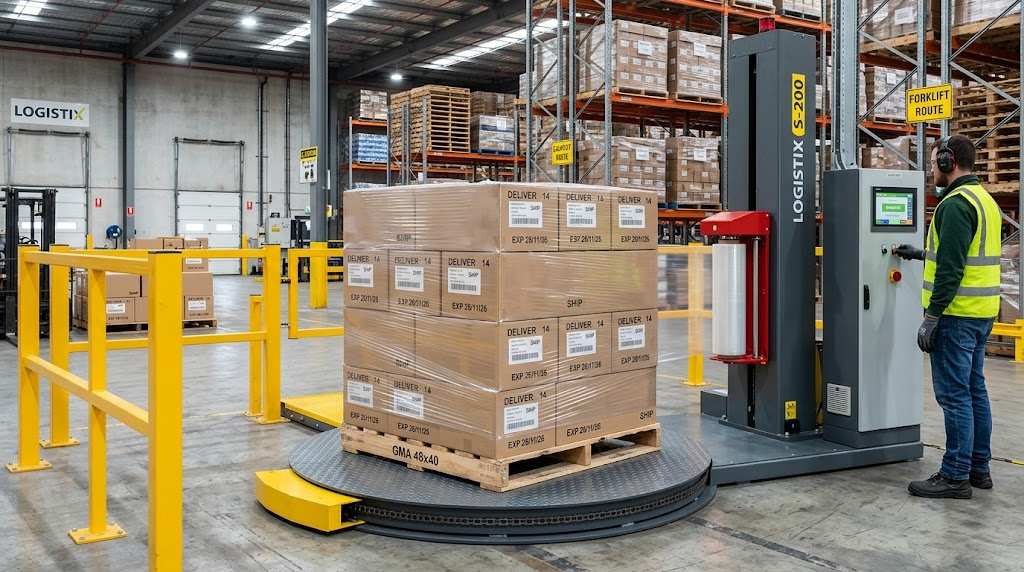
Hundreds of revolutions per shift, arms extended, walking circles on concrete. Stretch wrapping generates real ergonomic and mechanical hazards that accumulate across weeks and months. Building safety into the SOP protects your team and limits liability exposure when OSHA walks the floor. For film that tears, won’t cling or leaves loose tails, see hand stretch film troubleshooting.
Manual Wrapping Ergonomics and Machine Guarding
Manual hand wrapping creates three injury risks.
Lower back rotational strain from walking circles while controlling film tension. It loads the lumbar spine asymmetrically. Train operators on neutral spinal posture, keep dispensers at waist height, rotate wrapping duties on shifts exceeding 4 hours.
Backward walking trips. Operators facing the pallet and moving backward catch floor debris, adjacent pallets, dock plate edges. Correct technique: face forward, sidestep around the pallet.
Wrist fatigue from sustained grip pressure on manual dispensers builds across a shift. Ergonomic dispensers with extended handles and mechanical brakes cut grip force enough to matter over 8 hours.
For operations wrapping 15-20+ pallets per shift, semi-automatic turntable wrappers using machine stretch film start making sense economically. Breakpoint lands between 15 and 40 pallets per day depending on load complexity and labor costs.
Semi-automatic machines fall under OSHA 29 CFR 1910.212. The rotating turntable creates an ingoing nip point where platform meets stationary floor, and barrier guards, safety mats, or light curtains must block operator access during rotation. Powered film carriage contains gears, chains, and nip points needing physical guarding or electronic interlocks. E-stop controls must sit within immediate reach of the operator’s standing position.
Employers own verifying purchased equipment meets guarding requirements. Machines bought without guards need retrofitting before anyone uses them. OSHA doesn’t maintain a separate standard for stretch wrappers specifically. 29 CFR 1910.212 covers them under general machine guarding.
Running auxiliary high-tensile polyester strapping alongside stretch film for heavy, un-nested metal components? Build those strapping tool safety protocols into the same SOP.
Wrap Quality Checklist and FAQ
When every pallet leaves your dock with proper base anchoring, 50% spiral overlap, top-tier locking, and appropriate cabling, transit damage rates drop regardless of carrier handling.
Build these into your dock audit:
- Stack integrity verified before wrapping begins
- 3-5 base wraps capturing deck boards confirmed
- 50% overlap maintained through midsection spiral
- 2-3 top wraps executed with cap or cross-corner tie
- Film cable applied on multi-handler shipments
- Film tail pressed flat, no loose ends
- Operator facing forward throughout
Why does my pallet load shift even though the stretch film is still intact after transit?
Film contained the cartons but didn’t bond them to the deck. Base wraps missed the wooden deck boards, so the entire carton cluster slides as a unit during braking and cornering. Add 3-5 base revolutions catching both timber and lower cartons.
How do I prevent stretch film from tearing at the base when forklifts enter the pallet?
Roll the bottom 5 inches into a tight cable positioned just below the top deck boards. Dense rope anchors the load without exposing flat film across the entry zone. Fork tines pass beneath it.
What causes the “hourglass” shape where the middle pinches inward?
Inconsistent overlap in the midsection. When spiral revolutions drop below 50% width overlap, single-layer zones become hinge points where the load flexes inward. Hold 50% through both upward and downward spirals.
When should we switch from manual hand wrapping to a semi-automatic machine?
When throughput exceeds 15-20 pallets per shift, or when operators report fatigue-related inconsistency in wrap quality across the back half of their hours. Semi-automatic turntables deliver consistent pre-stretch ratios and tension profiles that manual wrapping can’t match at volume, and they pay for themselves in reduced damage claims within the first year at most operations running above 25 pallets daily.