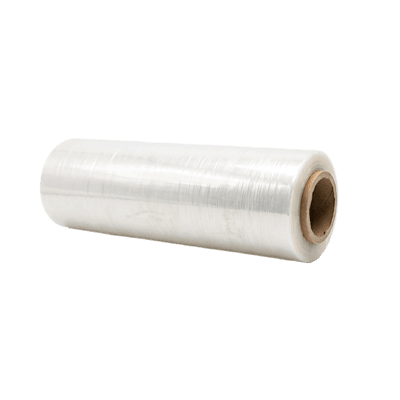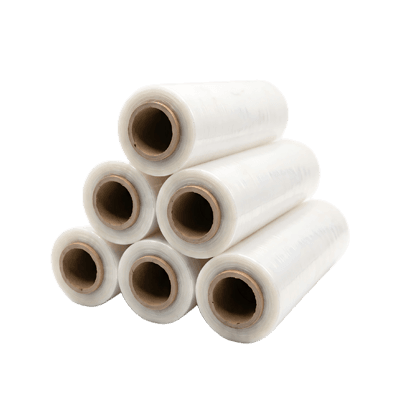
Is Stretch Wrap Waterproof? What It Can and Cannot Protect on a Pallet
By Tuosheng Packaging · Last updated October 2026
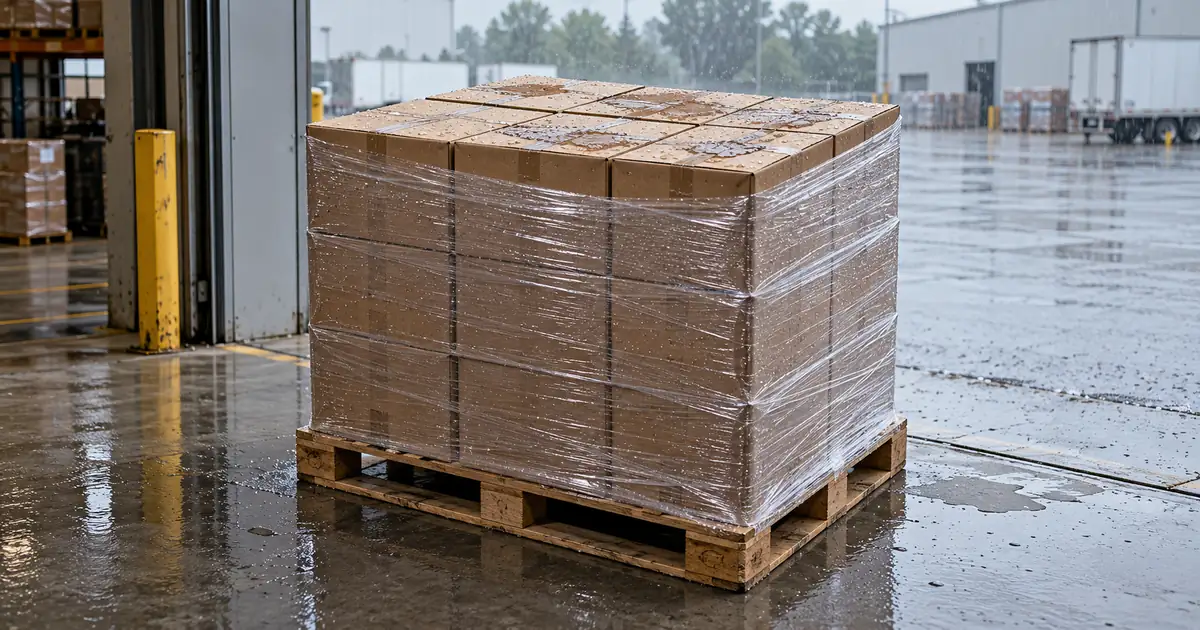
Is stretch wrap waterproof? Stretch film does not let liquid water through, but a stretch-wrapped pallet is not waterproof. Spiral wrapping covers the four sides and usually leaves the top open, the base sits on a pallet and a floor that can both be wet, and the film layers only cling to each other rather than seal. Add a forklift tear or a carton corner pushing through, and water has several ways in.
The better question is where the water gets in, and what you add to keep it out. Tuosheng Packaging makes hand and machine stretch film in Suzhou, China. This guide covers what the film does, where it stops, and how to read wet cartons to find the weak spot.
Quick answer
- Stretch wrap film keeps out dust, splashes and light handling moisture.
- A stretch-wrapped pallet is not rainproof: water gets in at the top, the base, the film overlaps and any tears.
- Stretch wrap does not stop condensation inside a shipping container, and it can trap moisture from wet pallets.
- To keep a pallet dry, combine a top sheet, base wraps that reach the pallet deck, and covered storage.
Is Stretch Wrap Waterproof?
Stretch wrap film itself is a water barrier: polyethylene doesn’t absorb water, and liquid water can’t pass through an intact layer. A stretch-wrapped pallet is a different matter. It’s only as dry as the film coverage, and that coverage has gaps from the start.
| Exposure | Stretch film itself | A stretch-wrapped pallet | What to add |
|---|---|---|---|
| Dust and splashes | Keeps them out | Mostly protected on the sides | Nothing for indoor use |
| Rain | Water runs off the film | Wet top layer; water can run down the overlaps | Top sheet or cover; covered storage |
| Standing water on the floor | Not the problem | Bottom cartons can wick water from the floor or pallet | Dry pallets; base wraps onto the deck; keep off wet floors |
| Condensation in a container | Can’t stop it | Drips land on the top; moisture forms inside the film | Dry pallets and container; moisture control |
| Direct sunlight | Breaks down over time | Film weakens and can split | Covered storage |
Standard stretch film is made for indoor use. ASTM D4649, the standard guide for selecting and using stretch wrap films, limits its scope to indoor unitizing, warehousing and transport, which is why a wrapped pallet left in an open yard is outside what the film is designed for.
Stretch wrap is there to hold cases together and tie the load to the pallet, as our guide to containment force and pallet stability explains. Keeping water out is a side effect.
Where Does Water Get Into a Stretch-Wrapped Pallet?
Water gets into a stretch-wrapped pallet at five weak spots. None of them is a film defect. They come from how spiral wrapping covers a load and what happens to the pallet afterwards.
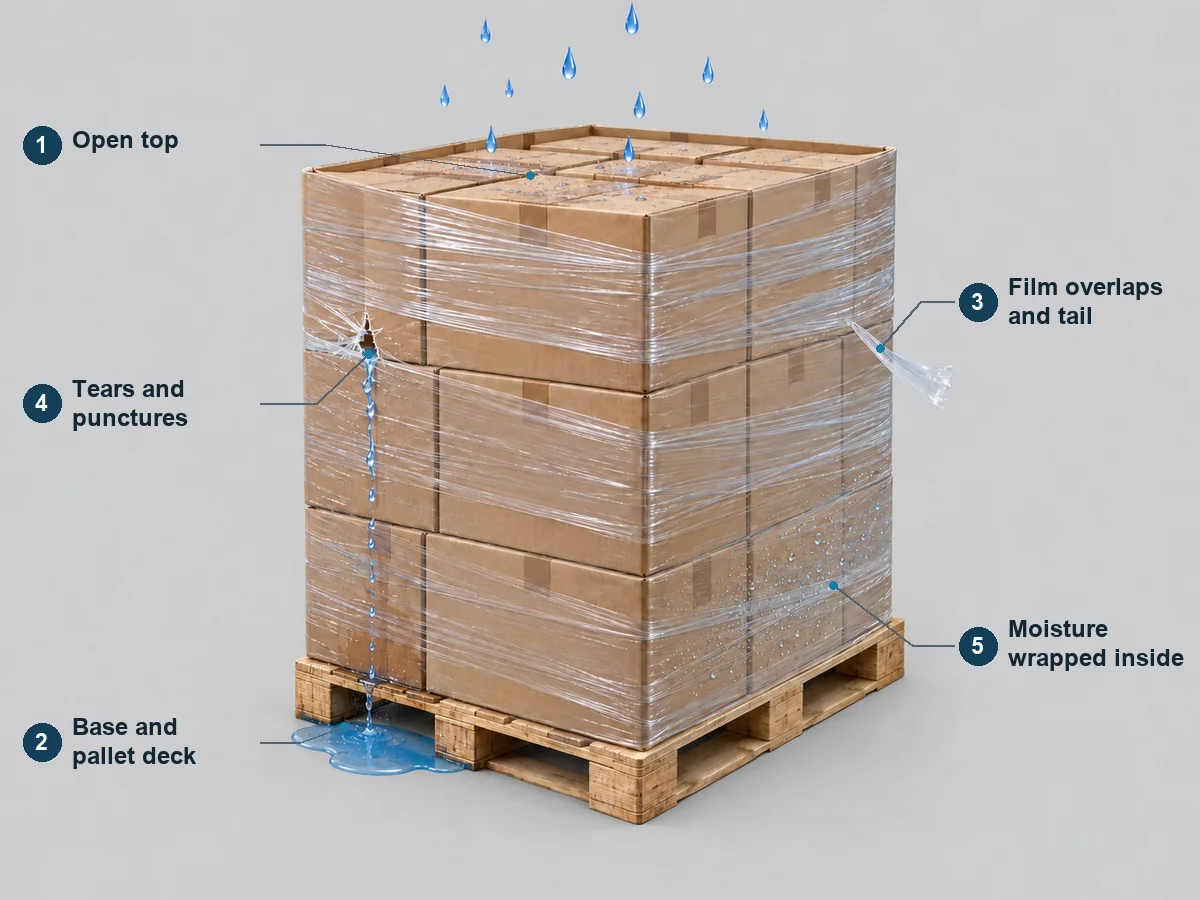
- The open top. Spiral wrapping covers the sides, not the top face. Rain, roof leaks and drips from a container ceiling land straight on the top layer of cartons.
- The base and pallet deck. When the film stops above the pallet, water from a wet floor or a damp pallet can reach the bottom cartons from below. Timber pallets carry moisture of their own.
- Film overlaps and the tail. Each layer of stretch wrap clings to the one beneath it. Cling is not a seal. Driven rain runs along the overlaps, and a loose tail lifts and lets water behind the film.
- Tears and punctures. Forklift tines, sharp carton corners and pallets rubbing in a trailer open holes, and stretched film keeps tearing from there. If tears are frequent, start with our guide to heavy-duty stretch wrap for heavy and irregular pallets.
- Moisture wrapped inside. Damp pallets, damp cartons or product that is still warm from the line hold moisture that can’t escape once the film is on. As the load cools, that moisture condenses on the inside of the film. Pallets moving between cold rooms and warm docks see the same effect; our guide to stretch film for cold storage and freezer pallets covers that case.
How Can You Tell Where the Water Came From?
Where the water marks sit on a damaged pallet usually points to the weak spot that let water in. Photograph the pallet before you unwrap it, then compare the damage with this table.
| Where the damage is | Likely cause | Fix next time |
|---|---|---|
| Only the top layer of cartons is wet | Open top: rain, a leak or drips from a container ceiling | Add a top sheet or cap before the final wraps; check how the container was loaded |
| Only the bottom layer is wet | Wet floor, damp pallet, or film that stops above the deck | Use dry pallets; wrap the base onto the deck; keep loads off wet floors |
| A wet streak down one side | A tear or an open overlap on that face | Check corners, corner boards and forklift handling; keep 50% overlap |
| Droplets inside the film and the whole load feels damp | Moisture wrapped in with the load, or condensation | Make sure pallets, cartons and product are dry and cool before wrapping |
It narrows down the cause; it doesn’t prove it. Keep the photos with the shipment details for any conversation with the carrier or your insurer.
Why Do Goods Still Get Wet Inside a Shipping Container?
Goods get wet inside a shipping container because the container makes its own water. Temperature swings make moisture condense on the ceiling and walls and drip onto the cargo (container rain), or condense on the goods themselves (cargo sweat). Stretch wrap can’t stop drips from above, and it can’t remove the moisture that pallets and cargo bring in.
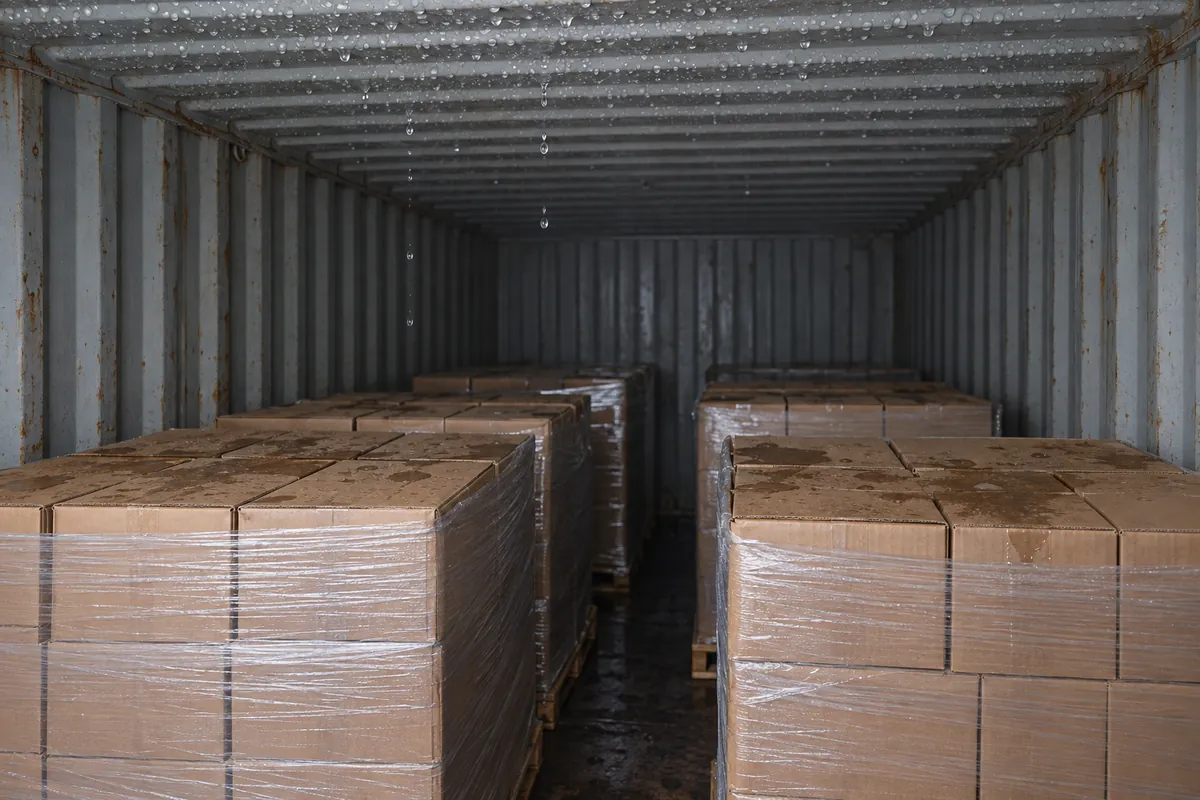
A marine surveyor writing for the International Institute of Marine Surveying, Neale Cawse of McLarens Marine, makes three points buyers should know:
- No container is airtight, and condensation can form even in an undamaged box.
- Insurers don’t treat condensation damage as a fortuitous loss, so it is generally not covered under the Institute Cargo Clauses (A). Check the wording of your own cargo policy.
- The moisture comes from timber pallets and dunnage, the cargo itself, the air inside the container, and water left behind after the container was cleaned.
His prevention list is short: use only dry pallets and dunnage, dry the container completely before loading, use moisture-absorbing products or dehumidifiers, and break down palletized cargo soon after unloading. Your packaging or logistics provider can advise on top sheets and desiccants for your route. If you import stretch film itself, our guide to importing stretch film from China covers how to write moisture protection into the export packing terms.
How Do You Wrap a Pallet So It Sheds Water Better?
Stretch wrap can cut how much water gets in, but it can’t make a pallet rainproof on its own. A pallet stays dry when the top is covered, the base wraps reach the pallet, the film is intact and the load sits under cover.
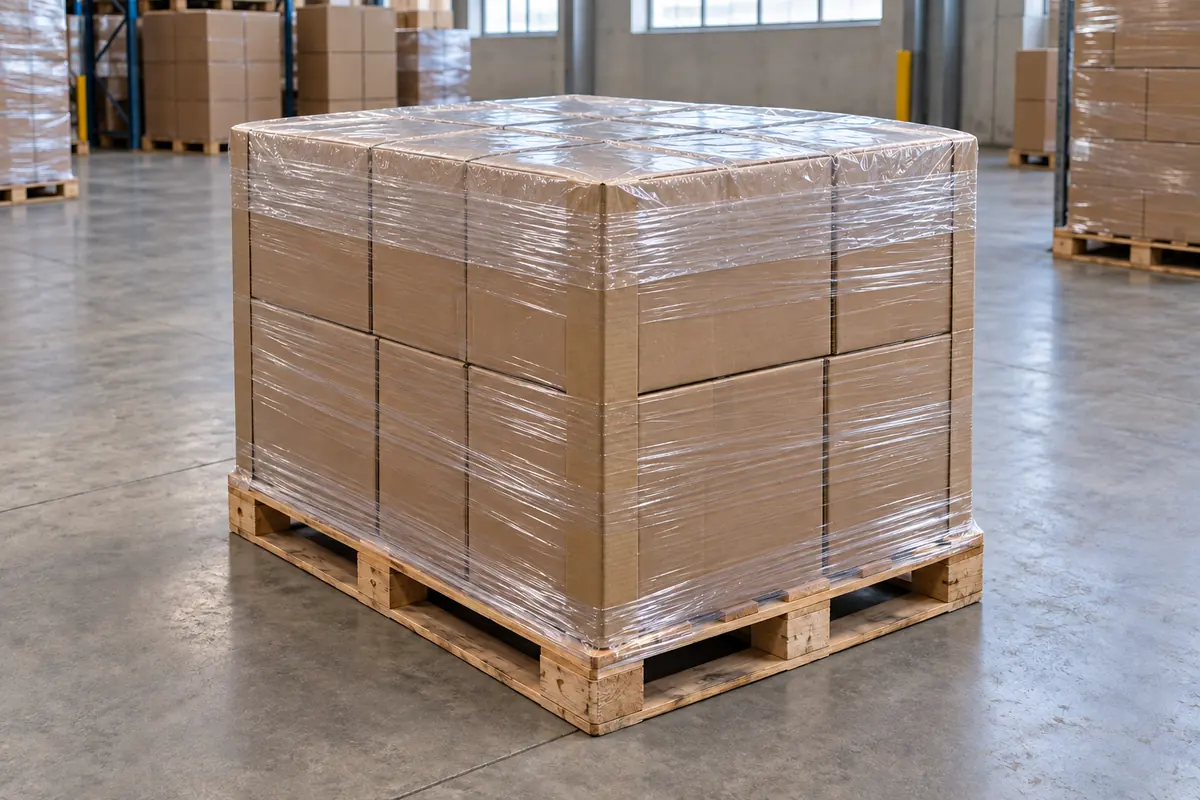
- Top: lay a top sheet or a plastic or corrugated cap over the load before the final wraps so the side film holds its edges, or tie film diagonally across the top corner to corner. Our guide on how to stretch wrap a pallet correctly shows the top-tier sequence.
- Base: run 3 to 5 base wraps that catch both the pallet deck boards and the lowest row of cartons.
- Sides: keep a 50% overlap on every revolution and press the tail flat.
- Corners and handling: add corner boards on sharp edges, and use a film cable at the base where forklift tines tend to tear the film.
- Moisture: don’t wrap wet pallets or damp cartons, and let warm product cool before wrapping.
- Storage: keep wrapped pallets off wet floors, and indoors for anything beyond short staging.
Whatever the method, don’t call a pallet rainproof until you’ve tested it against what it will really face: how long it stands outside, how long it travels, and in what weather.
Stretch Wrap, Top Sheet, Hood or Tarp: Which Keeps Rain Off?
Stretch wrap alone protects the sides of a pallet, not the top. Adding a top sheet closes that gap, and a full hood, such as a plastic pallet cover, covers the top and sides in one piece.
| Method | Top | Sides | Base | Note |
|---|---|---|---|---|
| Stretch wrap only | Open | Covered | Covered only if wrapped onto the deck | Fine for indoor storage and transport |
| Stretch wrap plus top sheet | Covered | Covered | As above | Seal the sheet’s edges under the final wraps |
| Shrink hood or stretch hood | Covered | Covered | Open at the bottom | A one-piece cover; check coverage and fit on your load |
| Tarp over pallets outdoors | Covered | Partly | Exposed | Pallets stored outside can still absorb a lot of moisture under a tarp |
The tarp row comes from the same IIMS article: pallets stored outside, even under tarps, can quickly absorb significant moisture. Our stretch wrap vs. shrink wrap guide compares the two film types in more detail.
Does Thicker Stretch Film Keep Water Out Better?
Thicker stretch film resists punctures better, and fewer tears mean fewer ways in. But no gauge closes an open top or stops condensation. Fix the top and the base first, then pick the gauge for the load’s corners, weight and route with our 60 vs 80 gauge stretch wrap guide and the stretch film thickness guide.
Is Stretch Wrap Waterproof? FAQ
Is pallet wrap waterproof in the rain?
Pallet wrap does not keep a pallet dry in the rain. The film sheds water on the sides, but the top is usually open and rain also runs in along overlaps and tears. Add a top sheet and move the pallet under cover.
Can you store stretch-wrapped pallets outside?
Stretch-wrapped pallets can stand outside for short staging, but there’s no fixed safe time. Standard film is made for indoor use and sunlight weakens it. For anything longer, cover the top, keep pallets off wet ground and test for the real time outside.
Is shrink wrap more waterproof than stretch wrap?
Shrink wrap is not automatically more waterproof than stretch wrap. A shrink hood or bag can cover the top of the load, which spiral stretch wrapping usually leaves open, but its coverage depends on the cover design and how evenly it shrinks.
Is black stretch wrap more waterproof than clear?
Black stretch wrap is no more waterproof than clear stretch wrap; color doesn’t change how the film handles water. Black and colored film are used to hide contents or identify loads, as our guide to black and colored stretch film explains.
Does stretch wrap protect cartons from a wet floor?
Stretch wrap only protects the bottom cartons from a wet floor if the film is wrapped down onto the pallet deck, and even then water can wick up through a damp timber pallet. Keep pallets on dry floors and don’t use wet pallets.
Choose the Right Stretch Film for Your Load
Intact film is the first layer of moisture protection, and that comes down to the right gauge and wrap pattern for your load. Send us your load size, weight, any sharp corners and the shipping route, and we’ll recommend a hand stretch film or machine stretch film spec and send samples to test on your own pallets.
Recommended Tuosheng Packaging Solution
Tuosheng Packaging manufactures hand stretch film and machine stretch film in Suzhou, China, with customizable thickness, width, roll length and export packing.