
Somebody has to decide what color the film is, and that decision lands on procurement or the warehouse manager. Black stretch film hides what sits on the pallet. Tinted colors mark a destination, flag a QC hold, keep two production batches from getting mixed, or cut the hunt for one load in a crowded staging lane. Pick the color for the job it does on the floor and the reasoning holds up later, when someone asks why the film costs what it costs.
Pigment changes nothing about what the film has to do mechanically. It still needs cling, puncture resistance, and enough retained containment to hold the load through the trip, on whatever equipment applies it. Buy on color alone and you trade one problem for four: film breaks at the corners, loads leaning by the time they reach the dock, barcodes the scanners refuse, and heavier film consumption per pallet.
What follows is the color-by-color reasoning, plus the fields to put in an RFQ so the quotes come back comparable on opacity, gauge, roll format, and test conditions. For available colors and formats, see Tuosheng’s colored stretch film product range.
Table of Contents
- What Is Colored Stretch Film Used For?
- Black Stretch Film for Privacy and Load Concealment
- Blue Stretch Wrap for Warehouse and Pallet Identification
- Red and Orange Stretch Wrap for Load Classification
- Opaque Stretch Wrap vs Tinted Colored Film
- Colored Hand Stretch Film vs Machine Film
- How to Choose Custom Colored Stretch Wrap
- Colored Stretch Film Applications by Industry
- Frequently Asked Questions
What Is Colored Stretch Film Used For?
Colored film does the same unitizing job as clear film, with a visual or privacy function added on top. The base resin is LLDPE with pigment or color additive worked in. Two purchasing categories matter.
Tinted film stays translucent. Blue, red, orange, green, and yellow all let a picker see part of the load while still marking it, which is what makes them workable for internal routing, product-family identification, batch separation, FIFO, and QC status. How much shows through depends on pigment density and how many layers the wrapper puts down.
Opaque film hides the contents. Black and white are the usual picks when privacy outranks seeing through the wrap. In a shared warehouse, a cross-dock, or a transport staging area, an opaque web keeps branded cartons and high-value goods from advertising themselves to everyone walking past. Treat it as one layer of pallet security. Access control, seals, correct load restraint, and shipment monitoring still carry the security burden.
Color codes are not universal across warehouses and supply chains. One site runs blue for export, red for QC hold, orange for urgent handling, and green for released stock. The plant twenty miles down the road uses something else. Write yours into the warehouse SOP, put it on signs at packing and staging, and back it up with pallet labels somebody can read from a forklift. For regulated hazard communication or carrier instructions, color is never enough on its own.
Black Stretch Film for Privacy and Load Concealment
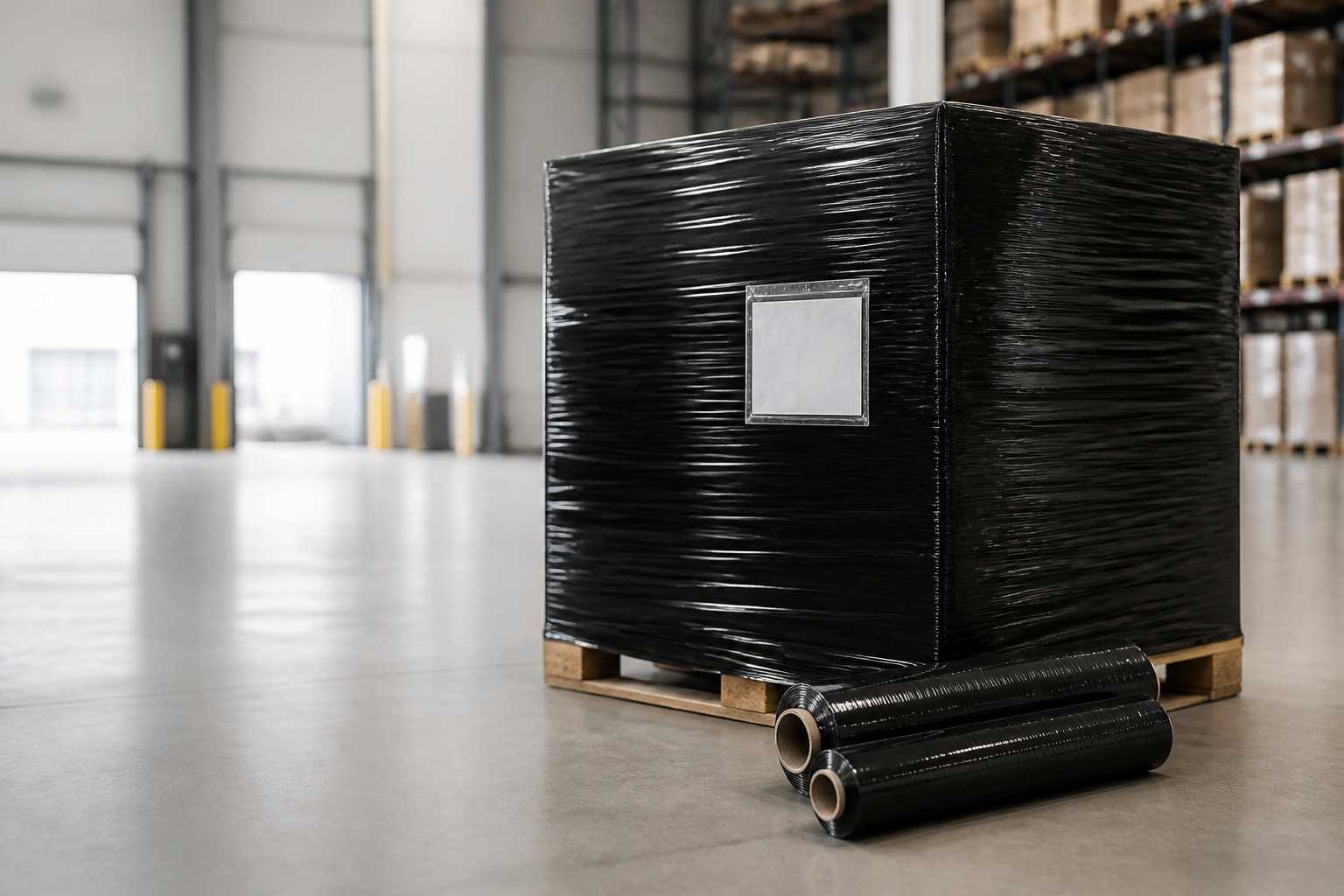
Concealment is the main reason to buy black stretch film wrap. By reducing the visibility of carton graphics, brand names, and SKUs, it can make electronics, branded consumer goods, export cargo, and other high-value loads less noticeable in shared or high-traffic areas.
Black pallet wrap can also make interference easier to notice. A clean cut, a rewrapped panel, a mismatched film layer, or a broken security label may stand out during inspection. A determined thief can still cut through the film.
Build concealment into a wider security process
For transport or cross-dock, the purchase spec needs opacity, thickness tolerance, puncture resistance, cling, roll dimensions, and the wrap pattern itself. The warehouse procedure needs the rest: where external labels go, seal numbers where you use them, which inspection points apply, and how somebody reports damaged film.
Don’t bury the routing label under an opaque web. Put the shipping label, barcode, and handling instructions on the outside of the finished wrap, or in a document pouch. And run one pallet all the way through the normal scan, dock, and carrier handoff before you convert every outbound load to black.
Treat outdoor performance as a separate requirement
Black pigment cuts light transmission. It doesn’t buy you an outdoor service life. Direct sun, heat buildup, how many weeks the pallet sits there, the formulation, and whether the grade carries UV stabilizer all decide that. If loads wait outside, ask for the UV specification in writing and run a wrapped pallet through a representative exposure cycle before committing. Black grades vary widely on UV resistance.
Blue Stretch Wrap for Warehouse and Pallet Identification
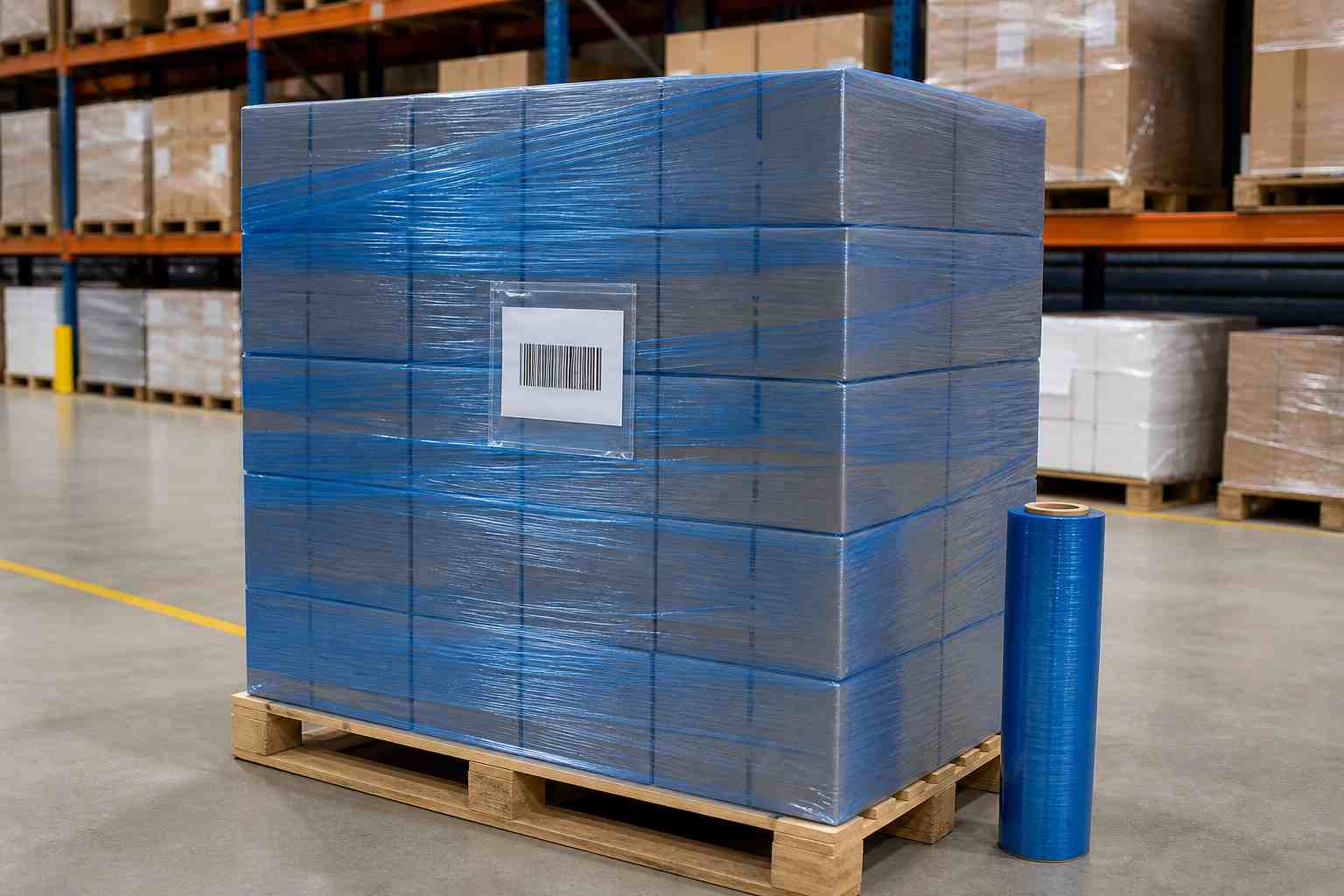
Blue stretch wrap gives separation at a glance while the goods stay visible. Sites assign it to international shipments, one customer account, the cold-storage zone, returned goods, a single production line. Consistency is what makes it pay off: an operator should know what a blue pallet means before reading anything, with the label still carrying the formal shipment detail.
Decide how much visibility you need from a blue stretch film pallet wrap before ordering. A light tint keeps cartons and labels readable. A heavier tint is easier to recognize at a distance but may reduce barcode readability when multiple layers cover the label. Test it the way you run it, with your barcode symbology, your scanner, your wrap count, your dock lighting, and your label position. If read rates drop, move the label outside the film. Thinning the application to rescue the scan will cost you containment.
Keep the blue definition tied to the WMS, the pallet ID, and the staging signs. When the supplier is out of blue for three weeks and green goes on instead, nobody should be routing from memory.
Red and Orange Stretch Wrap for Load Classification
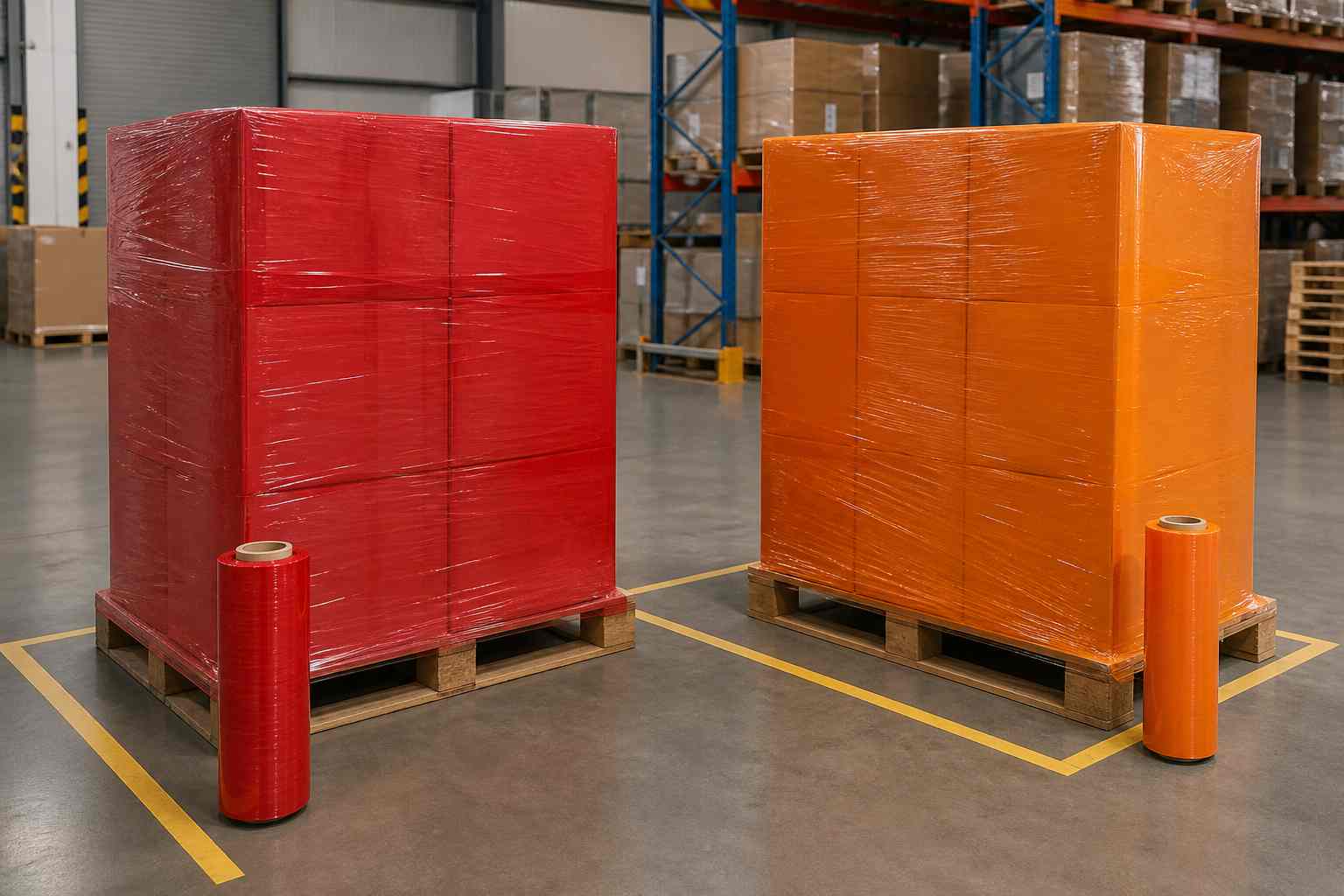
Red and orange cut through visually on a busy floor. They work when each color maps to exactly one action and the people on shift know what that action is.
Red Film for Holds and Exceptions
Red stretch wrap is the practical internal choice for QC hold, rejected material, damaged stock, returns waiting on inspection, and anything that must not leave the building. Back the red with a status label showing why the hold exists, which department owns it, the date, and who can release it. Otherwise red goes ambiguous the moment a pallet moves between sites.
Orange stretch wrap for priority or special handling
Orange stretch wrap works for rush orders, engineering samples, special projects, and loads that need one defined handling step. Don’t sell it internally as a hazard or warning color. Regulated loads get the required labels and paperwork regardless of what color the film is.
Check both colors under your own lighting, from the distance a forklift driver actually sees them. Shades that look distinct on a sample card blur at thirty feet, and dirty film or inconsistent pigment makes it worse. Where visual consistency matters to the system, put an approved color sample or a color code into the repeat-order spec.
Opaque Stretch Wrap vs Tinted Colored Film
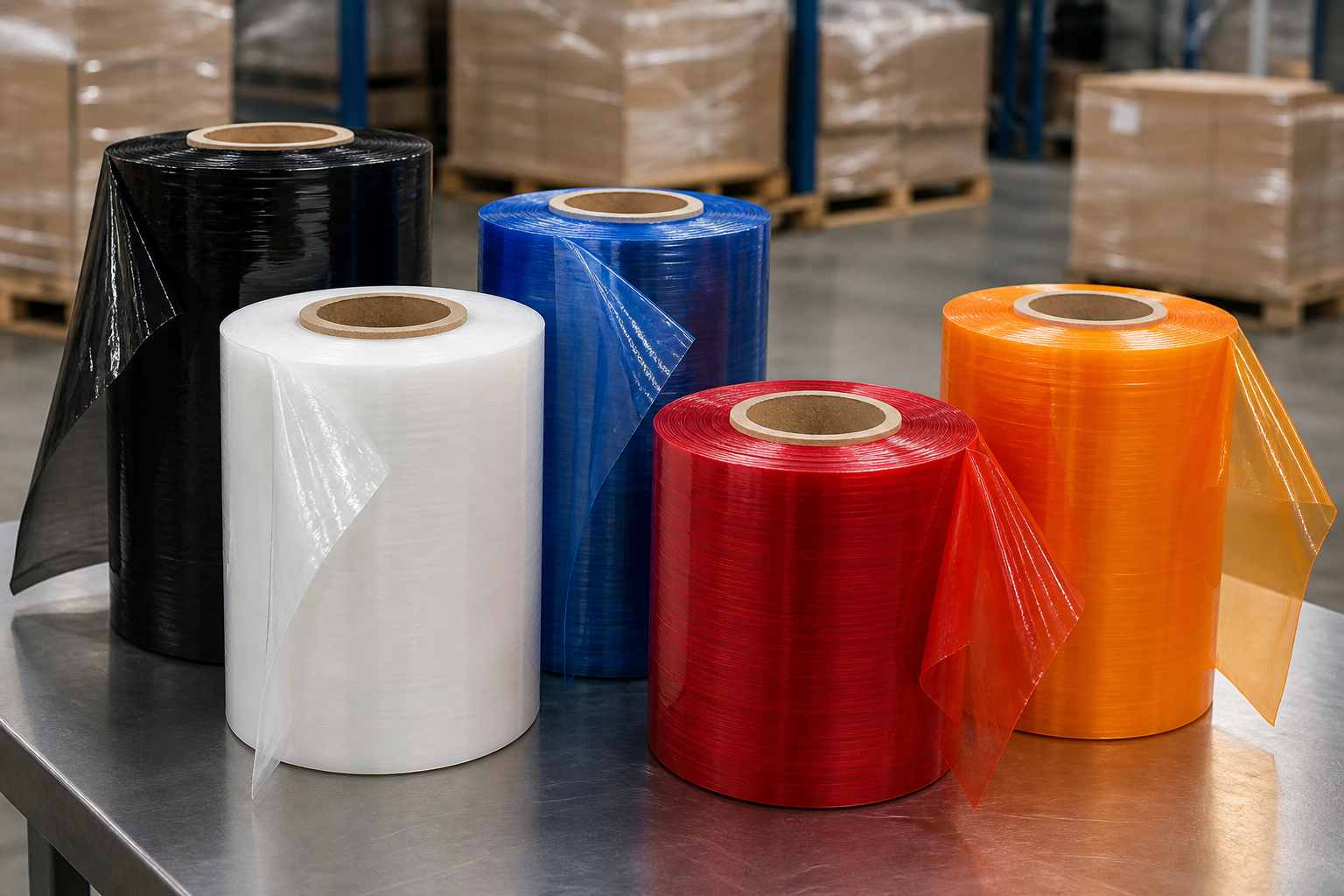
The optical choice that matters is concealment versus visibility. Opaque stretch wrap is designed to conceal the load. Tinted film marks the pallet and leaves some product showing.
| Selection factor | Opaque film | Tinted colored film |
|---|---|---|
| Primary purpose | Privacy and concealment | Visual classification and routing |
| Typical colors | Black or white | Blue, red, orange, green, yellow |
| Product visibility | Low to none, depending on specification and wrap layers | Partial visibility |
| Barcode approach | Apply labels outside the finished wrap | Test scanning through the normal layer count or label externally |
| Common use | High-value goods, export staging, shared storage | Batch control, destinations, FIFO, QC status |
| Printing | White surfaces may support warning text or branding | Usually selected mainly for color identification |
Specify opacity as a number or an approved sample. Two films both called black can carry very different pigment loads, and multiple layers of tinted film may eventually make the load difficult to see through. Ask for a sample at the pre-stretch and wrap count you run.
Physical performance is a separate conversation. An 80 gauge stretch film lands around 20.3 µm, or 0.8 mil, and the trade uses it as a reference point for industrial pallet wrap. It carries no load-weight rating. Work through the stretch film thickness guide and pick gauge off load weight, geometry, sharp edges, wrapping tension, layer count, and what the load goes through in distribution.
For irregular loads, compare puncture performance under ASTM D5748-26, which reports maximum force, penetration distance, and energy to break under biaxial deformation. Cling between layers has its own method, ASTM D5458-95(2025), and ASTM D5459-95(2025) handles elastic recovery, permanent deformation, and stress retention on top of that. Those give you equal footing. What they don’t give you is pallet load security, which comes out of the whole wrap system.
Colored Hand Stretch Film vs Machine Film
Roll format follows throughput, wrapper configuration, how consistent your pallets are, and what you pay in labor. Color and opacity can be produced either way. The rolls themselves don’t cross over.
Hand film for flexible, lower-volume work
Colored hand stretch film fits warehouses running a modest pallet count, dealing with load sizes that change through the day, or applying color only to exceptions. An 18-inch hand roll is the common reference, though width, length, net weight, and core size all move around. Look past unit price at operator fatigue, film control, roll weight, and whether the second shift wraps like the first one does. See the available hand stretch film formats for manual applications.
Machine film for repeatable, higher-volume wrapping
Machine rolls are built for semi-automatic and automatic wrappers. A 20-inch by 5,000-foot roll is a useful commercial reference, and plenty of sites run something else. With compatible film and equipment, powered pre-stretch systems may operate around 200%–300% or higher, depending on the grade, carriage settings, and load.
At high volume, compare candidates on net film weight per accepted pallet, film breaks, roll changes, cycle time, and retained containment. Send the wrapper model, core dimensions, current pre-stretch setting, load dimensions, and your current film data when you ask for machine stretch film. On construction, the cast vs. blown stretch film guide covers why cast gets picked for clarity and quiet unwind while blown gets evaluated for hard puncture and tear duty.
How to Choose Custom Colored Stretch Wrap

Start the custom spec with the operational purpose. Tell the supplier whether the film has to conceal product, identify a workflow status, match a color code you already run, feed a specific wrapper, or take external print.
Include these fields in the RFQ:
- color, plus an approved reference sample or color code
- tinted or opaque, and how much concealment you need
- film thickness and tolerance
- width, roll length, net film weight, core dimensions
- hand or machine application, with wrapper model where it applies
- target pre-stretch and wrapping settings
- required cling, puncture, tear, and containment performance
- external label and barcode-scanning method
- packaging, palletization, private-label, and documentation requirements
- estimated order volume and repeat-order schedule
White opaque film raises a printing question worth settling early. If you want a company name, a handling warning, a batch designation, or a security message on the web, agree on feasibility, ink adhesion, artwork, repeat length, and minimum quantity before production starts.
Tuosheng can customize color, opacity, thickness, width, roll length, core format, and packaging on qualifying requirements. Ask for free samples. Run them on your own pallets before a bulk order, and a useful trial records film breaks, corner punctures, load movement, label readability, application time, and film consumption per pallet. Specifications go through the custom colored stretch wrap page for evaluation.
Colored Stretch Film Applications by Industry
The same color does different work in different buildings. A short application matrix gets procurement and the warehouse team agreeing on purpose before anybody requests a quote.
| Operation | Likely film direction | Main purchasing checks |
|---|---|---|
| Shared warehouse or 3PL | Opaque black or white | Concealment, external labels, tamper inspection, load stability |
| Export and cross-dock staging | Black for privacy or blue for destination coding | Carrier label placement, scan test, handling cycle, pallet identification |
| Manufacturing plant | Tinted colors by product line or production status | Color legend, batch consistency, puncture risk, hand or machine format |
| Quality-control area | Red for hold or orange for special handling | Status label, release authority, physical segregation, staff training |
| Retail distribution | Blue, green, yellow, or customer-specific colors | Store or route coding, scanner readability, high-volume machine compatibility |
| High-value finished goods | Opaque black film with external shipment labels | Concealment, security procedures, inspection points, containment testing |
For every application, pin down who assigns the color, what action it triggers, and what happens when the specified film is unavailable. Keep the legend in writing. One color carrying two conflicting meanings will eventually ship the wrong pallet. Where several plants or logistics providers share the process, the legend belongs in operating instructions and in supplier onboarding.
Pigmented LLDPE may be accepted for recycling where suitable polyethylene collection and processing systems exist, and acceptance varies by region, color, additive package, contamination, and recycler capability. Buyers with recycled-content or traceability requirements can review the GRS-certified recycled stretch film guide. Tie any recyclability claim to the specific product and the destination waste system.
Frequently Asked Questions
What is the best color for concealing pallet contents? Black and white opaque films. Choose between them on measured opacity, load performance, your label strategy, and where the pallet gets stored.
Can scanners read labels through blue or red film? Sometimes, through a light tint and a limited layer count. Pigment density, overlap, lighting, barcode contrast, and scanner hardware all move the result. Test a normally wrapped pallet. If read rates wobble, put the label outside the film.
Does black film prevent cargo theft? No. It hides what sits on the pallet and makes some tampering easier to spot, which helps. Theft prevention comes from access control, load seals where they apply, documented inspections, and secure transport.
Is 80 gauge suitable for every industrial pallet? No. It’s a comparison thickness. Smooth stable cartons and sharp irregular castings can need different film constructions at identical pallet weight, so check containment at the top, middle, and bottom of the load. The containment force and pallet stability guide has a test framework you can run.
Should a high-volume warehouse buy hand or machine colored film? Machine film normally fits repeatable, high-throughput wrapping, while hand film still earns its place on lower volumes and exception pallets. Compare labor time, film per pallet, roll changes, breaks, and accepted-load performance before you standardize on either one.
Final recommendation: Concealment is the job for black stretch film. If somebody needs to identify a pallet in two seconds from a moving forklift, run a controlled tint instead: blue, red, orange, whatever the legend says. Spec it as the industrial packaging material it is. Opacity, gauge, roll format, equipment compatibility, puncture resistance, cling, containment. Then write the legend down and trial one representative pallet before the bulk order goes in.
Need Help Choosing the Right Stretch Film?
Every packaging application has different requirements. Share your wrapping method, load type and specifications, and Tuosheng Pack can help recommend a suitable stretch film solution for your business.
Suggestions based on product type, wrapping method and performance needs.
Support for thickness, width, roll size, color and packaging requirements.
Working with distributors, wholesalers and industrial packaging buyers.
Recommended Tuosheng Pack Solution
For buyers looking for reliable stretch film solutions, Tuosheng Pack supplies hand stretch film, machine stretch film, pre-stretched film and specialty packaging films with customizable thickness, width, roll length and packaging options.
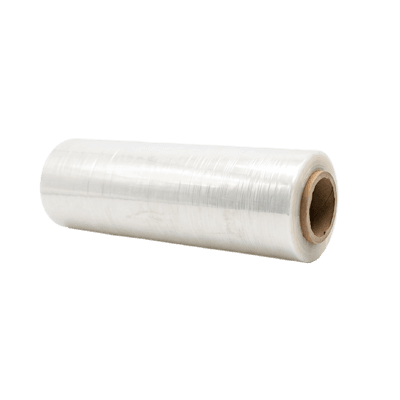
Hand Stretch Film
Flexible manual wrapping solution designed for warehouses, logistics and general pallet applications.
Learn More →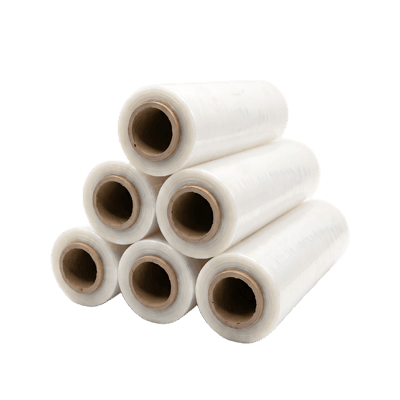
Machine Stretch Film
High-performance film designed for automated pallet wrapping operations with consistent load stability.
Learn More →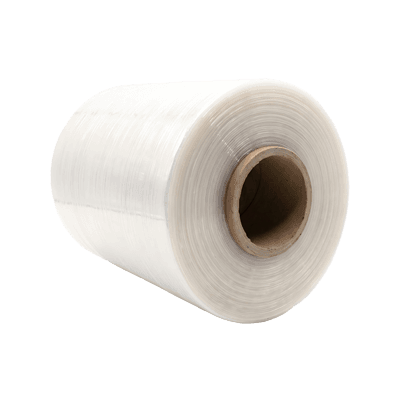
Jumbo Stretch Film
Large-format stretch film rolls designed for high-volume packaging requirements.
Learn More →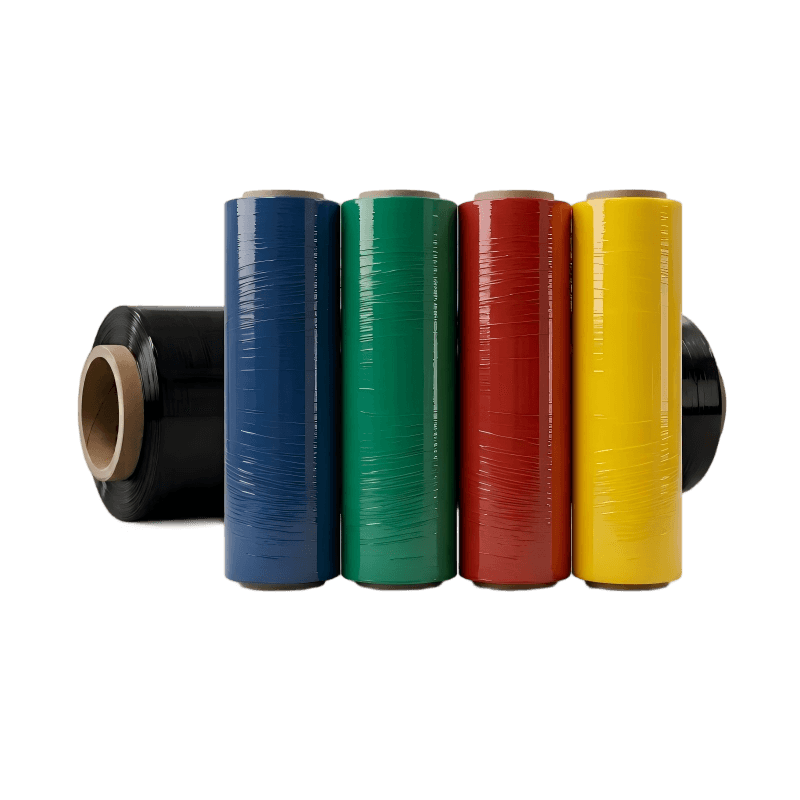
Colored Stretch Film
Custom color options for product identification, privacy protection and branded packaging needs.
Learn More →