PP vs PET Strapping: How to Choose for Cartons and Pallet Loads
PP vs PET strapping comes down to the load. PP (polypropylene) strapping is light, low-cost and easy to handle, and it suits cartons, bundles and light-to-medium pallet loads. PET (polyester) strapping is stronger at the same width and holds its tension longer, so it suits heavy, rigid or settling loads and long transit. Comparing width and break strength alone isn’t enough to choose between them.
We’re Tuosheng Packaging, a stretch film supplier in Suzhou, China. We supply PP strapping band alongside our stretch film. We don’t supply PET strapping, so this guide is meant to help you judge where PP is enough and where it isn’t.
Quick answer: PP or PET strapping?
- PP strapping: cartons, bundles, parcels and light-to-medium pallet loads, applied by hand tool or strapping machine.
- PET strapping: heavy or rigid loads such as bricks, timber, metal coils or heavy beverage pallets, loads that settle in transit, long storage, and jobs that used steel strap.
- Don’t compare width and break strength alone: check thickness, stretch, how the strap holds tension, the joint and your existing tools.
- Pallet loads: strapping ties the goods to the pallet, stretch film holds the whole load together. Many pallets need both.
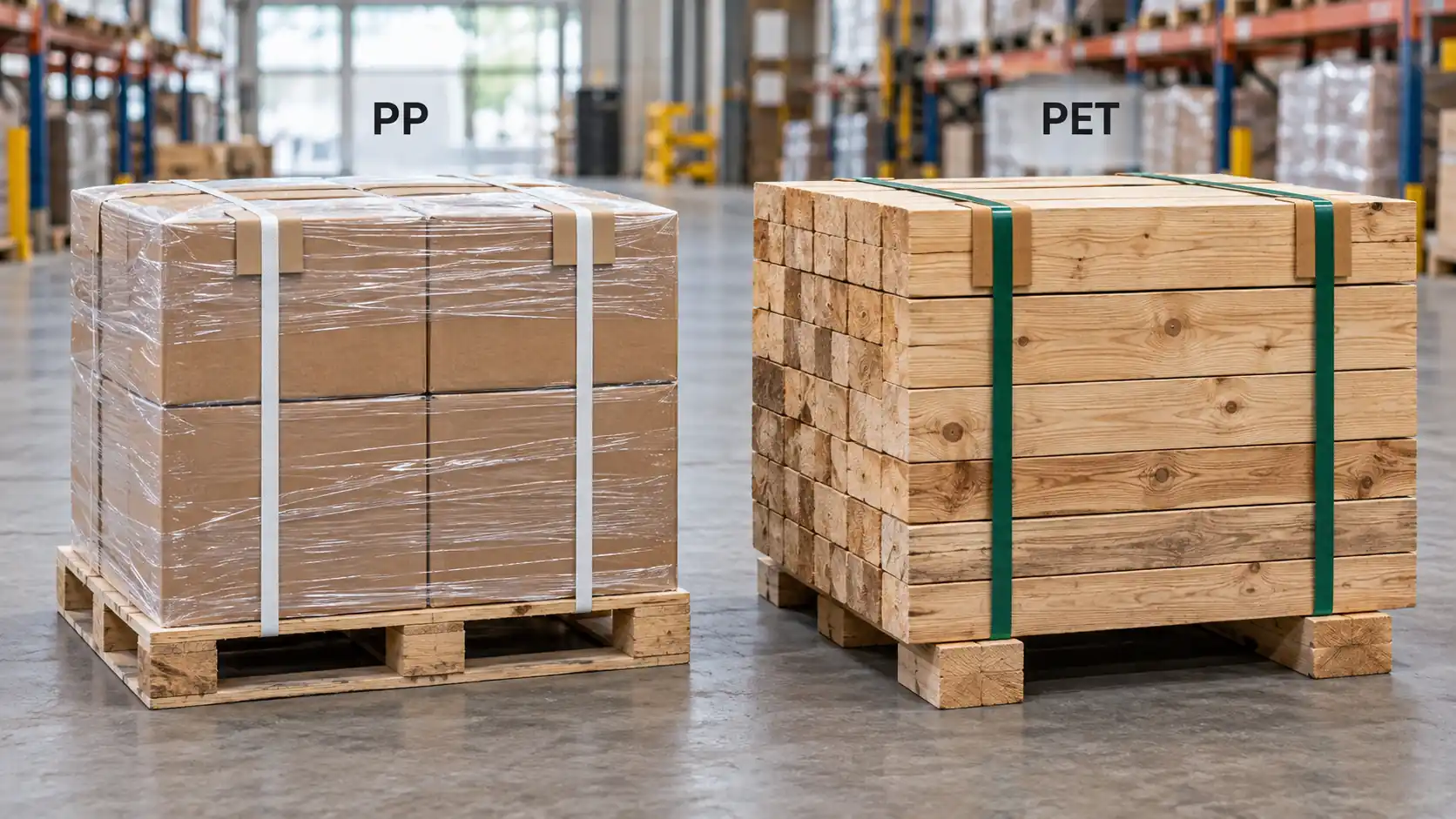
What Is the Difference Between PP and PET Strapping?
The difference between PP and PET strapping is the material, and that changes strength, stretch and how long the strap stays tight. Signode, one of the largest strapping makers, says its PET strap “yields higher break strengths and maintains a higher level of retained strap tension than polypropylene strapping”, and sells it for medium-to-heavy pallet loads. It positions its PP strap for light and medium-duty work.
The 5 key differences between PP and PET strapping:
- Strength: PET is stronger at the same width.
- Tension hold: PET keeps more of its applied tension; PP gives more and absorbs shocks.
- Joints and tools: the two are sealed and tensioned differently, so tools don’t always carry over.
- Typical loads: PP for cartons and light-to-medium loads, PET for heavy, rigid or settling loads.
- Cost: PP costs less per metre.
| Property | PP strapping | PET strapping |
|---|---|---|
| Material | Polypropylene | Polyester |
| Strength at the same width | Lower | Higher |
| Stretch under load | More stretch, absorbs shocks | Stiffer, less stretch |
| Retained tension | Lower | Higher |
| Weight and handling | Light, easy to cut and handle | Light, stiffer to handle |
| Common joints | Heat seal or friction weld (machine or tool), metal seals, buckles | Friction weld (powered tool), metal seals |
| Typical use | Cartons, bundles, light-to-medium pallet loads | Heavy, rigid or settling loads; steel replacement |
| Relative cost | Lower | Higher |
For reference, our PP strapping band comes in 15.5 mm and 19 mm widths, 0.6–0.8 mm thick. The 15.5 mm strap has a break strength of 1,500–2,000 N and the 19 mm strap 2,000–3,000 N, both from virgin T30S polypropylene.
Which Packages Is PP Strapping Right For?
PP strapping is right for packages that need to stay closed and together, not for loads that need to be held under heavy force for weeks. That covers most carton work in warehouses and distribution centres.
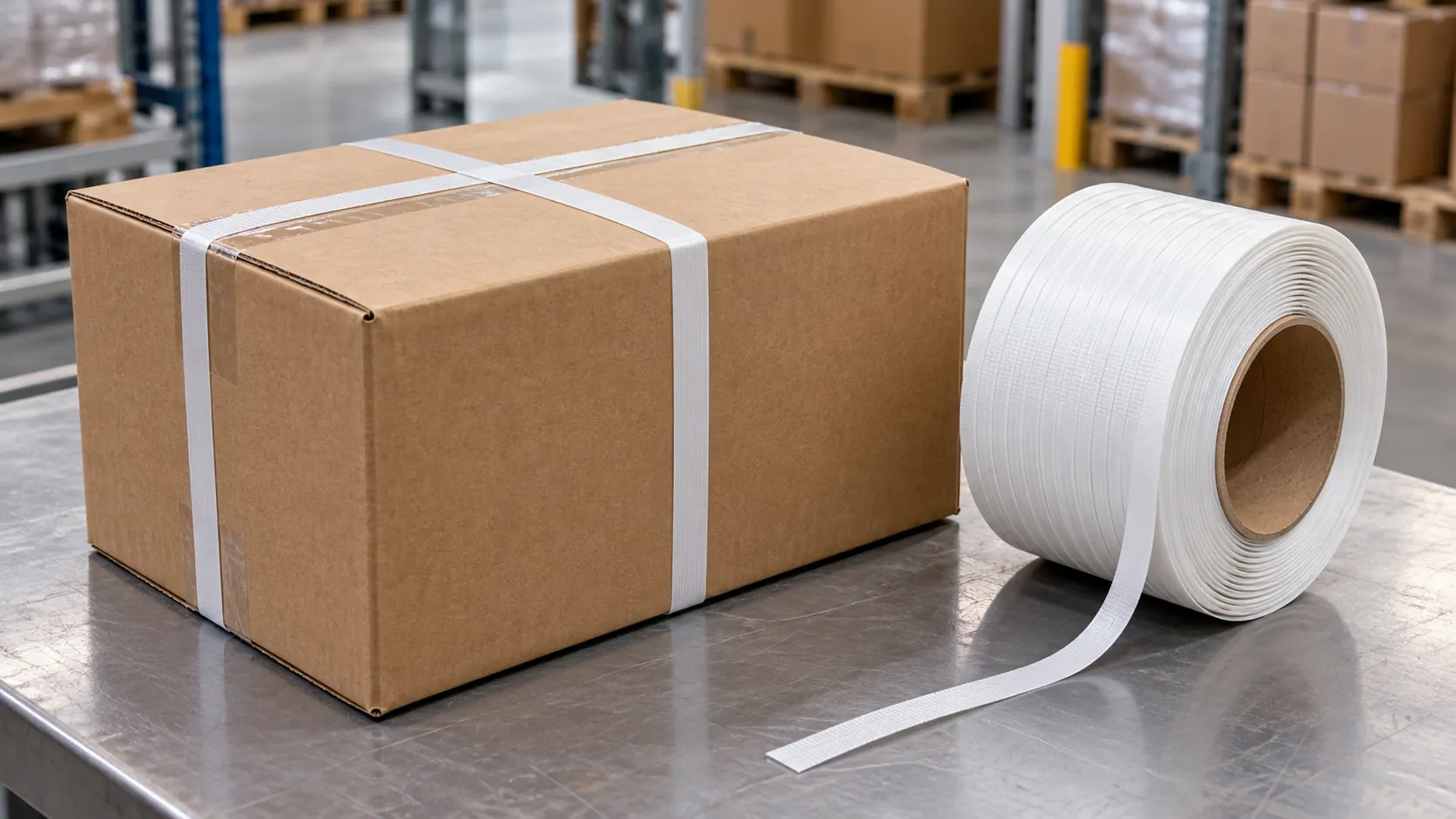
| Load | Typical PP choice | What matters most |
|---|---|---|
| Single cartons, parcels, light bundles | 15.5 mm, 1,500–2,000 N | Easy handling, low cost per package |
| Mixed cartons, everyday warehouse packing | 15.5 or 19 mm, by package weight | Consistent strap from roll to roll |
| Heavy cartons and pallet loads | 19 mm, 2,000–3,000 N, used with stretch film | Edge protection, testing before bulk orders |
PP has one real advantage over stiffer strap: it gives a little. Signode describes the “elastic memory” of its PP strap as absorbing shock and keeping the strap tight during handling and shipping.
When Should You Consider PET Strapping Instead?
Consider PET strapping when the load is heavy, rigid or likely to settle, or when it has to stay tight for a long time. Signode designs its PET strap for medium-to-heavy palletizing and for loads that shrink and settle in transit, and names PET bottle pallets as a common use.
Typical PET jobs:
- Bricks, blocks, timber, metal coils and other heavy, rigid goods
- PET bottle and other beverage pallets that settle in transit
- Export loads that sit in containers or yards for weeks
- Jobs that used steel strap, where buyers want a lighter, rust-free option
If your loads sit in this list, PP isn’t the right strap, even if it’s cheaper per roll.
Why Can’t You Compare Strapping by Width and Break Strength Alone?
You can’t compare strapping by width and break strength alone because neither tells you how the strap behaves after it’s applied. Break strength is the force that snaps the strap in a single pull. In transit, what matters is whether the strap stays tight.
| What a width-only quote leaves out | Why it matters |
|---|---|
| Thickness | Two 15.5 mm straps can differ in strength if one is thinner |
| Raw material | Ask whether the quote is for virgin or recycled-content PP; we use virgin T30S PP for consistent strength |
| Stretch and tension hold | Decides whether the load is still tight on arrival |
| Joint strength | The seal or weld is often the weakest point, not the strap |
| Applied tension | Too much crushes cartons; too little lets the load move |
| Roll and core size | Has to fit your dispenser or strapping machine |
A stronger strap isn’t always the better choice either. Over-tensioned strap crushes carton edges. Match width, thickness, tension and the number of straps per package to the goods, and test them together.
How Do Tension, Joints and Your Tools Affect the Choice?
Tension, joints and tools often decide the choice before the strap does. Check what your current tools and strapping machine take before you switch strap type or width.
- Tension. Set enough to hold the load without crushing it. Carton loads need less than rigid goods.
- Joints. PP is usually joined by heat seal on a strapping machine, or with metal seals or buckles by hand. PET is usually friction-welded with a powered tool, or joined with metal seals. A weak joint fails before a good strap does.
- Tools. A hand tensioner, semi-automatic machine or arch strapping machine is set up for a strap width and thickness range. Switching from PP to PET, or between widths, can mean new tools or a machine adjustment.
- Core size. Common strapping roll cores include 8 × 8 in, 9 × 8 in and 16 × 6 in in the US, and 200 mm, 280 mm and 406 mm in Europe. Check your machine’s manual or dispenser before ordering.
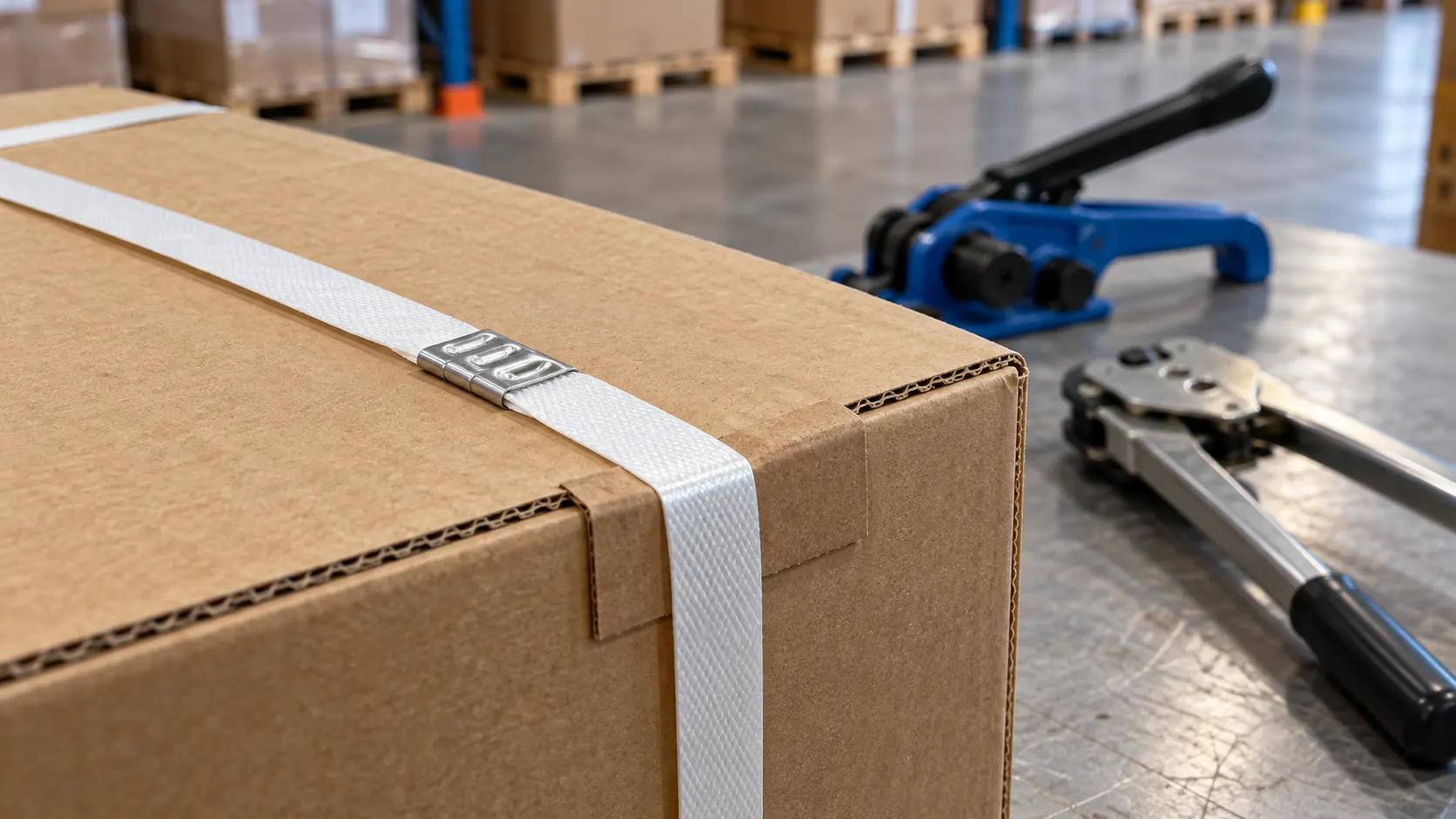
Before a bulk order, run sample rolls on your own tools and machine. That’s the only reliable compatibility check.
What Goes Wrong After You Switch PP Strapping?
The problems buyers run into after switching PP strapping are rarely a strap snapping. In warehouse discussions about plastic strapping, three other problems come up: machines that misfeed or jam on the new strap, strap that doesn’t match the tools and seals on hand, and straps that go slack right after they’re sealed.
| Problem | What’s usually behind it | What to check |
|---|---|---|
| The strapping machine misfeeds or jams after a supplier change | Strap width, thickness or flatness the machine isn’t set for; or worn guides, rollers and feed parts on the machine | Run sample rolls on the machine before a bulk order; keep the old roll label to compare |
| Strap, seals and tools don’t match | Ordering by width alone, without the thickness, seal type and tool model | Confirm width, thickness, seal or buckle type and the tool in one order |
| Strap goes slack right after sealing | Wrong threading or cutting order, a seal that didn’t lock, or cartons crushed by over-tension that then leave a gap | Re-check the tool’s threading steps, inspect a few joints, lower the tension on cartons |
Strap shape matters on machines, not only strength. Signode says its PP strap has low camber and curl, so it performs reliably in power strapping machines with fewer misfeeds. A strap that bends or curls can feed badly even when its width and break strength are on spec.
When a machine starts jamming after a switch, the strap and the machine can both be at fault, and the supplier and the service technician may blame each other. A sample trial on your own machine, before you change suppliers, settles that early.
When Do You Need Strapping and Stretch Film Together?
You need strapping and stretch film together when the pallet is heavy, tall or travelling far. They do different jobs. Strapping ties the goods to the pallet and holds them in one direction. Stretch film wraps the whole load into one unit, so cartons can’t shift and dust stays out. Our guide on how to stretch wrap a pallet correctly covers the wrap pattern.

Use both for:
- Heavy carton pallets and export shipments
- Tall or unstable stacks
- Loads that will be handled several times on the way
Put edge protectors under the strap at sharp corners, so the strap doesn’t cut the cartons or the film. Our guides on containment force and pallet stability and heavy-duty stretch wrap cover how much film a load needs. For the film itself, see our machine stretch film and hand stretch film.
What Should Distributors Confirm Before Ordering PP Strapping?
Distributors should confirm the full strap specification, not just the width, and check whether the strap can travel with their other packaging orders.
| Check | What to confirm |
|---|---|
| Width and thickness | e.g. 15.5 or 19 mm, 0.6–0.8 mm |
| Break strength | Per width and thickness |
| Material | Virgin or recycled-content PP |
| Color | e.g. white or green, to match what your customers use |
| Roll weight and core size | Matched to your customers’ dispensers and machines |
| Strapping method | Hand tool, semi-automatic or automatic machine; test samples on each |
| Seals and tools | Seal or buckle type and tool model that match the strap width and thickness |
| Packing | How rolls are packed and palletized |
| Shipping | Whether strap can share a container with your other orders |
What we see at Tuosheng: We added PP strapping band to our range for one reason: many of our customers can’t use a full container of stretch film. Rather than ship a part load, they fill the rest of the container with PP strap and get both products in one shipment.
That’s often the deciding factor for smaller distributors. If you already buy stretch film from China, putting strap in the same container can save a separate shipment. Our guide to importing stretch film from China covers the rest of the landed cost, and our guide for pallet wrap suppliers and distributors covers stocking and private-label orders. For other ways to lower freight per roll, see pallet wrap cost reduction.
PP vs PET Strapping FAQ
Is PET strapping stronger than PP strapping?
Yes, PET strapping is stronger than PP strapping at the same width. Strapping makers such as Signode say PET has a higher break strength and keeps more of its applied tension, which is why it’s used for heavy and rigid loads. PP strapping costs less and absorbs shocks, which suits cartons and light-to-medium loads.
Can PP strapping replace steel strapping?
PP strapping usually can’t replace steel strapping. Steel strap is used on heavy, rigid loads that need very high strength and almost no stretch. Where buyers move away from steel, they usually move to PET strapping, not PP.
What width of PP strapping do I need for a pallet?
For pallet loads, 19 mm PP strapping with a break strength of 2,000–3,000 N is a common starting point, used together with stretch film. Lighter cartons and bundles usually take 15.5 mm. Test on your own loads before a bulk order.
Do I need stretch film if I already strap the pallet?
You usually still need stretch film on a strapped pallet. Strapping holds the goods to the pallet but leaves the sides open, so loose cartons can still shift. Stretch film wraps the whole load into one unit. Heavy, tall or export pallets normally need both.
Why does my strapping machine jam after switching PP strap?
A strapping machine that jams after a switch of PP strap is usually reacting to a strap it isn’t set for, such as a different thickness or a strap that curls, or to wear on its own guides and rollers. Run sample rolls on the machine before a bulk order, and check the machine’s feed parts if jams continue with strap that is on spec.
Why does PP strapping loosen during transit?
PP strapping usually arrives loose for one of four reasons: the tension was set too low, the joint slipped, the load settled, or the load was too heavy for PP. Check the tension setting and the joints first. If the load is heavy or settles in transit, consider PET, which strapping makers sell for exactly those loads.
Need PP Strapping with Your Stretch Film Order?
Send us your package size, load weight, strapping method and the label from your current strap roll. We’ll recommend a PP strapping band width and thickness, send samples to test on your own tools, and quote it together with your stretch film so both can ship in one container.
Recommended Tuosheng Packaging Solution
Tuosheng Packaging manufactures hand stretch film and machine stretch film in Suzhou, China, with customizable thickness, width, roll length and export packing.