
Stretch film gets quoted by the roll, the case, the kilogram, or the pound. But on the warehouse floor, what actually matters is the finished pallet. A cheaper roll doesn’t always mean a cheaper wrap — if that roll is heavier, tears more often, needs extra revolutions, or can’t hold the load together at the right containment force, you’re just spending differently, not less.
To get a real number on stretch film usage, you need two approaches working together. The math-based method — width, length, gauge, density — tells you what a roll should weigh and how much film it should contain. A physical cut-and-weigh audit tells you what actually ends up on each pallet. Mix the measured weight with your actual material cost, and you’ve got a defensible stretch film cost per pallet that survives scrutiny.
Here’s the setup we’ll use throughout this guide: a 20-inch-wide, 5,000-foot machine-film roll, 80 gauge, bought for $72 net per roll. The line runs 200% pre-stretch, and a controlled cut-and-weigh audit gives us an average of 340 grams per pallet. These are placeholder numbers — swap in your own roll specs, prices, wrapper settings, and audit results before making any purchasing decisions.
Table of Contents
- Start With the Units and Roll Weight Formula
- Measure Actual Film Consumption With a Cut-and-Weigh Audit
- Calculate Stretch Film Cost per Pallet
- Quantify Pre-Stretch and Gauge Effects
- Build a Repeatable Usage and Cost Control Process
Start With the Units and Roll Weight Formula
Most of the ugly errors I’ve seen in film usage per load calculation come from mixed-up units. Before you touch any formula, nail down whether the thickness is in gauge, mil, or microns. Get that wrong and everything downstream is garbage.
The conversions you need:
So our example 80-gauge film:
If you plug in 80 as the mil value, you’ve just overstated thickness — and therefore calculated weight — by a factor of 100. That mistake shows up more often than you’d think.
Calculate theoretical net roll weight
Film weight is volume times density. Standard LLDPE stretch film sits around $0.918$–$0.920\text{ g/cm}^3$, though you should use the supplier’s verified density when you can get it. ASTM D4635 covers LDPE and LLDPE packaging films across a wider range, so high-performance blends shouldn’t just get assigned the example number by default.
At $0.920\text{ g/cm}^3$, the practical imperial formula is:
Running the example:
That’s the theoretical net film weight. It doesn’t include the paper core, carton, or anything else in the packaging. If all you have is gross roll weight, weigh and subtract the empty core before you start calculating material cost.
The metric equivalent:
For 0.508 m × 1,524 m × 20.32 microns at 920 kg/m3, you get roughly 14.47 kg — which checks out at about 31.90 lb.
Reverse the formula to calculate stretch film yield
Same equation, flipped around. When you know the net roll weight but need to verify the length:
With the example:
This stretch wrap yield formula is handy for checking whether the quoted width, gauge, length, and net weight all tell the same story. ASTM D4321 lays out the official method for package-yield determination, including how to handle nominal density and thickness.
But don’t confuse this number with how many pallets you’ll actually wrap. Real yield depends on your stretch ratio, overlap, top and bottom wraps, load shape, breaks, and film neck-down. Under tension, the effective web width can drop 10%–25%. A 20-inch web with 15% neck-down is really only covering about 17 inches — which means you may need more revolutions to maintain proper overlap and coverage.
Measure Actual Film Consumption With a Cut-and-Weigh Audit
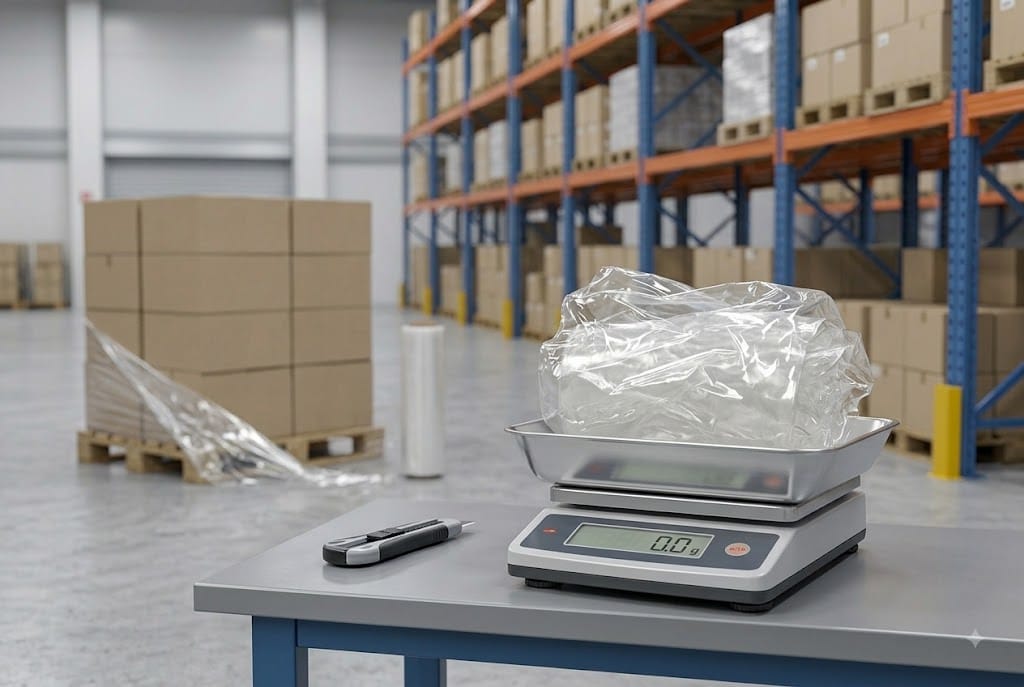
Theoretical roll math is fine for checking specifications, but the cut-and-weigh method gives you the truth on the ground. It captures everything at once — your wrapping pattern, pre-stretch performance, film tension, neck-down, overlaps, and whatever your machine or operators are actually doing.
Run a controlled pallet audit
Here’s a protocol that gives repeatable results:
- Pick a representative load type. Don’t compare a light, neat test pallet against a messy production load — that just muddies the data.
- Record pallet dimensions, weight, product config, film SKU, nominal gauge, roll width, wrapper recipe, pre-stretch setting, revolutions, and reinforcement wraps.
- Wrap it like you would any normal pallet. Don’t change your safety practices or minimum containment requirements for the test.
- After noting any stability observations, carefully cut and remove every piece of applied film. Don’t let labels, tape, corner protectors, dirt, or moisture get into your sample.
- Grab everything — tails, roping sections, the small bits. Only compact the film enough to fit the weighing container.
- Tare an empty container on a calibrated gram scale. One-gram readability works fine for pallet-level samples.
- Weigh the recovered film, record the net grams.
- Do this on at least 10 comparable pallets under normal operating conditions. If you have distinct load families, audit each one separately rather than blending them into a misleading average.
Say 10 pallets give you a combined 3,400 grams. Average per pallet:
Converting to pounds ($1\text{ lb}=453.592\text{ g}$):
So the baseline for this operation is 340 grams — about 0.750 pound — of applied stretch film per pallet.
Separate applied film from process waste
What you strip off a finished pallet is applied material. It doesn’t automatically include the film you lost to breaks, damaged roll edges, startup adjustments, or leftover remnants on the core. Track that waste separately during the same audit window.
As a rough reference, automated lines typically see 3%–5% waste, while manual hand wrapping can hit 10%–15%. But those aren’t gospel — operator skill, load shape, roll handling, and film quality all move the needle. Whenever you can, measure your own site-specific waste rate instead of using a default:
One caveat: if your measurement method already accounts for all roll depletion — scrap included — in the per-pallet figure, don’t slap a waste factor on top of it. That’s double-counting.
Calculate Stretch Film Cost per Pallet
Now we put the numbers together. Net roll weight plus cut-and-weigh data turns price-per-roll into cost-per-pound, and from there into cost-per-finished-load.
Use net film cost, not gross shipping weight
The core calculation:
For the example $72 roll:
And the stretch film cost per pallet formula:
Plugging in our 0.7496-pound cut-and-weigh result:
Cost per pallet = $2.261 × 0.7496 = $1.695 per pallet
Rounded up for the report, the applied film costs $1.70 per pallet before scrap.
If your line’s measured waste rate runs 4%, the purchasing-cost estimate becomes:
Scale that to 50,000 pallets a year:
Keep the unrounded numbers during calculation; only round the final reported result.
Translate usage into practical roll yield
You can also figure out pallets per roll:
For our example:
Practically speaking, that’s about 40 complete pallets per roll. Carry the fractional remainder into your forecast rather than assuming it’ll wrap another full load.
Compare this estimate against your actual production records — rolls consumed versus pallets wrapped. A persistent gap usually points to incorrect net weight, mixed load types, unrecorded scrap, or inconsistent wrapper settings.
One thing worth noting: keep your audit boundaries consistent across comparisons. If one trial counts scrap and another only counts film pulled off the load, the lower number might just be an accounting trick rather than a real improvement.
Quantify Pre-Stretch and Gauge Effects
Pre-stretch and gauge both change how much film mass goes onto each load, but neither one should be tuned in isolation from load containment. A cheaper wrap that lets loads shift or take damage isn’t a saving — it’s a problem with a different price tag.
Calculate the pre-stretch yield multiplier
Pre-stretch percentage describes how much the film elongates relative to its original length. The theoretical multiplier:
At 200% pre-stretch:
One foot of unstretched film gives you three feet of stretched coverage, in theory. If the pallet needs 350 feet of applied linear coverage, the raw film off the roll is:
At 20 inches wide and 0.80 mil, those 116.7 raw feet weigh about 0.743 pound, or 337 grams. That’s close to our 340-gram audit result, but the physical measurement still wins.
Here’s what the math looks like when you hold everything else constant — 350 feet of stretched coverage, same width, gauge, and cost per pound — and just move the pre-stretch:
| Pre-stretch | Yield multiplier | Raw film length | Theoretical film weight | Theoretical film cost |
|---|---|---|---|---|
| 150% | 2.5× | 140.0 ft | 404 g | $2.02 |
| 200% | 3.0× | 116.7 ft | 337 g | $1.68 |
| 250% | 3.5× | 100.0 ft | 289 g | $1.44 |
| 300% | 4.0× | 87.5 ft | 253 g | $1.26 |
On paper, going from 150% to 200% cuts raw-film consumption by 16.7%. Going from 150% to 300% drops it by 37.5%. But these are pre-stretch ratio cost savings on paper, not guaranteed shop-floor results. Neck-down, breaks, extra wraps, poor film-to-load tension, or insufficient containment force all erode the theoretical gain. Powered carriages typically run somewhere in the 150%–300% range when the film and equipment are matched up. Manual hand wrapping gets you much less — usually 10%–30% — so don’t apply machine assumptions to hand film.
Test gauge reduction by total mass, not gauge alone
The film gauge calculation is straightforward: same width, same raw length, 70-gauge film has 12.5% less material than 80-gauge.
But going thinner doesn’t automatically cut your cost per pallet. If the thinner film forces you into more revolutions, or if it breaks more often, the theoretical saving evaporates fast. A cleaner comparison:
For 70 gauge versus 80 gauge, your raw length can increase by no more than about 14.3% before the mass advantage disappears:
This is why looking at roll price or nominal gauge alone isn’t enough. Run the same cut-and-weigh protocol, confirm containment force and load stability, track breaks and scrap, and compare the adjusted cost per pallet. The winning spec is the one that meets your load requirement at the lowest verified total material cost — not necessarily the thinnest film on the shelf.
Build a Repeatable Usage and Cost Control Process
A stretch film program that actually works ties purchasing data to production evidence. Use the formulas for quick checks, then lean on controlled audits to replace assumptions with numbers you can defend.
For each film and load combination, keep a simple worksheet:
- supplier SKU, roll width, nominal gauge, length, and net film weight;
- gauge-to-micron conversion and the density you used in theoretical calculations;
- roll price and calculated net cost per pound or kilogram;
- wrapper recipe or manual wrapping standard;
- audited film weight per pallet and sample size;
- measured or clearly labeled estimated scrap rate;
- adjusted stretch film cost per pallet;
- pallets per roll and annual pallet volume;
- containment, stability, break, and quality observations.
Re-audit whenever something changes — film swap, gauge change, wrapper setting adjustment, major load redesign, or an unexplained jump in roll consumption. Don’t trust theoretical roll length by itself, because overlap and neck-down mess with coverage. Don’t compare gross roll prices without stripping out the core weight. And don’t declare savings until a physical trial confirms the film weight, waste, and load performance under normal operating conditions.
Coming back to our example, the key takeaway isn’t just that the roll costs $72. It’s that the roll holds about 31.84 pounds of film, the line applies an average of 340 grams per pallet, and a measured 4% waste rate gives you an adjusted cost of roughly $1.76 per load. That common unit — dollars per wrapped pallet — is what makes film specs, supplier quotes, and process changes directly comparable.
If you’re evaluating a different stretch film, gather the roll dimensions, net weight, price, current pre-stretch setting, load profile, and cut-and-weigh results. Tuosheng Pack can help turn those inputs into a like-for-like usage and cost-per-pallet comparison, with final recommendations based on an application trial and the required load-containment performance.
Need Help Choosing the Right Stretch Film?
Every packaging application has different requirements. Share your wrapping method, load type and specifications, and Tuosheng Pack can help recommend a suitable stretch film solution for your business.
Suggestions based on product type, wrapping method and performance needs.
Support for thickness, width, roll size, color and packaging requirements.
Working with distributors, wholesalers and industrial packaging buyers.
Recommended Tuosheng Pack Solution
For buyers looking for reliable stretch film solutions, Tuosheng Pack supplies hand stretch film, machine stretch film, pre-stretched film and specialty packaging films with customizable thickness, width, roll length and packaging options.
VCI Shrink Film
Specialty packaging film providing corrosion protection for metal products during storage and transportation.
Learn More →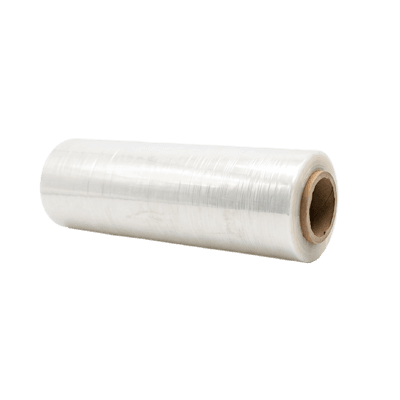
Hand Stretch Film
Flexible manual wrapping solution designed for warehouses, logistics and general pallet applications.
Learn More →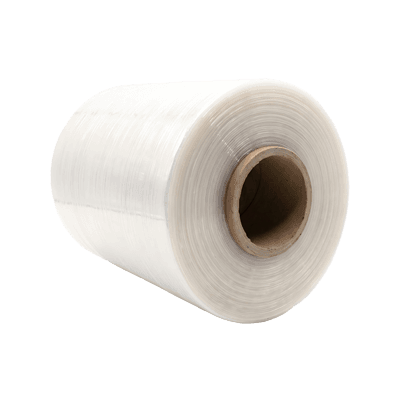
Jumbo Stretch Film
Large-format stretch film rolls designed for high-volume packaging requirements.
Learn More →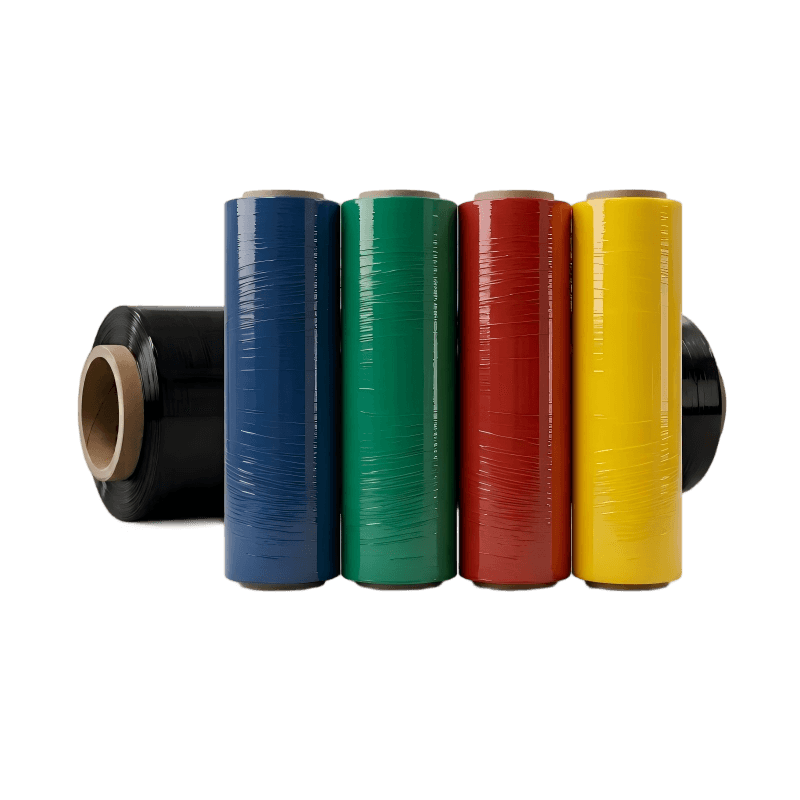
Colored Stretch Film
Custom color options for product identification, privacy protection and branded packaging needs.
Learn More →