What Is a Poly Bag? Types, Materials, Thickness and Sizes
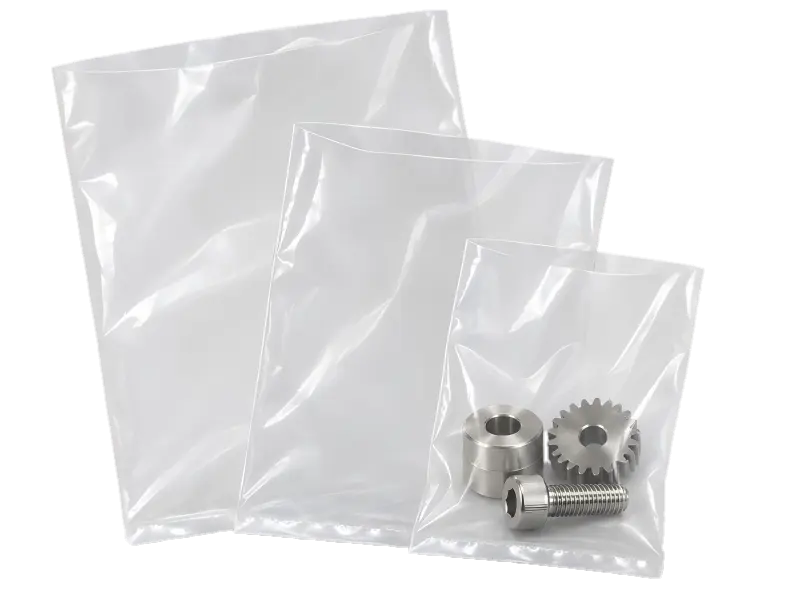
What is a poly bag? A poly bag is a bag made from polyethylene (PE) film, the same plastic family used for stretch film. “Poly” is short for polyethylene, not polypropylene, so poly bags and PE bags are the same thing.
This guide covers the main types of poly bags, the two materials, thickness and sizing, and what to tell a factory when you order custom bags. Tuosheng Packaging makes poly bags (PE bags) and stretch film in Suzhou, China.
Quick answer
- A poly bag is a polyethylene bag, made from LDPE (soft and clear) or HDPE (stiff, thin and slightly cloudy).
- The seven main types of poly bags are flat, reclosable, gusseted (square bottom), carton and gaylord liners, pallet covers, poly mailers and poly tubing.
- Poly bag thickness is given in mil or micron, and a 2 mil (about 50 µm) bag suits most packing jobs.
- A flat poly bag is sized width × length, and a gusseted poly bag is sized width × gusset × length, both measured inside the bag.
- To order custom poly bags, send the bag type, material, thickness, inside size, opening side, printing, any special function and the quantity.
What Is a Poly Bag Made Of?
A poly bag is made of polyethylene, almost always LDPE or HDPE, and some bags blend in LLDPE for extra toughness. Polyethylene is soft, waterproof and easy to heat-seal, which is why it became the standard plastic for packing bags.
What is LDPE?
LDPE (low-density polyethylene) makes soft, flexible, clear bags that resist punctures and tears well.
What is HDPE?
HDPE (high-density polyethylene) makes stiffer, slightly cloudy bags that crinkle when handled and can be made much thinner for the same job.
What is LLDPE?
LLDPE (linear low-density polyethylene) is a tougher, more stretchable PE, the main resin in stretch film; our LLDPE vs LDPE guide explains the difference.
Polypropylene (PP) bags are a different product: crisper and glassier, and mostly used in retail packaging. Poly bags can also be made from post-consumer recycled PE. Tuosheng’s SGS GRS 4.0 Scope Certificate covers bags made from up to 100% recycled PE; GRS certification needs at least 20% recycled content, and the GRS logo needs at least 50%. Our guide to recycled stretch film and GRS certification explains how to check a recycled claim.
What Are the Main Types of Poly Bags?
The seven main types of poly bags are flat bags, reclosable bags, gusseted (square bottom) bags, carton and gaylord liners, pallet covers, poly mailers and poly tubing. The types differ in shape and closure, not in material: each can be made in LDPE or HDPE.
| Type of poly bag | What it is | What it means for you |
|---|---|---|
| Flat poly bag | Open top, sealed bottom, no gusset | The simplest bag for parts, textiles and general packing |
| Reclosable poly bag | A press-to-close zip track or an adhesive self-seal strip on top | Opens for inspection and closes again; good for samples and spares |
| Gusseted poly bag | Side gussets open into a square bottom | Fits box-shaped goods and machinery without stretching |
| Carton and gaylord liner | A gusseted bag sized to a box, up to 48 × 40 in gaylords | Keeps dust and moisture off goods inside the box |
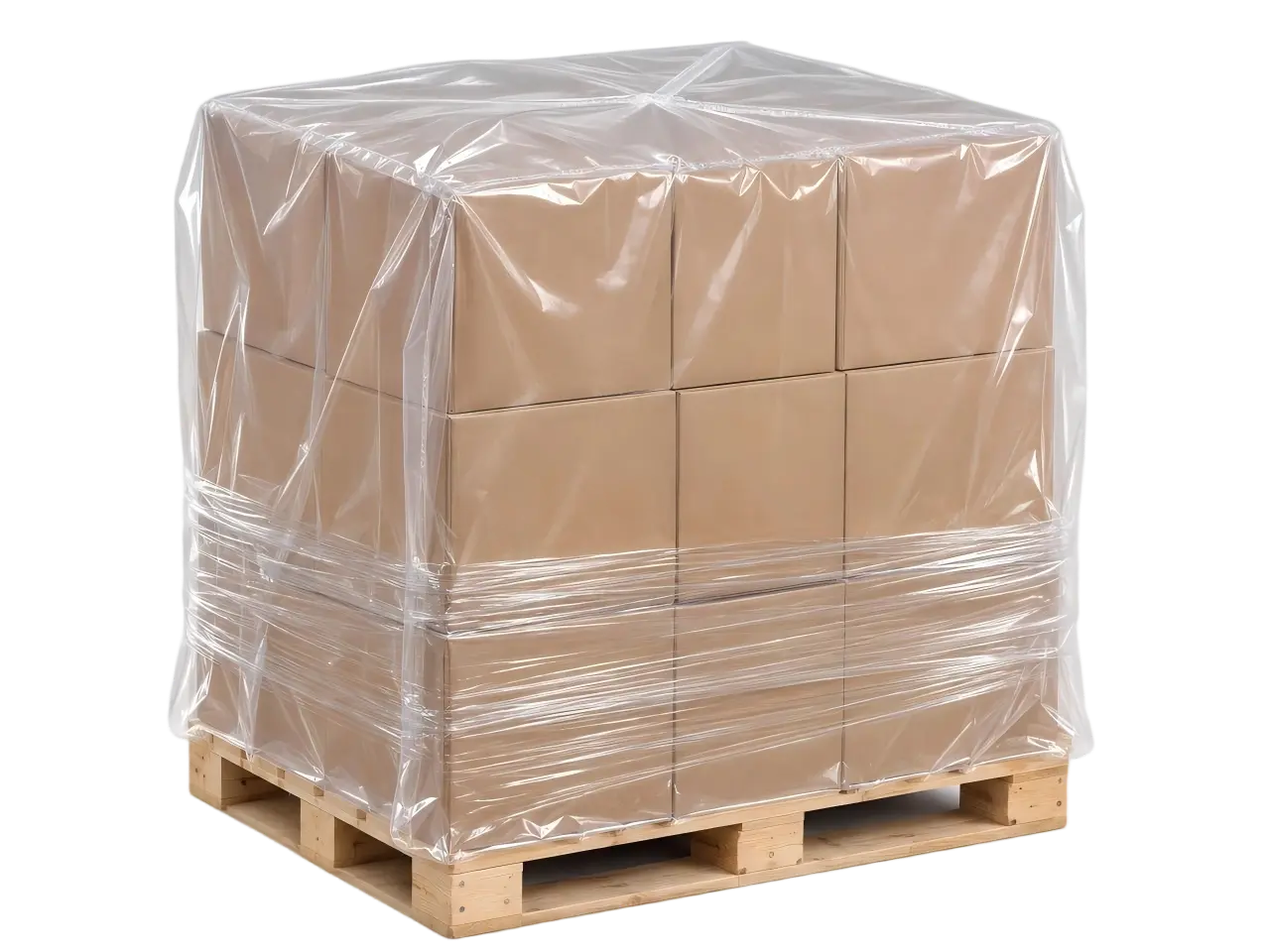
| Pallet cover | A large gusseted bag on a perforated roll | Covers the top of a pallet that stretch wrap leaves open |
| Poly mailer | A flat bag with an adhesive fold-over flap | Replaces a carton for shipping soft goods by courier |
| Poly tubing (lay-flat tubing) | A continuous PE tube on a roll, open at both ends | You cut it to length and seal one or both ends, so one roll makes bags of any length |

Tuosheng Packaging makes all seven types. Poly mailers are made on request, and reclosable bags come with either a zip track or an adhesive strip.
What is a gusset?
A gusset is a folded panel in the side or bottom of a bag that opens out, so the bag gains depth instead of lying flat.
LDPE vs HDPE: Which Poly Bag Material Should You Choose?
LDPE poly bags are softer, clearer and more puncture resistant, so they suit most parts and heavier goods. HDPE poly bags are stiffer and can be made thinner for the same job, which keeps the weight and cost per bag down for light items.
| Property | LDPE poly bags | HDPE poly bags | What it means for you |
|---|---|---|---|
| Clarity | Clear | Slightly cloudy | Choose LDPE if labels or the product must show |
| Feel | Soft, flexible | Stiff, crinkly | LDPE wraps irregular shapes; HDPE holds its shape |
| Puncture resistance | Better | Lower at the same thickness | Choose LDPE for sharp edges and heavy goods |
| Thinnest bag | Thicker for the same job | Down to 0.01 mm at Tuosheng | HDPE saves material on light items |
At Tuosheng, HDPE bag orders run slightly ahead of LDPE, because many buyers pack light goods where a thin, stiff bag does the job. If you are unsure, test samples of both with your product.
How Thick Should a Poly Bag Be?
Poly bag thickness is measured in mil (1 mil = 0.001 inch = 25.4 µm) or in microns. A 2 mil (about 50 µm) poly bag suits most packing jobs, thin HDPE bags suit light items, and 3–4 mil or more suits heavy or sharp-edged goods.
What is a mil?
A mil is one thousandth of an inch, about 25.4 µm, and is also written as 100 gauge.
| Microns | Mil | Typical use |
|---|---|---|
| 10–25 µm | About 0.4–1 mil | Light items, inner bags, dust protection (HDPE) |
| 50 µm | About 2 mil | Parts, components, textiles, general packing |
| 75–100 µm | About 3–4 mil | Heavier parts, hardware, sharp edges |
| Up to 200 µm | About 8 mil | Heavy-duty bags for heavy or abrasive goods |
These are common market references, not fixed rules; the flat poly bags page lists the same ranges. Chinese factories often quote thickness in si (丝), where 1 si = 0.01 mm = 10 µm, so a “5 si” bag is about 2 mil. Our stretch film thickness guide covers gauge, micron and mil conversion in more detail. An HDPE bag also feels stiffer than an LDPE bag of the same thickness, so retest when you switch materials.
How Do You Measure a Poly Bag Size?
A flat poly bag is sized width × length, and a gusseted poly bag is sized width × gusset × length, both measured inside the bag. In US practice the first figure is usually the width across the opening.
| Bag type | Size format | What to measure |
|---|---|---|
| Flat poly bag | Width × length | Product width and length, each plus the product thickness |
| Gusseted poly bag | Width × gusset × length | Product footprint and height |
| Carton or gaylord liner | Width × gusset × length | Inside box length and width; box depth plus a fold-over |
| Pallet cover | Width × gusset × length | Pallet footprint; load height plus the top |

For a flat bag, add extra length if you will fold, tape or heat-seal the opening. For box-shaped goods, a gusseted poly bag fits better than a bigger flat bag.
Can Poly Bags Be Printed, and Do They Need a Suffocation Warning?
Poly bags can be printed with a logo, handling instructions, product codes or a suffocation warning. Several US states require a suffocation warning on thin plastic bags, and marketplaces such as Amazon set their own poly bag rules, so check the current rules where the bag will be sold.
The rules vary by state, bag size and thickness, so put the warning in the bag specification from the start. Tuosheng prints to your artwork, including suffocation warnings, and confirms the layout with you before production.
How Do Poly Bags Work with Stretch Film on a Pallet?
Poly bags protect goods inside a carton or on top of a load, while stretch film holds the whole pallet together. Stretch wrap leaves the top of a pallet open, so a pallet cover goes on first and the stretch film is wrapped over it to hold the cover in place.
- Carton liner plus stretch film: the liner protects goods inside each carton; the film holds the cartons on the pallet.
- Pallet cover plus stretch film: the cover protects the top face. Our guide to whether stretch wrap is waterproof explains where film alone falls short.
- Machinery cover plus stretch film: a heavy-gauge gusseted bag covers the machine, and hand stretch film or strapping fixes it to the pallet.

Tuosheng makes pallet covers for 1200 × 800 mm, 1200 × 1000 mm and 48 × 40 in pallets, with the height made to your load. Our guide on how to stretch wrap a pallet correctly shows the wrap over the top tier. Poly bags and stretch film can ship in the same container; see importing stretch film from China for mixed loads.
What Should You Send a Factory to Order Custom Poly Bags?
To order custom poly bags, send the bag type, material, thickness, inside size, opening side, printing, any special function and the quantity. A photo of the bag you use now, plus the product weight, lets the factory suggest a spec and send samples.
| What to send | Why it matters |
|---|---|
| Thickness with its unit (50 µm, 0.05 mm or 2 mil) | Avoids mix-ups between mil, micron and si |
| Inside size, width first | Factories make bags to inside size |
| Opening side (short or long side) | The same two numbers give two different bags |
| Special function (anti-static, conductive, anti-rust, flame retardant) | Needs different materials or additives, so it changes the quote |
| Printing artwork | The layout is approved before production |
What we see in poly bag orders At Tuosheng, most problems in poly bag orders start with four details. Buyers leave out the opening side, so a 12 × 15 in bag could open on either edge. They write thickness in mil or micron while Chinese suppliers write si. They give the outside size, but the factory makes the bag to the inside size, so the bag comes out smaller than expected. And they forget a function, such as anti-static or anti-rust film, until the samples arrive.
Tuosheng makes anti-static, conductive, anti-rust and flame-retardant poly bags, so state the function in the first inquiry and it goes into the quote and the samples. At Tuosheng, samples are free (you pay the courier, deducted from your first bulk order). FOB orders work best as a full or half container, EXW orders have no minimum, bag orders run on about the same schedule as stretch film, and bulk bags are made to the approved sample.
What Is a Poly Bag FAQ
Is a poly bag the same as a plastic bag?
A poly bag is a plastic bag made from polyethylene. “Plastic bag” is the wider term and also covers bags made from other plastics, such as polypropylene.
Are PE bags and poly bags the same?
Yes. PE stands for polyethylene, and “poly” is short for polyethylene, so a PE bag and a poly bag are the same product.
What does 2 mil mean on a poly bag?
A 2 mil poly bag is 0.002 inch thick, about 50 µm or 0.05 mm. A 2 mil bag is the usual starting point for general packing.
Are poly bags recyclable?
Poly bags are polyethylene, which film recyclers can process. Whether used bags are accepted depends on your local recycler; our guide to whether pallet wrap is recyclable explains how PE film recycling works.
What is the difference between a poly bag and a poly mailer?
A poly mailer is a poly bag built for courier shipping, with an adhesive fold-over flap. A plain poly bag usually goes inside a carton or on a pallet.
Get Poly Bags Made to Your Size
Tuosheng Packaging manufactures poly bags in Suzhou, China, in LDPE and HDPE from 0.01 mm to 0.2 mm, with 0.05 mm (about 2 mil) as standard. Bags and poly tubing are made to your size, can be printed with logos or suffocation warnings, can be made anti-static, conductive, anti-rust or flame retardant, can use GRS-certified recycled PE, and can ship in the same container as our hand stretch film and machine stretch film.
Send the bag type, size, thickness, opening side and quantity, or a photo of the bag you use now, through the poly bags page, and we will confirm the spec and send samples.
Recommended Tuosheng Packaging Solution
Tuosheng Packaging manufactures poly bags, pallet covers and poly tubing in Suzhou, China, made to your size, thickness and printing, and shipped with stretch film in one container if you need both.