Pallet Strapping: How to Strap a Pallet So the Load Stays Put
Pallet strapping ties the cartons or goods on a pallet to the pallet itself, so the load can’t slide, tip or lift off when it’s forked, braked or bumped in a trailer. Strapping a pallet well comes down to four things: straps in both directions, straps in the right place, the right tension, and a strap that holds that tension for the whole trip.
Tuosheng Packaging supplies PP strapping band alongside our stretch film, and we strap our own export pallets before they’re wrapped. This guide covers how many straps a pallet needs, where they go, how tight to pull them, which strap to choose and the mistakes that leave straps loose on arrival.
Quick answer: 7 rules of pallet strapping
- Build a stable, flush stack before any strap goes on, because a strap can’t hold a load that settles or shifts underneath it.
- Strap the pallet in both the length and the width direction. ABF Freight’s LTL packaging guidelines call for straps in both directions and extra straps on loads longer than 48 inches.
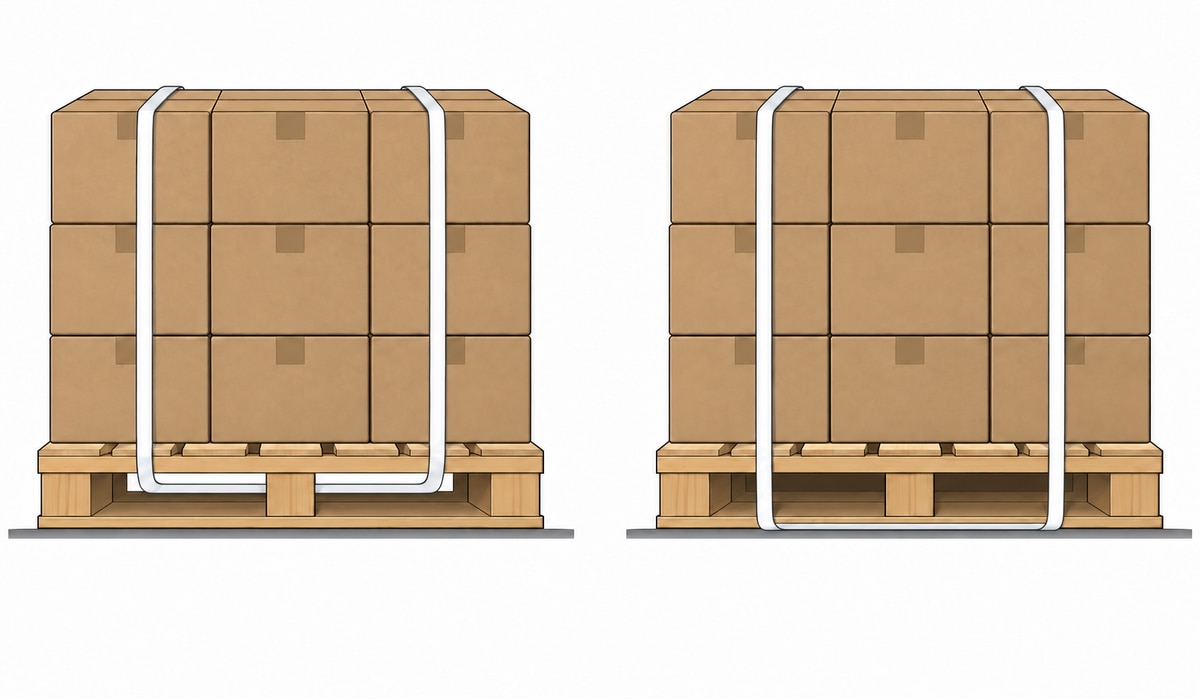
- Pass each strap through the pallet under the top deck boards, never under the bottom deck, where the dock floor will wear it through.
- Keep straps out of the fork openings and away from pallet-jack wheels, because a fork tine under a strap spikes its tension when the pallet is lifted.
- Put a corner board or strap protector wherever a strap crosses a carton edge.
- Tension the strap with a tensioner or strapping machine until the load doesn’t move, but stop before the strap crushes carton edges.
- Choose a strap that keeps its tension for the trip: PP for cartons and light-to-medium loads, PET or steel for heavy loads and long LTL journeys.
What Is Pallet Strapping, and When Does a Pallet Need It?
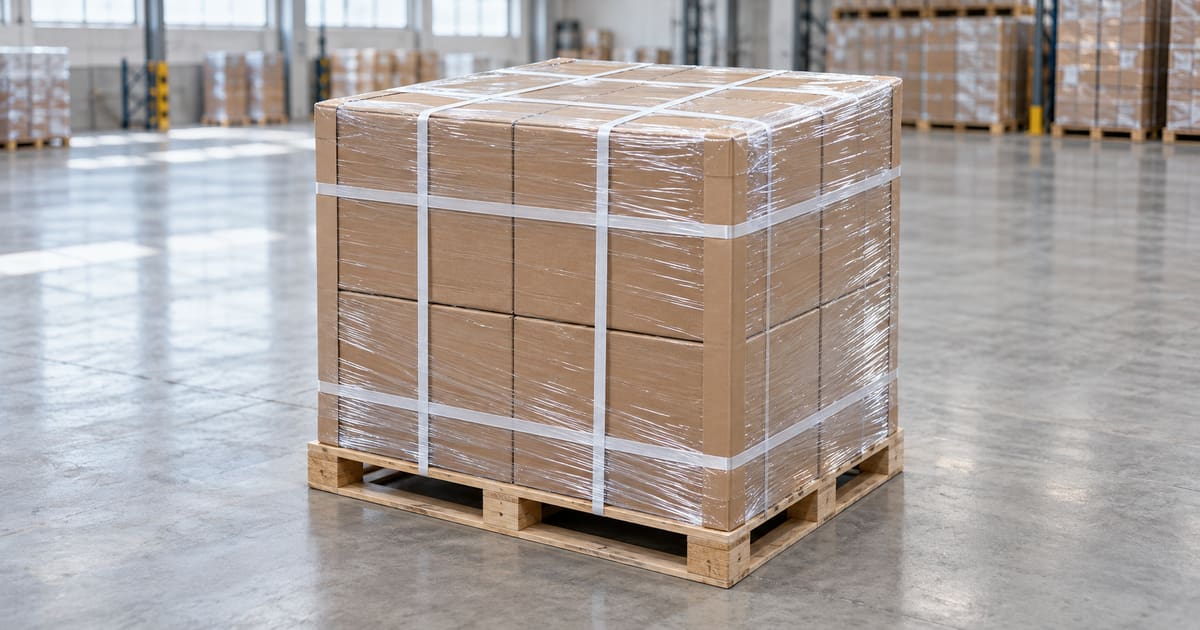
Pallet strapping is the use of plastic or steel straps to bind goods to a pallet. A pallet needs strapping when the load is heavy, tall, top-heavy, or will be handled several times on the way, as LTL and export freight often is.
Pallet strapping vs. pallet banding
Pallet strapping and pallet banding are the same job under two names, and buyers search for both.
Strap tensioner
A strap tensioner is a hand tool or machine head that pulls the strap tight before the joint is made.
Seal and buckle
A seal or buckle is the metal or plastic fastener that joins the two ends of a strap; machines usually heat-seal or friction-weld the joint instead.
Strapping and stretch film do different jobs. Straps hold the goods down onto the pallet in the direction they run. Stretch film wraps the whole load into one unit and keeps dust and moisture off it. Heavy or export pallets usually get both.
ABF Freight’s packaging guidelines add a warning that’s easy to miss: if the load changes size, because it shifts or the packaging compresses, the strapping stops working as a stabilizer. A strap pulled tight around cartons that later settle by a centimetre is a loose strap. That’s why the stack itself comes first; our guide to pallet stacking patterns covers how to build one that doesn’t settle.
How Do You Strap a Pallet? (Step by Step)
To strap a pallet, build a flush stack, protect the edges, run straps through the pallet in both directions, then tension, seal and check them. The same steps apply whether you band a pallet by hand or on a semi-automatic machine.
- Build a flush, stable stack. Heavy cartons go low, and every layer lines up with the pallet edge. See pallet stacking patterns for column vs. interlock.
- Fit corner boards on the vertical corners and anywhere a strap will cross a carton edge.
- Thread the strap through the pallet, under the top deck boards and over the bottom deck, not underneath the whole pallet.
- Strap the length direction, then the width direction. These vertical straps run over the top of the load and through the pallet. Add horizontal straps around the sides of the stack when cartons could walk outward.
- Tension and join the strap with a tensioner and a seal or buckle, or let the strapping machine tension and seal it.
- Trim the tail so it can’t snag on forks or other freight, and look at each joint.
- Stretch wrap the load. Some shippers strap first and wrap over the straps; others wrap first and strap over the film. Tuosheng Packaging straps first, then wraps. Our guide on how to stretch wrap a pallet covers the wrap pattern.
- Check the finished pallet. Push on the stack, look for strap that has slackened, and look for carton edges the straps have crushed.

How Many Straps Does a Pallet Need?
A pallet needs at least one strap in the length direction and one in the width direction, and more as the load gets longer, heavier or taller. ABF Freight’s guidelines call for additional straps on any load longer than 48 inches.
To check whether a strap is strong enough, strapping suppliers use a rule of thumb. SJF, a US packaging distributor, gives it as:
(Pallet weight × 1.5) ÷ number of straps = minimum break strength each strap needs
Here’s a worked example with our own PP strapping band, whose break strength is 1,500–2,000 N for the 15.5 mm strap and 2,000–3,000 N for the 19 mm strap.
| Pallet | Straps | Strength each strap needs | 15.5 mm PP (1,500–2,000 N) | 19 mm PP (2,000–3,000 N) |
|---|---|---|---|---|
| 1,100 lb (about 500 kg) | 3 | 550 lbf (about 2,450 N) | Not enough | Only at the top of its range: add a strap or test carefully |
| 1,100 lb (about 500 kg) | 4 | about 410 lbf (about 1,840 N) | Borderline | Enough |
The formula is a starting point, not a standard, and it ignores how much tension the strap keeps in transit. Test the strap count on your own loads before you settle on it.
How Tuosheng Packaging straps its export pallets
Tuosheng Packaging straps its export pallets of stretch film with PP strap. A typical pallet gets 4 vertical straps and 2 horizontal straps, but this is not a fixed standard: the count changes with the product and the roll weight. Each pallet has corner boards on all four vertical corners, and the straps go on before the stretch film.
| Pallet type | Starting point | What to check |
|---|---|---|
| Light cartons, local delivery | One strap each way | That the joints hold and cartons aren’t crushed |
| Heavy cartons or export pallets | Two or more straps each way, plus horizontal straps around the stack | The strength formula above, and corner boards under every strap |
| Loads longer than 48 in | Extra straps along the length (ABF Freight) | That no section of the load sits between straps unsupported |
| Tall or top-heavy loads | Extra vertical straps and horizontal straps high on the stack | Whether the load also needs bracing in the trailer |
Where Should Straps Go on a Pallet?
Straps should run through the pallet under the top deck boards and stay clear of the fork openings, the pallet-jack wheel paths and the bottom deck. Every one of the placements in the table below comes from ABF Freight’s packaging guidelines.
| Strap placement | What happens | What to do instead |
|---|---|---|
| Under the bottom deck | The strap rubs on the dock floor and wears through | Run it under the top deck, or recess it into a cut in the deck board |
| In the fork opening notch | Fork tines slide under the strap; lifting the pallet spikes the strap tension and can damage the freight | Keep straps where fork tines can’t reach them |
| Where pallet-jack wheels run | The wheels can hit the strap and break it, or the strap blocks the jack | Move the strap clear of the wheel path |
| Over a large underhang | High tension can pull the deck board’s fasteners, lift the board or break it, and the strap goes loose | Close the underhang when you build the stack, and don’t over-tension |
How Tight Should Pallet Strapping Be?
Pallet strapping should be tight enough that the load doesn’t move when you push it, and no tighter than the cartons can take. There’s no single tension figure for every pallet, so set the tensioner or strapping machine for the strap you use and check the result on a real load.
Too loose, and the load shifts. Too tight, and the strap cuts into carton edges or, on a pallet with underhang, pulls up the deck boards. ABF Freight recommends using a strapping tensioner or strapping machine to apply the tension, and putting strap protectors between the strap and corrugated cartons to spread the point load.
A strap that goes slack right after sealing usually points to the threading order, a joint that didn’t lock, or cartons crushed by too much tension. Our PP vs PET guide covers what goes wrong after a strap change, including machines that jam on a new supplier’s strap.
Which Strap Should You Use for Pallet Strapping: PP, PET or Steel?
PP strap suits cartons and light-to-medium pallets, PET strap suits heavy loads and long trips, and steel strap suits extreme weights. The deciding factor is often not strength but whether the strap keeps its tension until delivery.
| Strap | Pallet weight (SJF guidance) | Watch out for |
|---|---|---|
| Polypropylene (PP) | Up to about 2,000 lb (about 900 kg) | ABF Freight notes that PP strap is known to stretch or loosen in the LTL environment |
| Polyester (PET) | Up to about 3,000 lb (about 1,360 kg) | Needs matching seals or a friction-weld tool |
| Steel | 4,000 lb (about 1,800 kg) and over | Cuts cartons without edge protection; sharp ends when cut |
PP is the low-cost, easy-to-handle choice and works well when a pallet is strapped, wrapped and delivered without a long, rough journey. For heavy, settling loads on multi-stop LTL routes, PET holds its tension better. Our guide to PP vs PET strapping compares them in detail, and our guide to heavy-duty stretch wrap covers the film side of heavy and irregular loads.
Do You Need Corner Boards When You Strap a Pallet?
You need corner boards or strap protectors wherever a strap presses on a carton edge. ABF Freight’s guidelines say strapping can damage corrugated cartons if corner protectors are not used.
Corner board
A corner board is a full-height L-shaped edge protector that stands on a vertical corner of the load and spreads strap and film pressure along it.
ABF Freight’s guidelines add three practical rules:
- Use full-length, single-piece corner boards. Short or multi-piece boards are much less effective.
- Match the board to the underhang. If the load sits more than 1 inch in from the pallet edge, stand the corner board on the top deck; with less than 1 inch of underhang, run it to the floor.
- Skip honeycomb fiberboard under straps. Honeycomb corner boards don’t stand up to strapping forces.
Corner boards matter even more on finished goods. Our guide to stretch wrap for furniture covers padding and edge protection for pieces that scratch.
Do You Need Both Strapping and Stretch Film?
You need both strapping and stretch film on heavy, tall or export pallets, because each one covers what the other can’t. Straps hold the goods down in the direction they run; stretch film holds every carton together and keeps out dust and moisture.
On a light carton pallet travelling a short distance, well-applied stretch film can be enough. Once the load is heavy, top-heavy or going to be handled several times, add straps. How much the film itself holds is covered in our guide to containment force.
What Are the Most Common Pallet Strapping Mistakes?
The most common pallet strapping mistakes are straps in only one direction, straps in the wrong place, no edge protection and the wrong strap for the trip. Most of the mistakes below come from ABF Freight’s guidelines; machine jams after a strap change come up in warehouse discussions about plastic strapping.
| Mistake | What happens | Fix |
|---|---|---|
| Strapping in one direction only | The load slides out the unstrapped way | Strap both length and width |
| Strap under the bottom deck | The dock floor wears it through | Run it under the top deck |
| Strap in the fork opening | Fork tines spike the tension and damage goods | Keep straps out of fork reach |
| No corner boards | Straps crush carton edges, then go slack | Corner boards under every strap |
| Over-tensioning a pallet with underhang | Deck boards pull up and the strap loosens | Close the underhang; set tension lower |
| PP strap on a heavy, long LTL load | Strap stretches and arrives loose | Switch to PET or add straps |
| New strap, same machine settings | Misfeeds and jams | Run sample rolls before a bulk order |
| Strapping before the stack is stable | Cartons settle and straps go slack | Build a flush, stable stack first |
Pallet Strapping FAQ
How many straps should a pallet have?
A pallet should have at least one strap in each direction, length and width. Heavy, tall or export pallets need more; ABF Freight’s guidelines call for extra straps on loads longer than 48 inches. Tuosheng Packaging’s own export pallets typically get 4 vertical and 2 horizontal PP straps, adjusted for the product.
Should you stretch wrap or strap a pallet first?
Both orders are used, and ABF Freight’s packaging guidelines don’t prescribe one. Tuosheng Packaging straps its export pallets first and then stretch wraps them; check whether your customer or carrier has its own packing spec.
Is pallet banding the same as pallet strapping?
Yes, pallet banding and pallet strapping mean the same thing: binding a load to its pallet with plastic or steel strap.
Can you strap a pallet without a strapping machine?
Yes, you can strap a pallet by hand with a strap tensioner and seals or buckles. A tensioner gives you a controlled, repeatable pull, which is hard to get by pulling the strap tight by hand alone. ABF Freight recommends a tensioner or strapping machine.
Why does pallet strapping come loose in transit?
Pallet strapping comes loose when the load settles or compresses, when the joint slips, or when the strap itself stretches. ABF Freight notes that PP strap is known to stretch or loosen in LTL freight, so heavy loads on long routes are better on PET.
What width strap do you need for a pallet?
For pallet loads, 19 mm PP strap with a break strength of 2,000–3,000 N is a common starting point, used together with stretch film. Check the strap count with the strength formula above and test on your own loads.
Get PP Strapping and Stretch Film in One Order
Tuosheng Packaging supplies PP strapping band in 15.5 mm and 19 mm widths, 0.6–0.8 mm thick, from virgin T30S polypropylene, and can supply metal seals, plastic buckles and strap tensioners with it. Tuosheng doesn’t supply PET strap, steel strap or corner boards. Buyers who can’t fill a container with stretch film alone can add PP strap to the same shipment; our guide to importing stretch film from China covers MOQ, LCL vs. full-container orders and shipping.
Tell us your pallet weight, pallet size and monthly volume, and we’ll recommend a strap width alongside the right machine stretch film or hand stretch film.
Recommended Tuosheng Packaging Solution
Tuosheng Packaging manufactures hand stretch film and machine stretch film in Suzhou, China, with customizable thickness, width, roll length and export packing.