Stretch Wrap vs. Shrink Wrap: What Is the Difference?
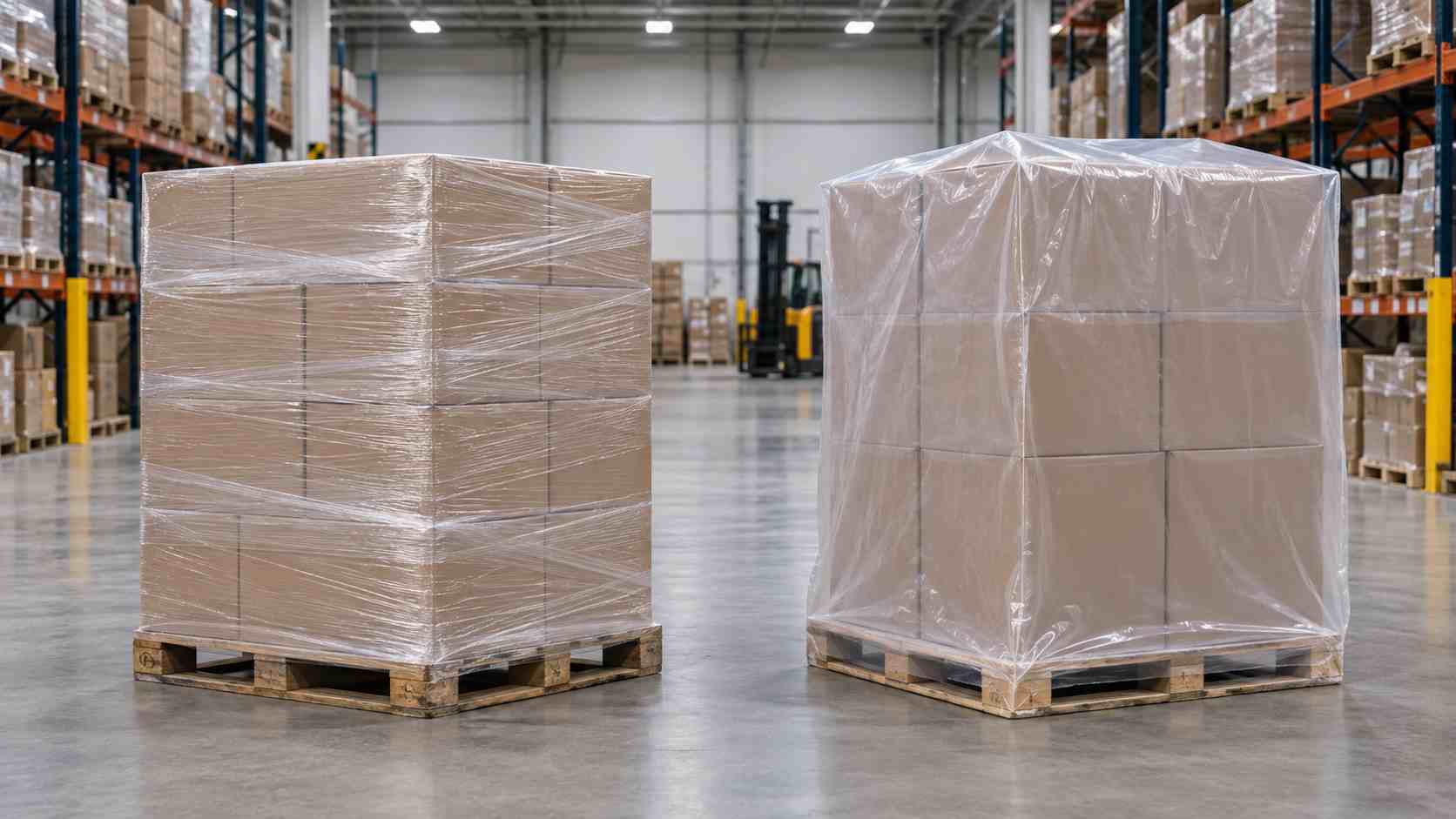
For a full pallet load, stretch wrap is pulled under tension around the goods and pallet. Full-pallet shrink wrap starts as a loose bag, hood, sleeve or sheet around the load, then tightens when heat is applied. Both can unitize a pallet, but they need different equipment and working conditions.
Stretch wrap usually fits operations that want a cold process, hand or machine application, and the freedom to adjust the wrap pattern around different loads. Pallet shrink wrap makes sense only when a full-load cover and a controlled heating step suit the product, building and production flow. Make the choice from the actual pallet and route, then prove it with a load trial. Buyers who need a wider overview of film types can start with the stretch film selection guide.
Stretch wrap vs. shrink wrap at a glance
This comparison covers pallet stretch wrapping and full-pallet heat-shrink wrapping. Small retail packs and shrink-wrapped product bundles use the same heat-activated principle, but they are outside this pallet-level decision. For metal parts that also need rust protection, see our guide to VCI shrink film.
| Decision point | Pallet stretch wrap | Full-pallet shrink wrap |
|---|---|---|
| How it tightens | Film is stretched as it is wrapped around the load | A loose cover is heated and contracts around the load |
| Heat required | No | Yes |
| Typical equipment | Hand roll and dispenser, turntable, rotary-arm or automatic stretch wrapper | Cover-placement method plus a heat tool, ring, chamber or tunnel |
| Working result | Overlapping bands apply containment around selected parts of the load | A bag, hood or sleeve contracts over the covered area |
| Main facility check | Wrapper compatibility, film delivery, space and safe access | Heat tolerance, fire controls, ventilation, clearance and heat equipment |
| Cost comparison | Film, labor, wrapper cost, downtime and failed loads | Cover, labor, energy, heat equipment, space and failed loads |
| Approval method | Test the finished pallet through expected handling and transport | Test the finished pallet through expected handling and transport |
The table shows process differences, not a universal winner. Load shape, stacking, pallet condition, temperature, handling and route can change the result for either system.
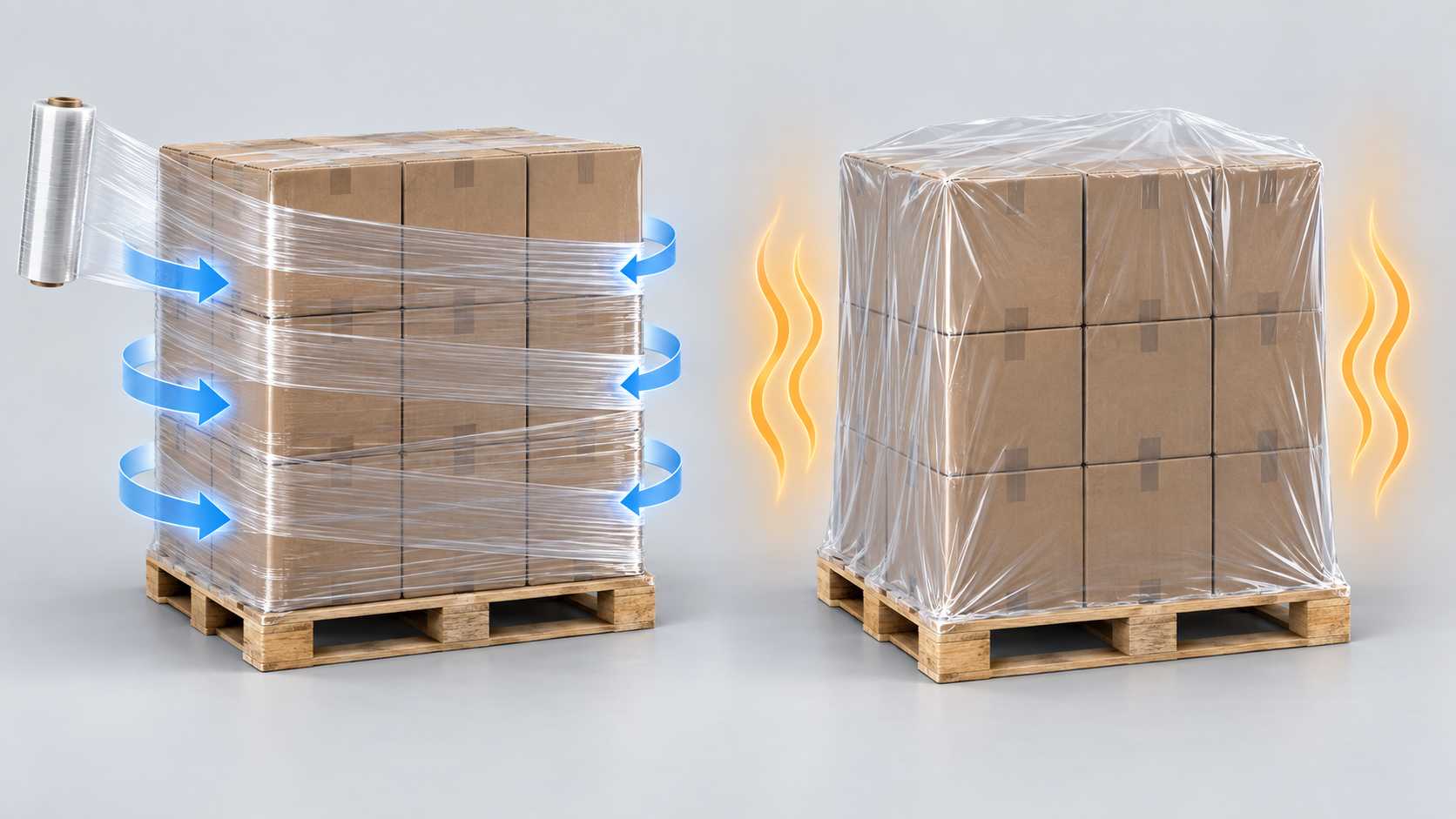
How each method holds a pallet load
Stretch film uses applied tension, elastic recovery and cling between overlapping layers. As the film tries to return toward its original dimensions, it applies inward force to the load. That force is often called containment force. More film or more tension does not automatically create a safer pallet: the force must suit the cartons, bags or other goods, and it must be distributed at the parts of the load that need support. The guide to stretch film containment force and pallet stability explains how load shape and wrapping settings work together.
ASTM D4649 treats stretch film as part of a palletizing application and notes that temperature and use conditions matter. This is useful for buyers because a film specification alone cannot describe the finished pallet. The same roll can give different results on a square carton load and a soft, irregular load.
Shrink film works through heat. The cover is placed around the pallet, then heated until the film contracts. ASTM D2732 explains thermal shrinkage, while ASTM D2838 shows why shrink force depends on temperature, material, thickness, manufacturing and restraint. A quoted film thickness or shrink value therefore cannot prove how evenly a cover will tighten around a specific pallet.
The physical coverage also differs. Stretch wrap is applied in bands, so an operator or machine can add reinforcement at the base, middle or top. A full-pallet shrink bag or hood begins as a larger cover over the load. Its final coverage depends on the cover design, how it is positioned and whether heat reaches the film evenly. Neither format should carry an outdoor-protection or damage-prevention claim without a test for the intended exposure. Our guide to whether stretch wrap is waterproof explains where water gets into a wrapped pallet.
Which process fits your load and facility?
Stretch wrapping is usually the first system to assess when the warehouse already uses hand rolls or a stretch wrapper, the goods should not be exposed to a heating step, or load types change often. The wrap pattern and film delivery can be adjusted for different pallet heights and weak zones. The chosen settings still need to be repeatable across operators, shifts and machines.
Use the load itself to choose between hand, semi-automatic and automatic application. A changing, low-volume operation may accept manual wrapping. Repeated pallet work may justify a powered wrapper when the machine, film and load are matched. Tuosheng’s pallet stretch film options cover hand, machine and pre-stretched formats for different wrapping methods.
Full-pallet shrink wrapping deserves assessment when the required pack format is a loose cover that contracts around most or all of the load, and the product can tolerate the planned heat exposure. The site must have room for cover placement and heating, plus a controlled operating area. Uneven heat can leave loose sections or overheat another part of the cover, so operator training and process control belong in the evaluation.
Some businesses may keep both systems for different product groups. That choice should follow separate trials for each load family. A result on regular cartons does not approve the same process for bagged products, unstable stacks or heat-sensitive goods.
Equipment, workflow and heat safety
Stretch wrapping adds tension while the film is dispensed. Manual work needs a suitable roll and dispenser. Powered systems may use a turntable, rotating arm or automatic line, with the film carriage controlling delivery and stretch. The practical checks are straightforward: can the equipment accept the roll dimensions, can it apply the required force without crushing the load, and can workers run the same pattern consistently?
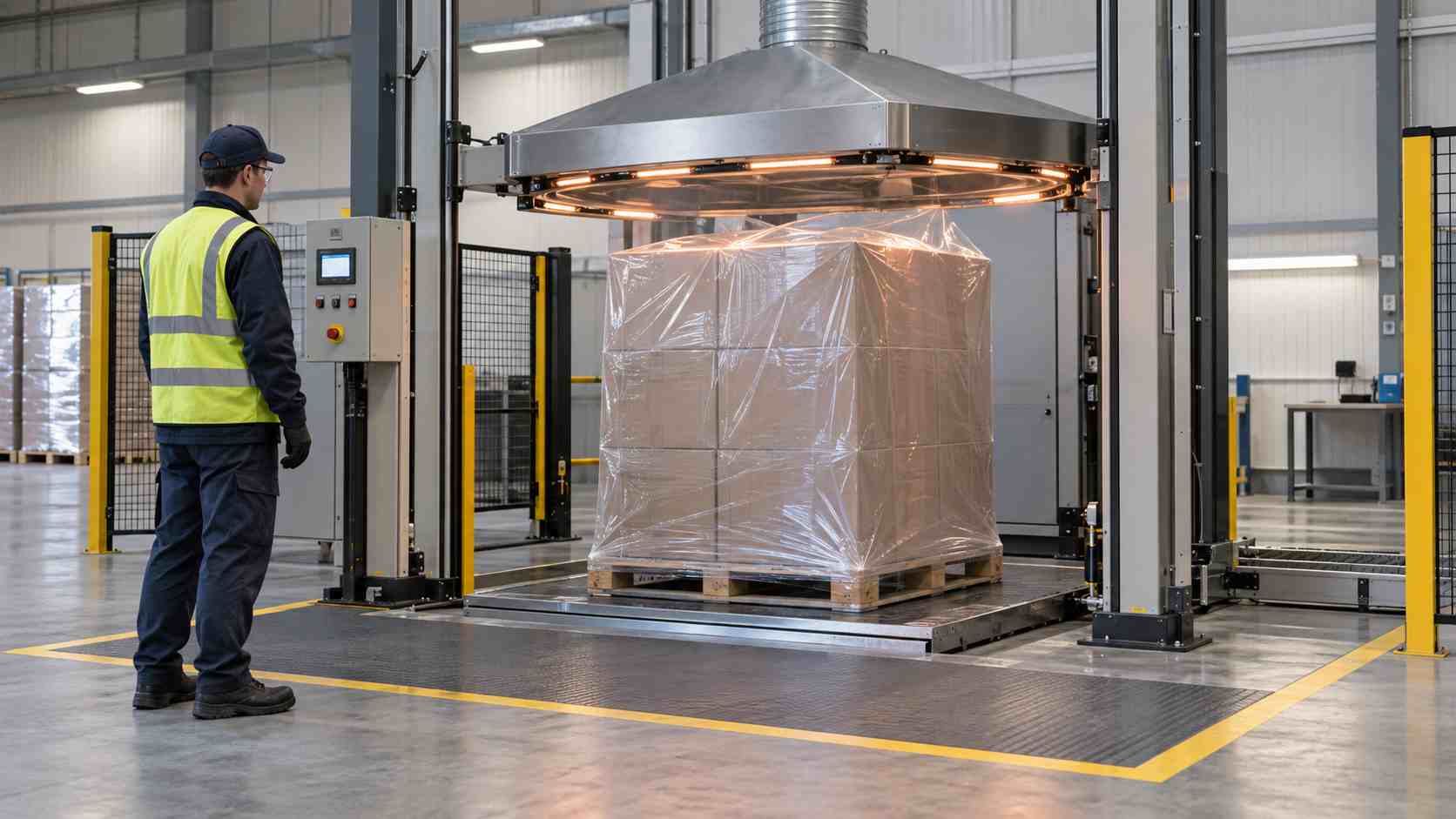
Pallet shrink wrapping adds two operations: placing the cover and applying heat. The heat may come from a handheld tool or a fixed ring, chamber or tunnel. Each option changes floor-space needs, labor, cycle time and maintenance. Equipment selection is a separate project, but these effects must be included before a packaging team approves the film.
Heat also changes the safety review. Check the goods, primary packs, pallet, labels and nearby materials for heat sensitivity. The operating area may need ventilation, fire precautions, restricted access and staff training under local rules and the equipment manufacturer’s instructions.
The risk becomes more specific in buildings that store flammable or dangerous goods. For example, UK HSE guidance for chemical warehousing advises that shrink-wrapping operations using heat should be outside the warehouse or in a purpose-designed bay. That guidance applies to its stated UK dangerous-goods setting; it is not a global rule for every warehouse. It does show why a heat process needs a site-level review before purchase.
Compare the total cost per accepted pallet
Roll price and cover price are only material prices. A useful comparison counts every input needed to produce a pallet that reaches the end of the planned handling trial in acceptable condition:
Total cost per accepted pallet = material + labor + energy + equipment allocation + maintenance + rework and disruption
For stretch wrap, record the actual film used per completed pallet, operator time, wrapper stops, broken film and rewrapping. Include the stretch wrapper and film-carriage costs where they apply. For shrink wrap, record cover use, cover-placement time, heating time, energy, heat-equipment cost and any rejected or reworked covers. Use the same load, handling route and acceptance criteria for both trials.
Throughput needs the same discipline. Count acceptable pallets over the available working time. A fast wrapping cycle loses its value if the process creates a queue at cover placement, repeated machine stops or extra inspection. A slower cycle may still fit an operation with spare capacity. There is no credible universal cost or speed winner without matched site data.
If stretch wrapping remains on the shortlist, the stretch film usage and cost-per-pallet guide gives a practical way to record roll yield, film use and completed-load cost. Keep the same accounting rules when comparing a shrink system.
Prove the choice with a finished-load trial
A wrapped pallet that looks tight on the warehouse floor may still move during forklift handling, braking, cornering or repeated transfers. Approval should come from the complete unit load, including the pallet, stack, primary packaging, film, settings and wrap pattern.
Use this short trial sequence:
- Define the job. Record pallet dimensions and weight, load shape, weak or sharp areas, heat sensitivity, storage conditions and the planned transport route.
- Set acceptance criteria. Decide what load movement, carton deformation, film failure, cover failure and product damage will cause rejection.
- Run representative pallets. Include common loads and the difficult loads that occur in normal work. Record material use, labor, settings and stoppages.
- Expose the load to expected hazards. Use controlled handling and transport tests that match the route. ISO 10531 provides a framework for unit loads exposed to storage, handling and land transport; its scope excludes marine transport.
- Inspect and compare. Check load movement, film or cover condition, product condition, rework and total cost per accepted pallet.
Machine settings are trial records, not proof by themselves. A pre-stretch percentage, number of revolutions or heating time describes what the equipment did. The final inspection shows whether the complete load passed.
What stretch film sizes should you specify if you choose stretch wrap?
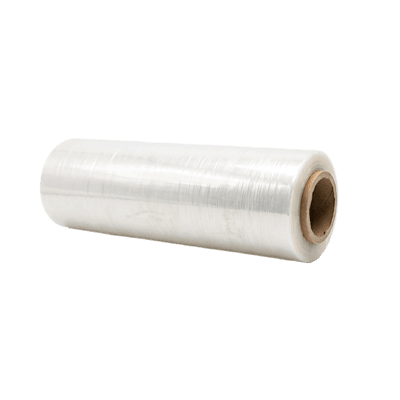
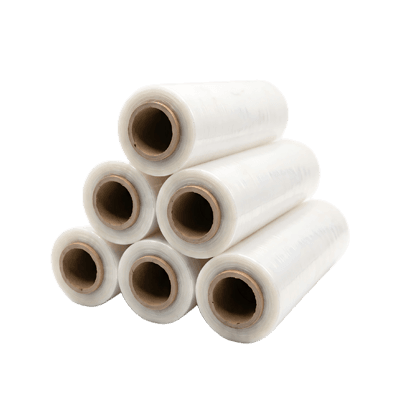
If the trial confirms stretch wrap, specify the film by width × roll length × thickness, plus the core size and net film weight. For Europe, the standard sizes are 500 mm × 250–300 m for hand rolls and 500 mm × 1,500 m for machine rolls. For the US, they are 18 in × 1,500 ft for hand rolls and 20 in × 5,000 or 6,000 ft for machine rolls.
| Roll type | Market | Standard size | Thickness | Packing |
|---|---|---|---|---|
| Hand stretch film | Europe / UK | 500 mm × 250–300 m | 17–23 µm | 4 or 6 rolls per carton |
| Hand stretch film | US | 18 in × 1,500 ft (457 mm × 457 m) | 60–80 gauge (approx. 15–20 µm) | 4 or 6 rolls per carton |
| Machine stretch film | Europe / UK | 500 mm × 1,500 m | 17–23 µm | 1 roll per carton |
| Machine stretch film | US | 20 in × 5,000 or 6,000 ft (made at 500 mm wide) | 60–80 gauge (approx. 15–20 µm) | 1 roll per carton |
Run your trial pallets with the same size and thickness you plan to order, so the trial result applies to the film you buy. Tuosheng Packaging labels stretch film by its true thickness, so an 80 gauge roll is about 20 µm thick. All rolls are wound on a 76 mm (3 in) paper core, and roll weights are stated as net film weight, excluding the core. When you compare quotes, check the net film weight as well as the gauge on the label.
For roll weights, core weights and container loading, see the stretch wrap size chart. Full specifications are on our hand stretch film and machine stretch film pages.
Finish the comparison with a clear RFQ
Stretch wrap vs. shrink wrap FAQ
Is stretch wrap the same as shrink wrap?
No. Stretch wrap tightens because it is pulled under tension around the pallet. Shrink wrap is placed over or around the load and contracts when heat is applied. The two processes use different equipment and need separate operating checks.
Does pallet stretch wrap need heat?
No. Pallet stretch wrap relies on applied tension, elastic recovery and cling between overlapping layers. It can be applied by hand or with a stretch-wrapping machine. The film and wrap settings still have to match the pallet load.
Which wrapping method is better for pallets?
The answer depends on the load and facility. Stretch wrapping usually suits a cold process with hand or machine application. Full-pallet shrink wrapping may suit a load that needs a shrink cover and can tolerate controlled heating. Approve either method through a finished-load trial.
Which method costs less per pallet?
There is no universal cost winner. Compare material use, labor, energy, equipment, maintenance, throughput and rework under the same conditions. Calculate the result per accepted pallet after the handling trial, since roll or cover price shows only one part of the cost.
Can a warehouse use stretch wrap and shrink wrap?
Yes. A warehouse may use stretch wrap for one load family and full-pallet shrink wrap for another. Keep the specifications and work instructions separate. A result from regular cartons does not approve the same process for soft, irregular or heat-sensitive goods.
How should a pallet-wrapping method be tested?
Test the complete pallet with representative goods, the planned film or cover, recorded settings and agreed rejection limits. Expose it to handling and transport conditions that match the route, then inspect load movement, packaging failure, product condition and rework before approving the method.
Common selection mistakes
Separate the terms in the RFQ. In some warehouses, workers call any clear pallet film “shrink wrap.” State “pallet stretch wrap” or “full-pallet heat-shrink cover” so suppliers quote the intended process.
Include the full process in the comparison. Stretch containment depends on the applied film and load system. Shrink force depends on the film and heating conditions. Thickness is one input for both.
Inspect the pallet and stack. Poor stacking, damaged pallets, sharp edges and weak cartons can defeat either wrap. Correct those problems or include them in the test before blaming the film.
Use the same conditions for the price comparison. Material use, labor, energy, output and rejection criteria must be measured on the same load and route.
Approve the method from its handling performance. A smooth cover or tidy wrap pattern does not show what will happen after handling. Test the finished pallet.
Recommended Tuosheng Packaging Solution
Tuosheng Packaging manufactures hand stretch film and machine stretch film in Suzhou, China, with customizable thickness, width, roll length and export packing.