
If an RFQ only says “80-gauge machine film, 20 inches wide, best price,” suppliers can quote products that look similar on paper but perform very differently on the wrapping line. The roll may contain less usable plastic than expected, the film may not reach the claimed pre-stretch on your carriage, or it may lose holding force after the pallet leaves the machine.
As explained in our complete machine stretch film guide, a useful specification connects four things: the pallet load, the wrapper, the film, and the required result.
The required result is not just an unbroken roll—it’s a stable pallet at a repeatable cost per load.
From Tuosheng’s experience, most sourcing problems start with three omissions: buyers compare gross roll weight instead of net plastic weight, accept a maximum stretch claim without checking machine compatibility, or select gauge before describing the load. The fix is straightforward: make every quotation answer the same questions, then validate the shortlisted films on the actual line.
This guide explains what to specify and ends with a copy-ready machine stretch film RFQ checklist.
Table of Contents
- Start with the pallet, wrapper, and required result
- Write a machine stretch film specification suppliers can quote
- Connect pre-stretch to yield and cost per pallet
- Set performance and testing requirements that matter
- Copy-ready machine stretch film RFQ checklist
1. Start with the pallet, wrapper, and required result
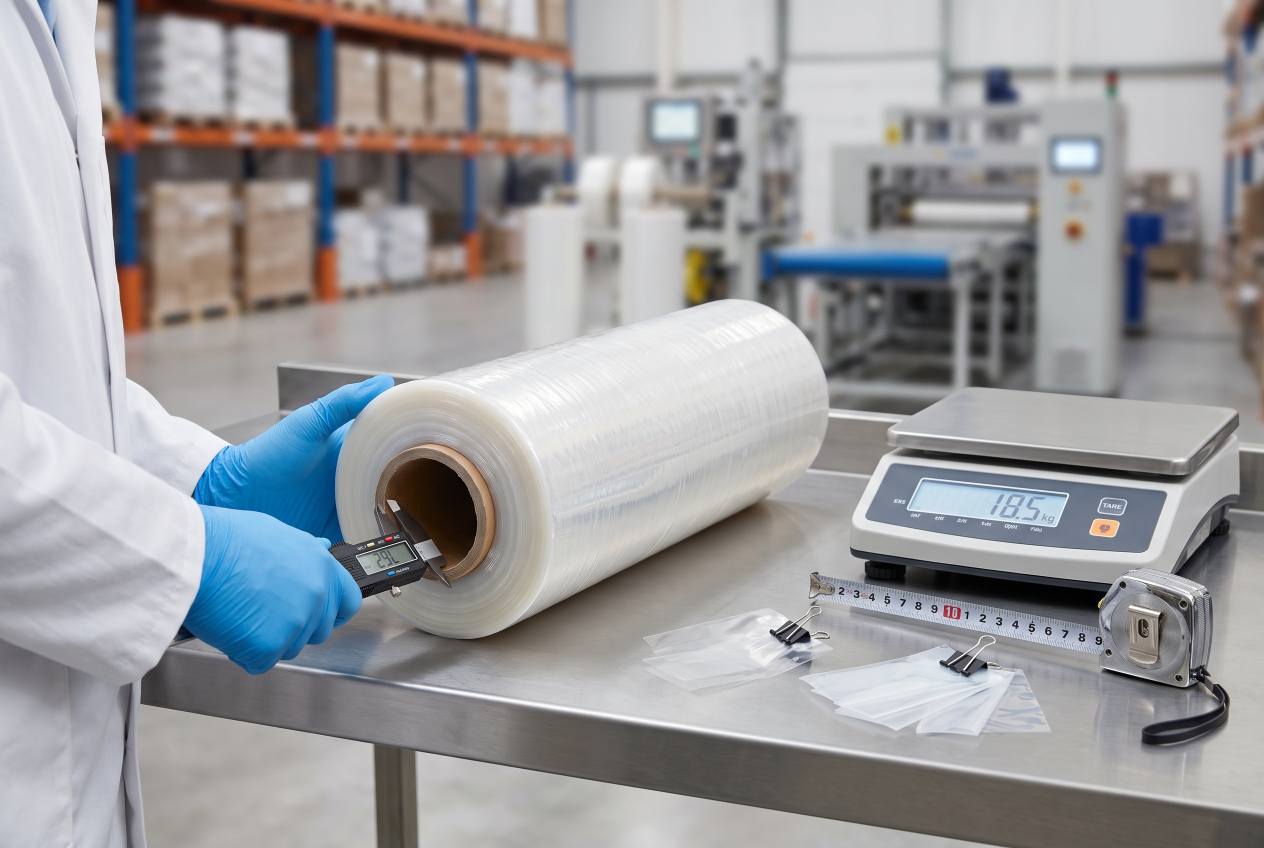
Don’t begin by asking a supplier to recommend one universal grade. First define what the film must wrap and how it will be applied. This information narrows the choice faster than a long list of polymer terms.
Classify the load profile before choosing gauge
A simple load profile A B C system is useful for initial screening:
| Load profile | Typical pallet condition | Main film risk | Practical starting direction |
|---|---|---|---|
| Profile A | Uniform cartons, flush sides, stable layers, no sharp points | Insufficient holding force or unnecessary overwrapping | High-yield cast film; approximately 50–70 gauge may be trialled |
| Profile B | Irregular faces, moderate corners or protrusions | Local thinning, puncture, and tear propagation | Tough cast or blown film; approximately 70–90 gauge is a common trial range |
| Profile C | Severe protrusions, sharp products, unstable geometry | Repeated puncture, edge cutting, and web breaks | Puncture-resistant blown or heavy-duty performance film; often 90–120+ gauge |
These ranges are starting points, not guarantees. A dense Profile B pallet may be more demanding than a lightweight Profile C pallet. Tell suppliers the pallet dimensions, weight, height, product type, sharp-contact points, overhang, center of gravity, and distribution route. Include photos of the most difficult load—not only the cleanest pallet in the warehouse.
Here’s the thing: thicker film is not automatically better, and thinner film is not automatically more economical. A well-designed multilayer film can provide more puncture resistance and holding force than a thicker conventional film, but down-gauging must be proved on the real load.
Record the wrapper and carriage interface
State whether the line uses a turntable, rotary arm, vertical ring, or horizontal orbital wrapping system. For the machine, provide:
- wrapper type and operating speed;
- film carriage type: powered pre-stretch or friction brake;
- installed and available pre-stretch gear ratios;
- accepted roll width, maximum roll outside diameter, and maximum roll weight;
- mandrel dimensions and required 3-inch ID core;
- film unwind direction and required cling-side orientation;
- normal carriage speed, overlap, top wraps, and bottom wraps;
- current film grade, break frequency, and reason for changing.
A claim of 300%+ stretch is irrelevant if the carriage is designed for 200% or cannot handle the film’s roll inertia. For orbital wrapping, also specify the ring opening, film width, product shape, and required wrap angle. There’s no need to include machinery repair details in the film RFQ.
2. Write a machine stretch film specification suppliers can quote
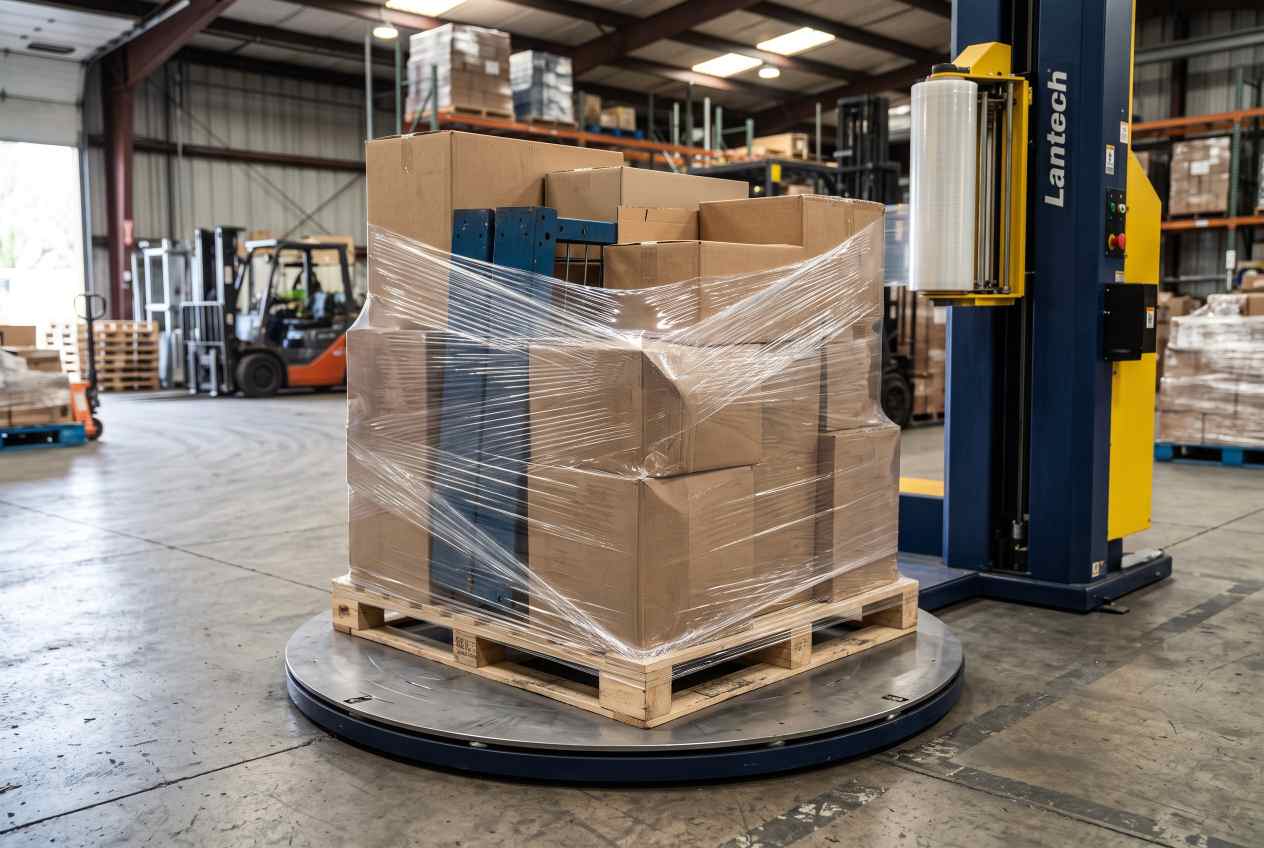
The specification should separate measurable dimensions from performance claims. “Equivalent 80 gauge,” “premium,” and “nano film” are product descriptions, not complete technical requirements.
Specify thickness, dimensions, construction, and net plastic
The basic conversion is:
100 gauge = 1.0 mil = 25.4 microns
Microns = gauge × 0.254
Use this machine stretch wrap gauge chart to compare common nominal thicknesses:
| Gauge | Mil | Microns |
|---|---|---|
| 47 | 0.47 | 11.9 µm |
| 50 | 0.50 | 12.7 µm |
| 60 | 0.60 | 15.2 µm |
| 70 | 0.70 | 17.8 µm |
| 80 | 0.80 | 20.3 µm |
| 90 | 0.90 | 22.9 µm |
| 100 | 1.00 | 25.4 µm |
| 115 | 1.15 | 29.2 µm |
Ask the supplier to state both the physical micron thickness and any commercial “equivalent gauge” grade. They should not be presented as the same measurement. Also request the permitted thickness and width variation, the method used to verify roll length, and the acceptance rule for telescoping or damaged edges.
Every quotation should list:
- nominal film width and tolerance;
- nominal roll length and tolerance;
- net plastic weight, gross roll weight, and core tare weight separately;
- core inside diameter, core length, concentricity, and moisture resistance;
- maximum roll outside diameter;
- rolls per pallet and pallet packaging;
- splice allowance and lot traceability.
Net plastic weight matters because the cardboard core doesn’t wrap pallets. We recommend comparing price per kilogram of net film as well as price per roll. The actual core tare varies by construction, so write the required deduction and verification method into the RFQ rather than assuming a fixed core weight.
For cast versus blown film, base the choice on the application. Cast film normally offers better clarity, quieter unwind, and more uniform thickness. Blown film is often preferred when puncture resistance and resistance to tear propagation are the dominant risks. Neither process is universally superior.
Multilayer and metallocene LLDPE structures can support higher stretch and down-gauging yield, but layer count alone doesn’t predict field performance. Whether a film has 5, 7, 33, or more layers, ask for measured results, production tolerances, and a sample trial. Don’t accept an automatic promise that a 47–60 gauge film will replace a conventional 80–90 gauge film on every load.
Define cling, appearance, recycled content, and additives
For dense warehouse staging, one-sided cling is often a sensible default: the inside surface clings to overlapping film, while the outside surface has lower tack. This reduces the chance that adjacent wrapped pallets lock together or tear each other during loading and unloading. State which side must face the pallet and confirm that the roll is wound accordingly.
Also specify clarity, color, opacity, and surface slip where they affect barcode scanning or load identification. Specialty options should be requested only when needed: UV inhibitors (UVI) for defined outdoor exposure, VCI rust protection for compatible metal products, or anti-static (ESD) additives for electronics applications.
If post-consumer recycled (PCR) resin is required, state the minimum certified percentage and the supporting documentation. For guidance on Scope Certificates, Transaction Certificates, and supplier verification, see our GRS-certified recycled stretch film buyer’s guide. Then apply the same break-rate, pre-stretch, containment, and appearance acceptance criteria used for virgin film. PCR content is a sourcing attribute; it’s not proof of machine performance by itself.
3. Connect pre-stretch to yield and cost per pallet
Pre-stretch affects both performance and economics, but only when the film and carriage work together. The RFQ should ask for a recommended operating window, not only the film’s laboratory elongation at break.
Read the pallet wrap pre-stretch ratio correctly
A powered carriage uses rollers running at different speeds to elongate the film before it reaches the pallet. The yield multiplier is:
Applied length multiplier = 1 + pre-stretch percentage
| Nominal pre-stretch | 1 ft of roll film becomes | Theoretical yield from a 5,000 ft roll |
|---|---|---|
| 200% | 3.0 ft | 15,000 ft |
| 250% | 3.5 ft | 17,500 ft |
| 300% | 4.0 ft | 20,000 ft |
At a 250% pallet wrap pre-stretch ratio, one foot of unstretched film becomes approximately 3.5 feet after the carriage. That doesn’t mean every 5,000-foot roll delivers exactly 17,500 usable feet. Startup waste, tails, web breaks, neckdown, roller slip, and recipe variation reduce real yield.
The best setting is not necessarily the highest number. A film rated for 300% may run more consistently at 250% on a sharp or variable load. Require the supplier to state the recommended continuous operating range, the maximum claimed stretch, and the wrapper conditions used to establish both values.
Compare cost-per-pallet wrapped, not roll price
If applied web length is known, an initial estimate is:
Estimated film cost per pallet = roll price × applied feet per pallet ÷ [roll length × (1 + pre-stretch)]
For example, a $72 roll containing 5,000 feet and running at 250% has a theoretical 17,500 feet of stretched web. If a validated wrap recipe applies 280 feet per pallet, theoretical yield is 62.5 pallets and material cost is about $1.15 per pallet.
Use this only as a planning calculation. For a complete calculation method, see our guide on how to calculate stretch film usage, yield and cost per pallet. The more reliable plant method is to weigh film actually applied to a representative group of pallets:
Actual cost per pallet = net film cost per unit weight × average applied film weight
Run candidate films on the same pallet family and record applied film weight, pallets per roll, breaks per 100 pallets, containment force, rejected loads, and downtime. A higher roll price can produce a lower cost-per-pallet wrapped if the film achieves more usable stretch with fewer layers and stable runnability. A cheap roll becomes expensive when operators add wraps or stop the line repeatedly.
4. Set performance and testing requirements that matter

Avoid turning the RFQ into a laboratory report. Ask for the few properties that explain whether the film will survive application and retain the load.
Use containment, puncture, tear, and stress retention as decision points
For a detailed explanation of measurement points, holding force, and load movement, see our guide to stretch film containment force and pallet stability.
Define the required stretch film containment force PLI at the top, middle, and bottom of each load profile. PLI means pounds per linear inch of film width, but plants must use one documented measurement method and location so results remain comparable. ASTM provides guidance for film selection and testing; it doesn’t certify a particular commercial containment-force tool.
Don’t rely only on the reading immediately after wrapping. Film relaxes over time. Ask for stress-retention or elastic-recovery data and confirm containment again after an agreed dwell period or simulated distribution cycle.
For Profiles B and C, request puncture resistance, dart drop impact, and tear data using identified test methods. For tensile properties, state machine direction and transverse direction where applicable. A high tensile number doesn’t compensate for weak puncture behavior at a sharp contact point.
Put ASTM methods into the RFQ without calling them certifications
The current ASTM catalog lists 2025 editions of the main stretch-wrap methods. Use them as agreed evaluation tools:
| Standard | Practical RFQ use |
|---|---|
| ASTM D4649-20(2025) | Framework for selecting, specifying, and applying stretch film for unitization |
| ASTM D5459-95(2025) | Compare elastic recovery, permanent deformation, and stress retention |
| ASTM D5458-95(2025) | Compare peel cling in stretched and unstretched conditions |
| ASTM D5416-95(2025) | Compare abrasion resistance under vibration against an approved control film |
For load-level validation, ASTM D5415-95(2025) can compare film or wrap-cycle containment under vibration. ASTM itself notes that users must establish an acceptable rating for their end use. In other words, naming a test is not enough: the RFQ must state the control film, conditioning, load, wrap recipe, number of samples, measurements, and acceptance criteria.
5. Copy-ready machine stretch film RFQ checklist
The following table can be copied into a sourcing spreadsheet or supplier questionnaire. Replace bracketed items with plant data.
RFQ specification table
| RFQ category | Information to provide or request |
|---|---|
| Application | Product, pallet dimensions, gross load weight, height, Profile A/B/C, sharp points, overhang, storage temperature, and distribution route |
| Wrapper | Turntable, rotary arm, ring, or orbital; model if permitted; operating speed and pallets per day |
| Carriage | Powered pre-stretch or friction brake; installed ratio; target operating range; maximum supported roll weight and diameter |
| Current baseline | Current film type, physical gauge/microns, width, roll length, net weight, applied weight per pallet, breaks, and cost per pallet |
| Film process | Cast or blown, with the supplier’s reason for the recommendation |
| Film construction | Standard or high-performance multilayer; actual thickness must be separate from equivalent-grade claims |
| Thickness | Nominal gauge and microns, plus allowed average and point-to-point tolerance |
| Roll dimensions | Width and tolerance, guaranteed length, net plastic weight, gross weight, and outside diameter |
| Core | 3-inch ID, core length, concentricity requirement, tare weight disclosure, and mandrel compatibility |
| Cling | One- or two-sided cling, cling-side orientation, peel-cling data, and exterior slip requirement |
| Mechanical data | Recommended continuous pre-stretch, ultimate elongation, tensile data, puncture, dart drop impact, tear, elastic recovery, and stress retention with methods |
| Applied performance | Required containment at top/middle/bottom, approved wrap recipe, maximum breaks per 100 pallets, and no unacceptable load movement or package damage |
| Testing | Applicable ASTM D4649, D5459, D5458, D5416, and load-validation requirements; identify control film and pass/fail criteria |
| Quality tolerance | Width, thickness, roll length, net weight, edge quality, telescoping, splices, winding, and lot-to-lot variation |
| Traceability | Roll and pallet labels, production lot, manufacturing date, certificate of analysis, and complaint traceability |
| Special options | Color, opacity, UVI, VCI, ESD, one-sided cling, or certified PCR content only where required |
| Trial | Sample-roll quantity, production-machine trial, representative load families, data to record, and approval authority |
| Price basis | Price per roll and per net kg/lb, core deduction, packaging, freight, duties, minimum order, and payment terms |
| Resin adjustment | Named public LLDPE benchmark, base month/value, review frequency, trigger band, calculation formula, time lag, cap/floor, and equal escalation/de-escalation |
| Supply terms | Lead time, capacity commitment, safety stock, pallet quantity, labeling, forecast rules, and delivery performance |
| Change control | Written notice and requalification before changes to resin family, PCR percentage, thickness, structure, additives, core, winding, or production site |
How Tuosheng recommends comparing final quotations
First remove quotes that don’t fit the wrapper or fail to disclose physical thickness and net plastic weight. Next compare technical evidence and trial results. Only then compare commercial terms.
A practical scorecard can assign weight to four areas: 35% applied performance, 30% cost per pallet, 20% consistency and quality control, and 15% supply and contract terms. Plants can adjust these weights, but roll price should never be the only deciding field.
The final purchase specification should record the approved sample or control film, machine recipe, load family, containment readings, applied film weight, break limit, and commercial price formula. That turns a supplier promise into a repeatable acceptance standard.
If you’re preparing an RFQ, send us your pallet photos, load dimensions and weight, wrapper and carriage details, current film data, and target cost per pallet. We can recommend a trial specification and provide the quotation in the same line-item format, making supplier comparison faster and reducing hidden differences between rolls.
Need Help Choosing the Right Stretch Film?
Every packaging application has different requirements. Share your wrapping method, load type and specifications, and Tuosheng Pack can help recommend a suitable stretch film solution for your business.
Suggestions based on product type, wrapping method and performance needs.
Support for thickness, width, roll size, color and packaging requirements.
Working with distributors, wholesalers and industrial packaging buyers.
Recommended Tuosheng Pack Solution
For buyers looking for reliable stretch film solutions, Tuosheng Pack supplies hand stretch film, machine stretch film, pre-stretched film and specialty packaging films with customizable thickness, width, roll length and packaging options.
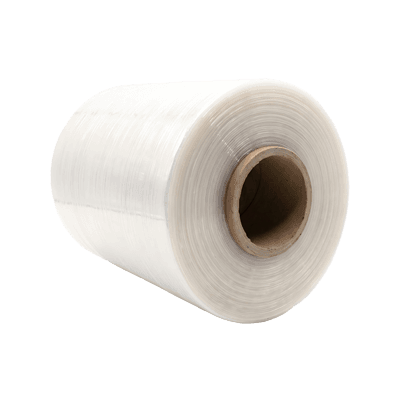
Jumbo Stretch Film
Large-format stretch film rolls designed for high-volume packaging requirements.
Learn More →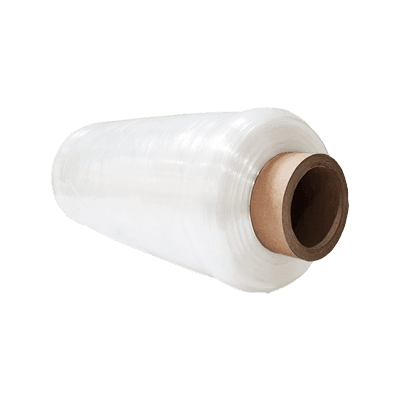
Pre-Stretch Film
Lightweight pallet wrapping solution helping reduce material consumption while maintaining load security.
Learn More →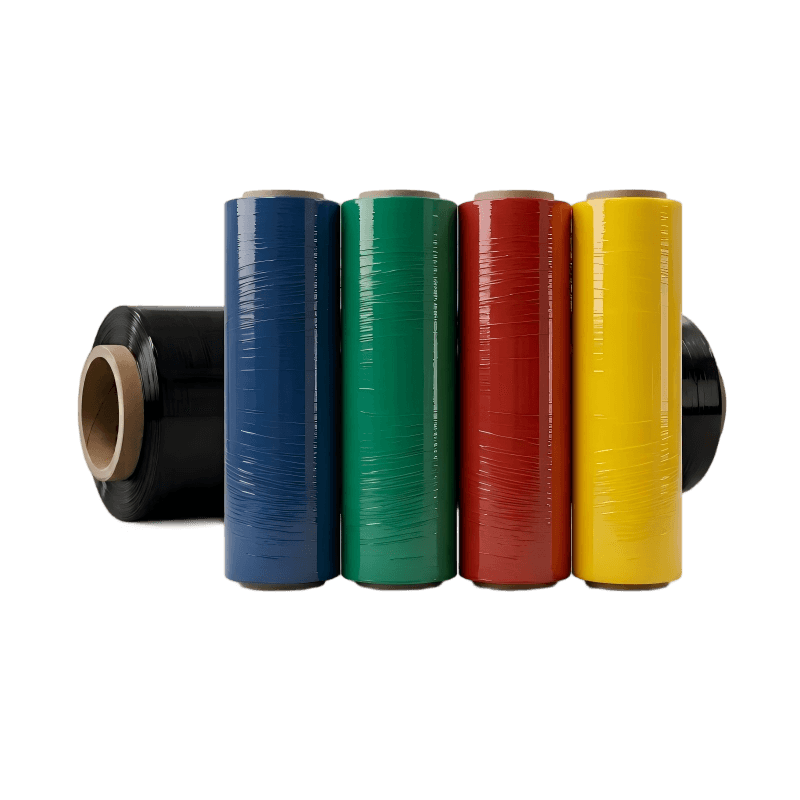
Colored Stretch Film
Custom color options for product identification, privacy protection and branded packaging needs.
Learn More →
VCI Shrink Film
Specialty packaging film providing corrosion protection for metal products during storage and transportation.
Learn More →