
A pallet can look secure on the warehouse floor and still fail during braking, cornering, vibration, or repeated handling. The difference is often not the visible amount of stretch film for wrapping, but the containment force that the applied film maintains around the load.
Containment force converts stacked cartons, containers, bags, or components into a unit load that can resist lateral movement. It is influenced by the film, the pre-stretch ratio, force-to-load, overlap, number and location of layers, pallet connection, load geometry, and the ability of the primary and secondary packaging to withstand compression. Gauge alone cannot describe the result.
This guide is written for packaging engineers, warehouse managers, logistics teams, and industrial buyers who need a repeatable method for improving pallet stability. It explains the physics, relevant ASTM and European frameworks, empirical starting targets, a standardized wrapping pattern, material selection, and field auditing. For broader product-selection context, see Tuosheng Pack’s stretch film selection guide.
The numerical containment-force ranges below are commissioning references, not universal pass/fail limits. A final specification must be validated on the complete unit load under its actual handling, storage, transport, temperature, humidity, and stacking conditions.
How Stretch Film Containment Force Stabilizes a Pallet
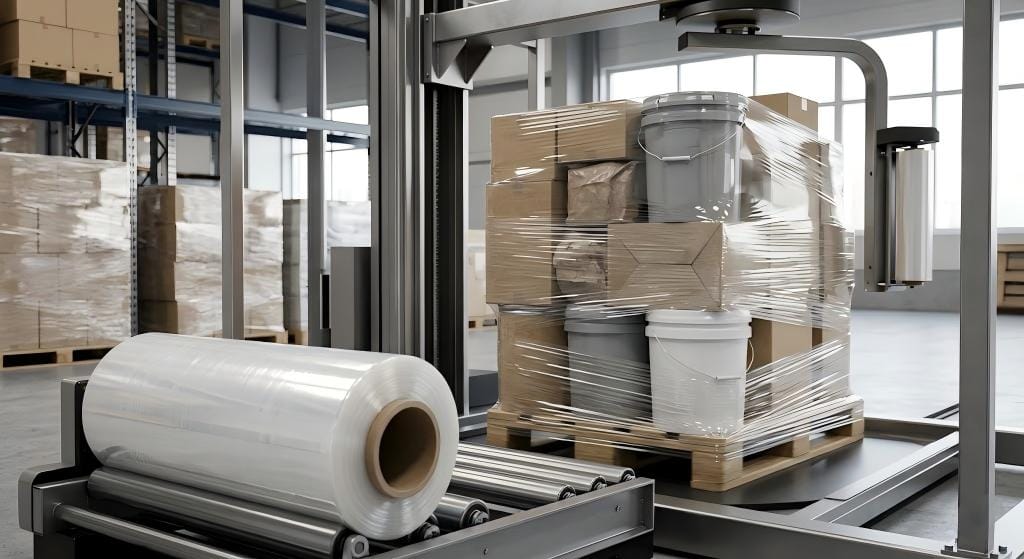
Wrap force, pre-stretch, and containment force are related, but they are not interchangeable.
Wrap force, also called film tension or force-to-load, is the tension applied as film leaves the carriage and reaches the pallet. Pre-stretch ratio describes how much the film is elongated between carriage rollers before application. Containment force is the cumulative inward force retained by all applied film layers at a particular point on the finished load.
An idealized relationship is:
In practice, effective layers matter more than revolutions. A 50% overlap creates approximately two layers over much of a spiral pass, while top and bottom reinforcement bands create locally higher layer counts. Film width reduction, corners, roping, inconsistent overlap, relaxation, and load compressibility prevent the equation from being a perfect prediction. It remains useful for understanding why a moderate application force distributed through several layers can produce more stable containment than a single excessively tight pass.
In the controlled dynamic-load research supplied for this article, optimizing containment reduced lateral unit-load deflection by as much as 81%. That result demonstrates the potential value of controlling retained force, but it should not be generalized into an 81% improvement promise for every pallet. Geometry, package friction, test severity, and the original wrapping condition all influence the measured change.
Elastic memory, recovery, and creep
LLDPE stretch film stores elastic energy as its molecular chains orient during stretching. After the film is applied, those chains attempt to recover toward their original state, creating continuing inward pressure. The useful property is not simply maximum elongation; it is how much force the film retains after minutes or hours on the load.
This distinction explains why a film can feel tight immediately after wrapping but allow mid-zone bulging later. Recovery helps sustain containment. Creep and stress relaxation reduce it. Machine stretch film commonly works in a controlled high-elongation range, often around 150%–250% and sometimes higher when both film and carriage are designed for it. A setting of 200% means one unit of original film becomes three units after elongation, not two.
Manufacturing history also affects performance. Research cited in the project materials shows that increasing cast-line speed from 200 to 1,000 m/min can more than double machine-direction tensile modulus and raise tensile strength by about 22% through greater molecular orientation. This is a useful reminder that two films with the same nominal gauge may behave differently; it is not a reason to select film by line speed alone.
Stretch wrap should also not be confused with shrink wrap. In the shrink wrap vs stretch wrap comparison, stretch film creates restraint through mechanical elongation and elastic recovery, whereas shrink film requires heat to contract around an item. A pallet wrapped with ordinary stretch film does not need a heat tunnel.
The 0.8g braking problem
Pallet stability is a dynamic problem involving the center of gravity and the support polygon formed by the pallet footprint. Under acceleration, the apparent load vector shifts. If the combined center-of-gravity vector moves outside the support polygon, the load can tilt or overturn; if layers slide first, the stack can shear or bulge even while the pallet remains flat.
The EU cargo-securing principles in Directive 2014/47/EU, Annex III require securing to withstand forces equivalent to 0.8 times cargo weight in the driving direction and 0.5 times cargo weight laterally and to the rear. As a static visualization, a forward deceleration of 0.8g produces an equivalent tilt angle of:
This does not mean an acceleration test is literally a 38.7-degree tilt test. It illustrates why a pallet that survives a gentle push in the warehouse may be inadequate during emergency braking. Containment force works with inter-package friction and pallet friction to limit relative movement, but it cannot compensate for a badly damaged pallet, an excessively high center of gravity, weak cartons, or an unsupported overhang.
ASTM, EUMOS, and Regulatory Requirements
Standards provide different pieces of the validation system. They should be used as a matrix rather than treated as one universal stretch-film certification.
ASTM D4649-20(2025) is the current standard guide for selecting, specifying, and applying stretch film used to unitize, reinforce, and palletize loads. Its scope covers indoor storage and enclosed transport environments such as warehouses, truck trailers, rail boxcars, and associated terminals. It explicitly does not cover outdoor-exposure performance, and it notes that extreme temperatures can negatively affect film performance.
This boundary matters. A successful indoor trial does not establish long-term suitability for an open yard, direct sunlight, precipitation, or unverified cold- and heat-exposure cycles.
The ASTM test matrix
ASTM Subcommittee D10.25 maintains a group of active standards that examine different failure modes. The official subcommittee register includes:
| Standard | Primary evaluation |
|---|---|
| ASTM D5331 | Mechanical handling of unitized loads secured with stretch film |
| ASTM D5414 | Horizontal-impact performance |
| ASTM D5415 | Load containment under vibration |
| ASTM D5416 | Film abrasion resistance under vibration |
| ASTM D5458 | Peel cling between film surfaces |
| ASTM D5459 | Machine-direction elastic recovery, permanent deformation, and stress retention |
| ASTM D5728 | Cargo securement in intermodal and unimodal surface transport |
| ASTM D8314 | Performance testing of applied stretch films and wrapping |
No ASTM standard approves, certifies, or recommends a particular commercial containment-force meter. A dedicated force gauge or plate-style method can support internal process control, but the tool, displacement, contact geometry, sampling locations, and procedure must remain consistent. A number produced by one method should not be assumed equivalent to a number produced by another.
ASTM has also documented the industry’s move beyond a single force reading at one pull distance. A D4649 revision initiative discussed stretch netting, stretch tape, roping, revised evaluation times, and multiple force readings at multiple distances so applied-film stiffness can be distinguished from containment force. This reinforces the need to record the complete test method instead of reporting an unexplained pound value.
EUMOS 40509 evaluates the complete unit load
EUMOS 40509:2020 is a dynamic acceleration-bench method for evaluating load-unit rigidity. It addresses test conditions, elastic and plastic deformation, and test-certificate requirements. It is referenced in Annex III of Directive 2014/47/EU as a transport-packaging standard.
The test object is the complete unit load: the product arrangement, primary and secondary packaging, pallet, stretch film, wrapping pattern, and machine settings together. A film manufacturer therefore should not claim that a roll of film by itself is “EUMOS 40509 certified.” A film can support a validated load design, but changing the cartons, stack pattern, load height, pallet, film, or wrapper recipe may change the result.
For practical screening, the project research uses the commonly cited criteria of less than 10% elastic deformation and less than 5% permanent deformation after testing, with permanent displacement also below 6 cm. Formal compliance decisions should use the purchased standard, an appropriately equipped laboratory, and the applicable legal requirements. A top/mid/bottom containment-force audit is valuable process evidence, but it does not replace acceleration testing of the complete load.
Material reduction is another design pressure. California’s SB 54 requirements set 2032 statewide goals that include a 25% reduction in single-use plastic packaging and plastic food-service ware compared with the 2023 baseline, 100% recyclable or compostable covered material, and a 65% recycling rate for covered plastic material. These targets support measured down-gauging and process optimization—not removing film until pallet safety is compromised.
The supplied business research also cites an average cargo-damage claim of $1,511 for pallet collapse associated with inadequate restraint. Because that figure is not a universal market benchmark and varies by product value, route, and claims practice, it should be used only as an internal example. The broader purchasing lesson is sound: compare film cost per accepted load with damage, rework, returns, and delay—not film price per roll alone.
Load Profiles and Containment-Force Starting Targets
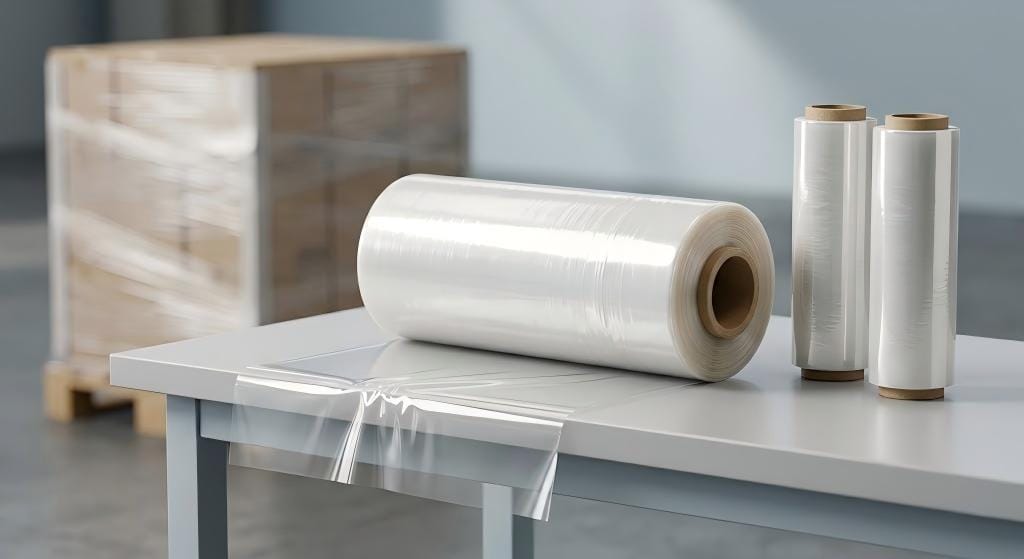
Containment-force targets should begin with both geometry and weight. Geometry controls puncture concentration and how easily packages move. Weight and center-of-gravity height influence the dynamic force that must be resisted. Carton compression strength, stacking pattern, friction, humidity, transport mode, and journey duration then modify the starting point.
Profile A, B, and C loads
| Profile | Geometry and risk | Typical film strategy | Common commissioning window* |
|---|---|---|---|
| A | Uniform cube, aligned cartons, flat sides, few protrusions | Clear cast stretch wrap; stable high-speed machine application | 6–10 lb |
| B | Mixed carton sizes, recessed areas, moderate projections or irregular edges | Higher puncture and tear resistance; reinforce the mid-zone | 10–14 lb |
| C | Sharp projections, bags, pails, metal components, very irregular or unstable geometry | High-toughness multilayer or heavy duty pallet wrap; localized protection and pallet lock | 14–18 lb |
*These are empirical setup ranges for typical industrial loads, not certified limits. A light Profile A load may require less, while an extremely heavy or tall Profile C load may require more. The selected measurement method must be stated.
Profile alone does not determine the target. The following weight-and-stability references from the project research offer a second screening view:
| Load class | Approximate gross weight | Empirical containment-force range | Indicative mid-zone lineal-force reference |
|---|---|---|---|
| Very light | Under 250 lb / 113 kg | 2–5 lb | 10–15 PLI |
| Medium, stable | 500–1,100 lb / 225–500 kg | 5–7 lb | 18–25 PLI |
| Heavy, unstable | 1,100–1,700 lb / 500–770 kg | 8–17 lb | 20–30 PLI |
| Extreme or very heavy | 1,700–2,200 lb / 770–1,000 kg | 15–22 lb | 25–35 PLI |
These two tables are not separate promises. Use geometry to identify failure risk, then use weight and stability to choose an initial test window. PLI and a containment-force reading in pounds are also not automatically interchangeable: PLI expresses force relative to a linear dimension, while a field meter reports according to its own displacement and contact method. Record both the unit and the method.
Top, middle, and bottom are different systems
A single measurement cannot represent an entire pallet. The top restrains upper-layer movement and protects corners. The middle often carries the largest bulging force from bottles, bags, mixed cartons, or column-stacked cases. The bottom must control lower-layer spread and connect the load to the pallet.
Column stacking aligns carton corners and usually preserves the greatest vertical compression strength, but it provides limited lateral interlock. Interlocked stacking improves lateral connection but can reduce vertical carton compression strength by approximately 20%–30% in the project research. Neither pattern eliminates the need for a tested wrap design.
Establish separate top, middle, and bottom minimums. For example, a heavy beverage load may need its highest target in the middle, while a tall light-carton load may require additional top restraint. Avoid simply applying the maximum force everywhere. Excessive force can crush carton corners, deform bottles, reduce stacking strength, and create a different instability.
Use visible failure modes to refine the recipe:
| Observation | Likely cause | Controlled response |
|---|---|---|
| Mid-zone bulging | Insufficient middle layers, low retained force, package creep | Add a localized reinforcement band or adjust force-to-load, then remeasure |
| Load slides on pallet | Weak load-to-pallet connection | Add a correctly positioned cable lock or pallet grip |
| Crushed upper corners | Excessive local force or too many tight top wraps | Reduce top-zone force and distribute restraint through more appropriate layers |
| Film tears at projections | Film lacks puncture tolerance or tension is too high | Protect the contact point, select tougher film, or lower local force |
| Film loosens after storage | Stress relaxation, low effective pre-stretch, heat exposure | Review film recovery, settings, and environmental conditioning |
Wrapping Pattern, Overlap, and Cable Locking
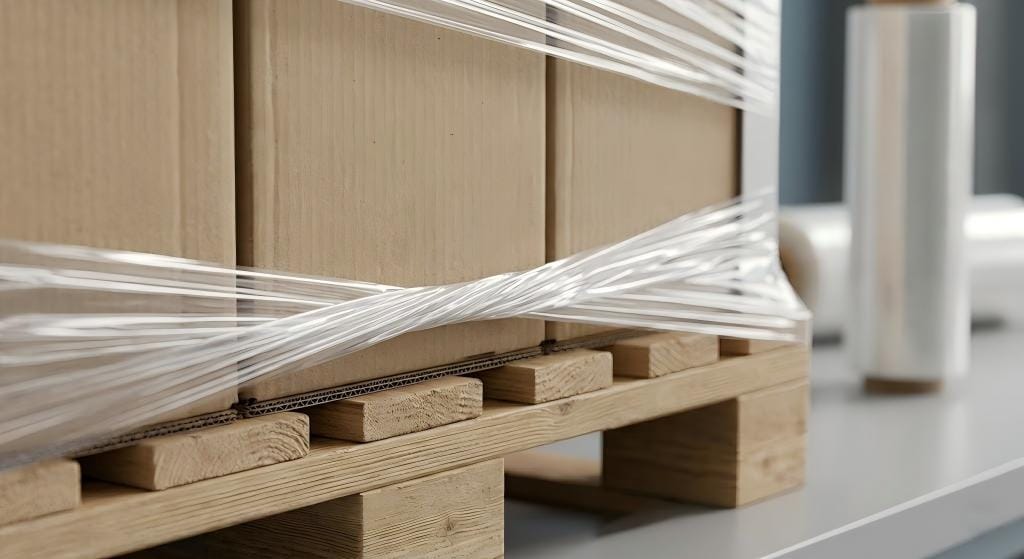
A repeatable pattern converts a target into a physical wrap. Machine settings should be documented by load family rather than left to operator judgment. Manual wrapping can be suitable for low volume, but its stretch, overlap, and force vary more between operators. A pallet wrapping machine with a compatible powered pre-stretch carriage can provide more stable elongation and force-to-load, but automation does not correct a poor recipe by itself.
Apply the 3-1-3-1 pattern as a controlled baseline
The project research specifies a 3-1-3-1-style process as a commissioning baseline:
- Anchor the film. Secure the film tail to the load or pallet in a way that will release safely and will not leave a loose knot in a fork-entry area.
- Build the bottom band. Apply three to four reinforcing revolutions around the lower load. This controls base spread and creates a foundation for the spiral.
- Spiral upward with 40%–60% overlap. Maintain a repeatable carriage speed and overlap. At 50% overlap, most of the load receives approximately two effective layers per pass. Less than 40% can leave weak seams; excessive overlap adds material without necessarily correcting a zone-specific problem.
- Reinforce the top. Apply three to four top revolutions where the validated recipe requires them. A controlled 2–6 inch film overhang can capture top corners, provided it does not damage the product or interfere with handling.
- Spiral downward. Return through the middle and add localized reinforcement where measured bulging or force loss occurs.
- Lock load to pallet. Form a narrow, high-strength film cable that captures both the lowest product layer and the pallet deck.
- Secure the tail. Keep the loose tail under about 4 inches where practical and attach it reliably so it cannot snag conveyors or rollers.
The numbers are a starting pattern, not a substitute for measurement. A stable Profile A load may need fewer localized wraps; a tall Profile B load may need a second middle band. Changing carriage speed, turntable speed, overlap, force-to-load, or pre-stretch alters the outcome even when the displayed program name remains unchanged.
Cable locking and stretch-film roping
Cable locking, pallet grip, and roping concentrate part of the web into a narrow band with high tensile capacity. At the base, the band should capture the upper edge of the pallet deck and the first product layer without hanging into the fork-entry path. The project research uses a 1–2 inch capture zone. Too high, and the film only squeezes the product; too low, and forks or pallet-jack tines can tear it.
The goal is to resist bottom slip, not to tie a cosmetic cord around the pallet. Check that the band remains intact after lift, transfer, and vibration. Loads with under-hang or slippery bottom cases need particular attention because a broad film web may pull upward without forming a positive pallet connection.
Roping can also create an open X-pattern for produce and other loads that need ventilation. Because the web is gathered into narrow cables instead of forming a continuous skin, most of the load surface remains open to airflow, reducing the opportunity for trapped condensation. This can be evaluated as an alternative to stretch netting or perforated film, but claims about ventilation, strength, product life, and cost must be confirmed on the actual load. Open patterns also provide less dust and splash protection.
Avoid over-wrapping. More layers can raise measured force, but excessive localized compression may buckle cartons and reduce the vertical strength that the unit load depends on. The correct process uses the fewest verified layers that maintain the required top/mid/bottom force and pass handling or transport testing.
Film Gauge, Pre-Stretch, and Material Selection
The purchasing specification must describe performance as well as thickness. The basic conversion is:
The following values are screening references from the project materials, not universal load ratings:
| Nominal specification | Thickness | Typical screening application |
|---|---|---|
| 37 gauge | 9.40 μm | Pre-stretched film for light, uniform loads, often below 800 lb / 360 kg |
| 47-gauge equivalent | 11.94 μm | High-stiffness hybrid or multilayer film for selected uniform medium loads |
| 80 gauge | 20.32 μm | General true-gauge industrial baseline |
| 100–120 gauge | 25.40–30.48 μm | Heavy or irregular loads requiring additional toughness |
| 150 gauge | 38.10 μm | Extreme puncture exposure and very heavy Profile C applications |
Do not turn this table into a load guarantee. A sharp 600-pound fabrication can be harder to wrap than a smooth 2,000-pound block of aligned cartons. Test puncture, tear propagation, retained containment, and load stability.
Why thinner film can outperform a thicker film
Modern multilayer films can combine stiffness, puncture resistance, cling, and stretch behavior in different functional layers. When matched to a powered carriage, some 37–47 gauge-equivalent or other down-gauged films can maintain the required containment with less mass than a conventional 80-gauge film. The project research reports 20%–30% film-weight reduction in selected applications using 250%–300% pre-stretch. Treat that as a trial objective, not a guaranteed saving.
Higher pre-stretch does not automatically mean higher containment force. Pre-stretch determines film elongation and can improve yield and stiffness; force-to-load determines how hard the stretched film is applied. If a film is stretched beyond its working range, it may lose recovery, narrow excessively, or break. If force-to-load is too high, cartons can crush even when the film itself performs well.
Evaluate alternatives by grams of film per accepted pallet, retained top/mid/bottom containment, break rate, and transport performance—not roll price or gauge alone. Tuosheng Pack’s machine stretch film options can be screened against the existing wrapper, target pre-stretch, load profile, and containment specification before a production trial.
Cast versus blown stretch film
| Selection factor | Cast stretch film | Blown stretch film |
|---|---|---|
| Optics and unwind | High clarity, quiet release, useful for barcode visibility | Hazier appearance and noisier unwind |
| Tear behavior | Good general performance, but a tear can propagate along an orientation path | Strong multidirectional tear and puncture resistance |
| Cling | Commonly controlled one-side cling | Often stronger two-side cling |
| Common fit | High-speed automatic wrapping and regular Profile A loads | Cold, irregular, sharp, or Profile B/C loads |
These are category tendencies, not absolute rules. A high-performance cast multilayer film may outperform a basic blown product in a specific trial. For cold storage or high heat, condition and test the actual film-and-load combination; do not extrapolate a room-temperature result or invent an unsupported relaxation curve.
Measuring Containment Force and Running a PDCA Audit
A containment-force target only becomes useful when the site defines how, where, and when it is measured. The method should specify the instrument, calibration status, pull displacement, contact geometry, measurement direction, dwell time after wrapping, environmental condition, and load family.
Use a top/middle/bottom sampling protocol
Measure at three vertical zones: near the top, at the middle, and near the bottom above the pallet lock. At each height, take readings at consistent positions on the load. The project research recommends left, center, and right sampling across representative film paths to reduce the effect of cross-web thickness variation and local package geometry.
Use the following procedure:
- Select a representative, undamaged load and apply the locked production recipe.
- Allow the same defined dwell time before every measurement so stress relaxation is comparable.
- Measure top, middle, and bottom using the same tool and displacement method.
- Take three to five readings per defined location or load, as specified by the internal method, and calculate the average and range.
- Inspect for crushed corners, punctures, neck-down, loose tails, poor overlap, base slip, and package deformation.
- During initial validation, obtain at least 10 consecutive compliant unit loads before locking the recipe.
- Retest after handling, storage, or transport conditioning when retained force is part of the requirement.
A hand-push check can reveal an obviously loose load, but it is not a quantitative release test. Likewise, one strong bottom reading does not compensate for a weak middle zone. If different sites use different devices, conduct a correlation study before comparing the values.
Plan, Do, Check, Adjust
Build the process around a simple PDCA cycle:
- Plan: Classify the load, identify the likely failure mode, set provisional top/mid/bottom targets, select the film, and define the wrap recipe and acceptance test.
- Do: Apply the documented pre-stretch, force-to-load, overlap, top and bottom revolutions, reinforcement bands, and pallet lock.
- Check: Measure containment force, film usage, breaks, and load condition. Run handling, impact, vibration, or acceleration testing in proportion to the transport risk.
- Adjust: Change one controlled variable at a time, repeat the sample set, and lock the setting only after the complete load meets its requirements.
Common corrections should remain evidence-based. If retained force is low, confirm actual pre-stretch, film compatibility, applied layers, and relaxation before increasing tension. If light cartons crush, lower local force and redistribute layers rather than simply removing all top restraint. If shifts differ by shift, restrict recipe access, train operators, and post the approved wrapping standard. If a load slips from the pallet, inspect cable-lock position before adding film across the entire height.
Record film SKU and lot, nominal and measured gauge where relevant, wrapper ID, recipe version, operator or shift, load dimensions and weight, stacking pattern, measurement results, film mass per load, and defects. Trend the data to identify setting drift, film variability, worn carriage components, or a change in the packaged product.
The final acceptance decision should combine four questions: Does the load retain the required containment force? Does it avoid product and carton damage? Does it remain stable through the relevant distribution test? Does it use a controlled amount of material? Only when all four answers are yes has down-gauging or process optimization succeeded.
Tuosheng Pack can help review a custom stretch wrap requirement using the pallet dimensions, gross weight, Profile A/B/C geometry, current film specification, wrapper model, pre-stretch setting, wrap pattern, top/mid/bottom readings, and observed failure mode. Any recommendation should then be confirmed in an application trial on the complete unit load; no film specification alone can guarantee ASTM, EUMOS, or transport compliance.
Need Help Choosing the Right Stretch Film?
Every packaging application has different requirements. Share your wrapping method, load type and specifications, and Tuosheng Pack can help recommend a suitable stretch film solution for your business.
Suggestions based on product type, wrapping method and performance needs.
Support for thickness, width, roll size, color and packaging requirements.
Working with distributors, wholesalers and industrial packaging buyers.
Recommended Tuosheng Pack Solution
For buyers looking for reliable stretch film solutions, Tuosheng Pack supplies hand stretch film, machine stretch film, pre-stretched film and specialty packaging films with customizable thickness, width, roll length and packaging options.
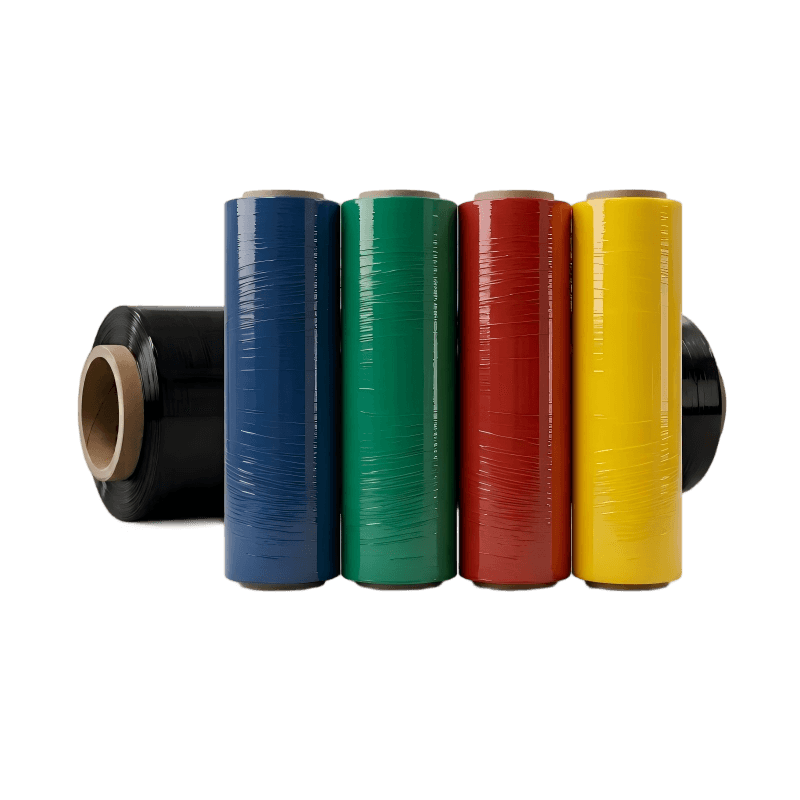
Colored Stretch Film
Custom color options for product identification, privacy protection and branded packaging needs.
Learn More →
Pre-Stretch Film
Lightweight pallet wrapping solution helping reduce material consumption while maintaining load security.
Learn More →
VCI Shrink Film
Specialty packaging film providing corrosion protection for metal products during storage and transportation.
Learn More →
Machine Stretch Film
High-performance film designed for automated pallet wrapping operations with consistent load stability.
Learn More →